Home / Heijo-kyo and the palace site
Heijo-kyo and the Heijo Palace Site
Ride the Kintetsu train from Yamato-Saidaiji toward Nara, and grassland opens up on both sides of the window as huge vermilion buildings come into view. This is the site of the Heijo Palace, the heart of Heijo-kyo, once the capital of Japan. Trains still run right through the middle of the grounds of a palace from 1,300 years ago.
World HeritageHistoric Monuments of Ancient Nara (1998)
Labels: Factdocumented Likelysupported by most sources Legendoral tradition Urban legendlocal lore and rumour
710: the capital of "aoniyoshi"
FactIn Wado 1 (708), Empress Genmei issued an edict to move the capital, and in Wado 3 (710) the capital moved from Fujiwara-kyo to Heijo-kyo (see Fujiwara-kyo). Modelled on the Tang capital of Chang'an, it was a city with roads laid out in a grid around Suzaku Oji, an avenue about 74 m wide running north to south. Its main body measured about 4.3 km east to west and 4.8 km north to south, with the "Gekyo" (Outer Capital) jutting out on the east side.
LikelyAt its height the population is estimated at around 100,000. At the centre of the northern edge of the city stood the Heijo Palace (about 1 km square plus an extension to the east), where the emperor's residence and the government offices were gathered.
The people who built the capital
FactPeople gathered from all over the country worked on building the capital. Hida Province in particular had a special rule to send carpenters (takumi no yoboro) to the capital every year instead of taxes, and as the "Hida no takumi" (Hida craftsmen) they supported the building of palaces and temples. Many people ran away from the construction sites, and orders to catch runaways survive.
FactA huge number of mokkan (wooden tablets with writing on them) have been dug up from the Heijo Palace site and the site of Heijo-kyo. They range from tags on tax goods sent from the provinces to office slips and even officials' doodles, bringing to life the daily life of the capital 1,300 years ago. Mokkan found at the site of Prince Nagaya's residence even recorded foods such as abalone, and the delivery of ice from an icehouse.
A palace asleep under the rice fields
FactWhen the capital moved to Nagaoka-kyo in 784 and to Heian-kyo in 794, the buildings of the Heijo Palace were torn down or moved, and the site eventually became rice fields (the Lecture Hall of Toshodai-ji is a building moved from the Heijo Palace; see Toshodai-ji). Even where the palace had stood was gradually forgotten.
FactIn the Meiji era, a Nara gardener named Tanada Kajuro was moved by the research of the architectural historian Sekino Tadashi, who had studied the palace's location. Tanada spent his own fortune starting a preservation movement, set up a stone marker on the site of the Daigokuden, and appealed to influential people across the country for support. The movement bore fruit, and in 1922 the Heijo Palace site was designated a national Historic Site (later a Special Historic Site).
A train across the palace site
FactThe Kintetsu Nara Line cuts east to west through the Heijo Palace site. In 1914, Osaka Electric Tramway (the forerunner of Kintetsu) laid the tracks while the extent of the palace site was still unclear. Plans to move the line to protect the site have been debated for a long time, but because of the cost and the impact on the surrounding area, trains still run through the palace site.
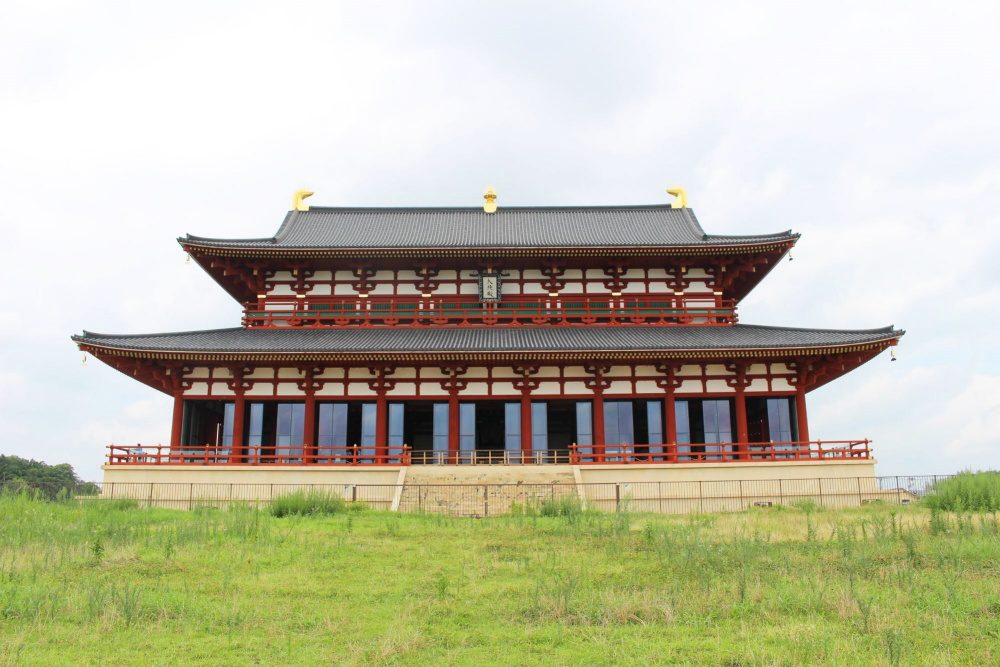
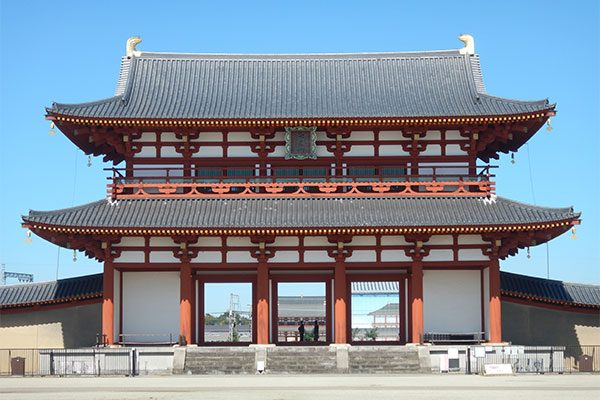
FactBased on excavations and research, Suzakumon Gate was reconstructed at full scale in 1998, and the Former Daigokuden (Great Audience Hall) in 2010, in time for the 1300th anniversary of the move to Heijo-kyo. The Daigokuden is about 44 m wide at the front and about 27 m tall. It was the building where the nation's most important ceremonies were held, such as emperors' enthronements and the New Year's Day audience. In 2022 the Daigokumon (South Gate), south of the Daigokuden, was also reconstructed.
Look for this: the Excavation Site Exhibition Hall and Toin Garden
At the Heijo Palace Site Excavation Site Exhibition Hall, you can see pillar holes and wells just as they were excavated, under a roof. The Toin Garden in the southeast corner of the palace site is a reconstruction of an excavated Nara-period garden, and its winding pond and artificial hill hint at the prototype of Japanese gardens from the Heian period onward. The palace site is large, so a rental bicycle is handy.
"Aoniyoshi" and the capital of Nara
FactA poem by Ono no Oyu in the Man'yoshu, "Aoniyoshi / Nara no miyako wa / saku hana no / niou ga gotoku / ima sakari nari" (The capital of Nara, "aoniyoshi", is now at its height, like flowers in fragrant bloom), was written from Dazaifu in Kyushu, longing for the capital. "Aoniyoshi" is a makurakotoba (poetic epithet) attached to Nara, loved as a word that calls to mind the capital's buildings painted in blue-green and red (there are several theories about its origin).
Main sources: Ministry of Land, Infrastructure, Transport and Tourism, Nara Palace Site Historical Park / Nara National Research Institute for Cultural Properties, Nara Palace Site Museum / Shoku Nihongi, entries for Wado 1 and Wado 3 / Nara City materials on Tanada Kajuro