Home / Kofuku-ji and the Ashura statue
Kofuku-ji and the Ashura Statue
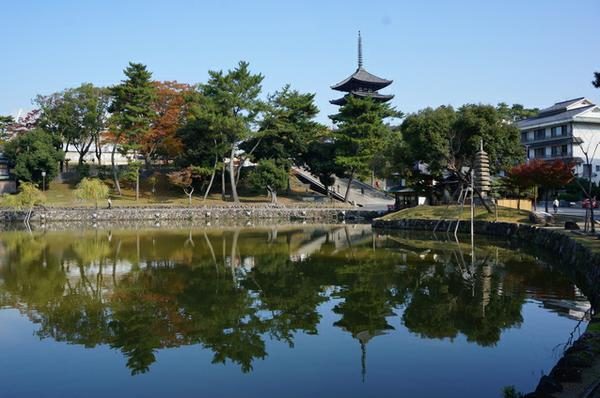
The five-storey pagoda reflected in Sarusawa Pond is one of Nara's signature views. This temple was the "family temple" of the Fujiwara clan, who held power longer than anyone else in Japanese history. In the Middle Ages it was powerful enough to rule the whole province of Yamato, and in the Meiji era it was pushed to the brink of abandonment: a temple of dramatic ups and downs.
World HeritageHistoric Monuments of Ancient Nara (1998)
Labels: Factdocumented Likelysupported by most sources Legendoral tradition Urban legendlocal lore and rumour
From Yamashina to Asuka, then to Heijo-kyo
FactKofuku-ji is said to have begun as Yamashina-dera, a temple built in 669 at Yamashina in Yamashiro Province (today's Yamashina Ward, Kyoto) by Kagami no Okimi, wife of Nakatomi no Kamatari, founder of the Fujiwara clan, to pray for her husband's recovery from illness. When the capital moved to Asuka, the temple moved too and became Umayasaka-dera. With the move of the capital to Heijo-kyo in 710, Kamatari's son Fujiwara no Fuhito relocated it to its present site and named it "Kofuku-ji".
LikelyThe temple stands on high ground in the "Gekyo" (Outer Capital), an area that jutted out beyond the eastern edge of Heijo-kyo. Placing the clan's temple on this prime site looking down over the Heijo Palace is said to show the power of the Fujiwara.
The temple that ruled Yamato Province
FactAs the Fujiwara prospered, so did Kofuku-ji, which wielded power as one with neighbouring Kasuga Taisha (see Kasuga Taisha). In the Heian period it repeatedly staged "goso" (forceful petitions), carrying the sacred sakaki tree of Kasuga Taisha into Kyoto to force the court to accept its demands. Together with Enryaku-ji on Mount Hiei, it was feared as "Nanto Hokurei" (the Southern Capital and the Northern Peak).
FactIn the Kamakura and Muromachi periods, the shogunate appointed no military governor (shugo) for Yamato Province, and Kofuku-ji effectively ruled the province in that role. This arrangement lasted until the Warring States period.
The Ashura statue: a god of war with a boy's face
FactThe Ashura statue, kept in Kofuku-ji's National Treasure Museum, is one of the Eight Legions statues commissioned in 734 by Empress Komyo for the first anniversary of the death of her mother, Tachibana no Michiyo. It is made by the "dakkatsu kanshitsu" (hollow dry lacquer) technique, building up the form from many layers of hemp cloth stiffened with lacquer, and weighs only about 15 kg. It has three faces and six arms.
FactAshura is by nature a fierce god forever at war with Taishakuten (Indra). Yet this statue has the delicate expression of a boy knitting his brows. The "National Treasure Ashura" exhibition held at the Tokyo National Museum in 2009 drew about 940,000 visitors, and together with its Kyushu venue it became a record-breaking show with over 1.6 million visitors.
FactIn Taira no Shigehira's burning of Nanto in 1180, Kofuku-ji was almost entirely destroyed. The Eight Legions statues, including Ashura, are thought to have survived because they were carried out of the flames.
Was the pagoda really put up for sale?
FactThe separation of Shinto and Buddhism and the anti-Buddhist movement (haibutsu kishaku) of the early Meiji years dealt a heavy blow to Kofuku-ji, which had been one with Kasuga Taisha. The monks left the temple to become Shinto priests at Kasuga Taisha, and for a time the temple was almost deserted. Its earthen walls were torn down, and the grounds became part of Nara Park.
LegendA story has been handed down that at this time the five-storey pagoda was put up for sale for just 250 yen (some say 25 yen), and that the buyer planned to burn it down just to take the metal fittings, but gave up after local residents, afraid the fire would spread, objected. However, no reliable record backing this up has been found, and the details vary depending on who tells it.
The Central Golden Hall, after 300 years
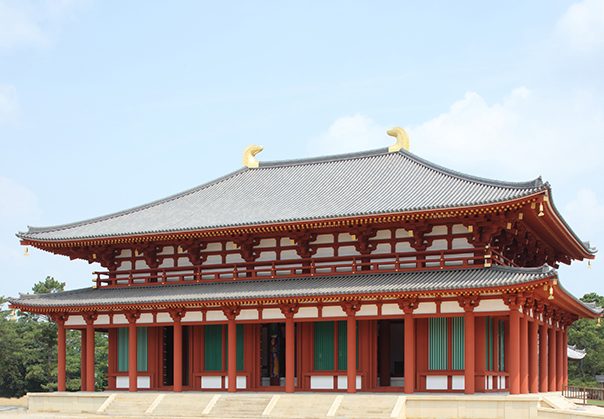
FactThe Central Golden Hall, the heart of the temple, burned seven times after its founding. After a fire in 1717 it could not be properly rebuilt, and spent 300 years as a temporary hall. In 2018, the Central Golden Hall, rebuilt on the scale of the Tenpyo era, was dedicated, bringing back the look of the temple as it was first built in the Nara period.
Look for this: the pagoda under repair
In 2023 the five-storey pagoda began its first major repair in about 120 years, and it is wrapped in a suyane (a protective cover for repair work). The work is scheduled to last until around 2031. Precisely because the pagoda can't be seen, turn your attention to the Eastern Golden Hall just east of it, rebuilt in 1415 in the Muromachi period, and the octagonal Northern Round Hall (the oldest surviving building at Kofuku-ji).
Main sources: Kofuku-ji official website / Agency for Cultural Affairs, Database of National Cultural Properties / Nara Prefecture materials on the Kojiki, Nihon Shoki and Man'yoshu / Kofukuji Ruki