Home / Horyu-ji
Horyu-ji
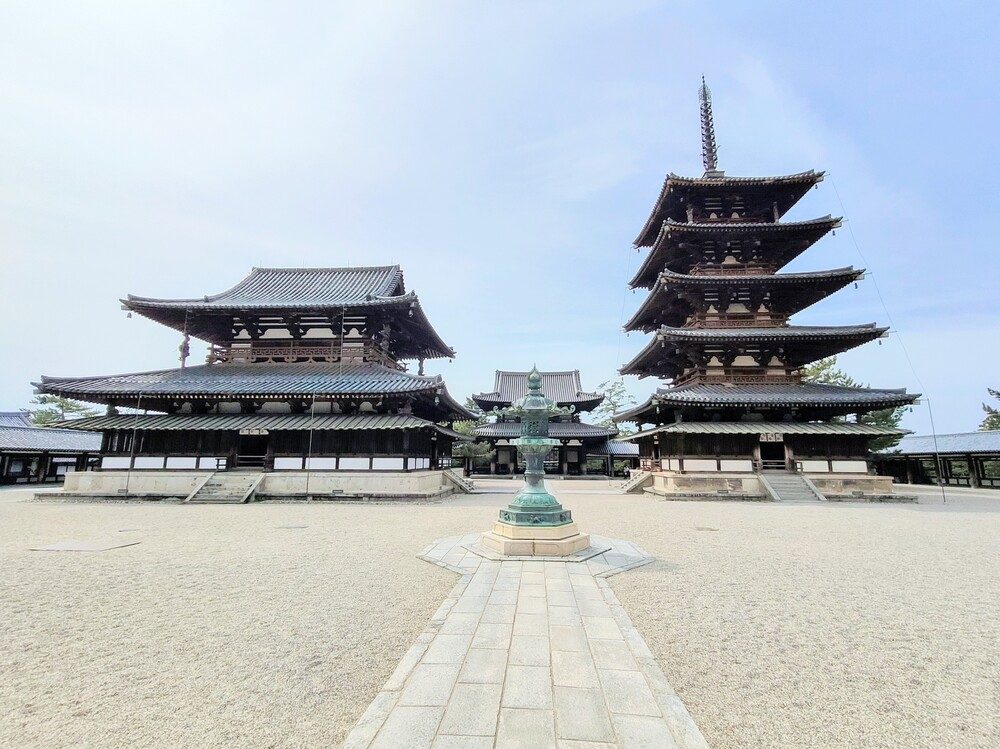
The Golden Hall and five-storey pagoda of Horyu-ji, in the village of Ikaruga, are the oldest surviving wooden buildings in the world. Yet whether they still stand just as Prince Shotoku built them was argued over for almost half a century, from the Meiji era into the Showa era. What finally settled it was another temple, sleeping under the ground of the temple precinct.
World HeritageBuddhist Monuments in the Horyu-ji Area (1993)
Labels: Factdocumented Likelysupported by most sources Legendoral tradition Urban legendlocal lore and rumour
607: a temple for the prince
LikelyThe halo of the Yakushi Nyorai (Medicine Buddha) statue in Horyu-ji's Golden Hall bears an inscription saying the work was begun to pray for Emperor Yomei's recovery from illness, and was completed by Empress Suiko and Prince Shotoku in the 15th year of Suiko (607). The temple's founding has long been dated to this year. However, many scholars believe the inscription itself was carved at a later date, so it is safest to think of 607 as "the founding year according to the temple".
FactIn 1993, Horyu-ji and Hokki-ji were inscribed together as the "Buddhist Monuments in the Horyu-ji Area", among Japan's very first World Heritage sites (at the same time as Himeji Castle, Yakushima and Shirakami-Sanchi).
"Not a single building remained": did it burn or not?
FactThe Nihon Shoki (Chronicles of Japan), in its entry for the 30th day of the 4th month of the 9th year of Emperor Tenji (670), says: "Yahan no nochi ni Horyuji ni hi tsukeri. Hitotsu no ie mo amaru koto nashi." In other words, Horyu-ji burned in the middle of the night, and not one building was left standing. If this is true, the present buildings do not date from the prince's time, but were rebuilt afterwards.
FactWhen historians began arguing for this "rebuilt theory" from around 1887 (Meiji 20), the architectural historian Sekino Tadashi and others hit back in 1905 with a "never-rebuilt theory", arguing from the style of the buildings and the measuring unit used (the Koma-shaku, or Goguryeo foot) that the buildings were still exactly as they had been in the Asuka period. The debate split Japanese academia for decades.
The "Wakakusa Garan" under the ground
FactThe decisive evidence came from excavation. In 1939 (Showa 14), the remains of an older temple, with its pagoda and Golden Hall lined up in a straight north-south row, were dug up to the southeast of today's Western Precinct. The site, called the "Wakakusa Garan", was turned about 20 degrees away from the current temple layout. In 2004, fragments of wall paintings burned at high temperature were also found at the Wakakusa site, backing up the record of a fire. The prince's temple had burned once and been rebuilt in a slightly different spot. This was the moment the rebuilt theory became the accepted view.
FactResearch using tree rings to find the year trees were felled also moved forward. In 2004 it was announced that many of the timbers in the Golden Hall and five-storey pagoda were cut between the end of the 650s and the end of the 690s. But earlier, in 2001, it had been announced that the pagoda's central pillar came from a tree felled in 594, raising a new mystery: why is only the central pillar so old?
LikelySome say old timber was reused, others that it had been stored for a long time, but the question is still open.
Look for this: the "clouds" of the Golden Hall and pagoda
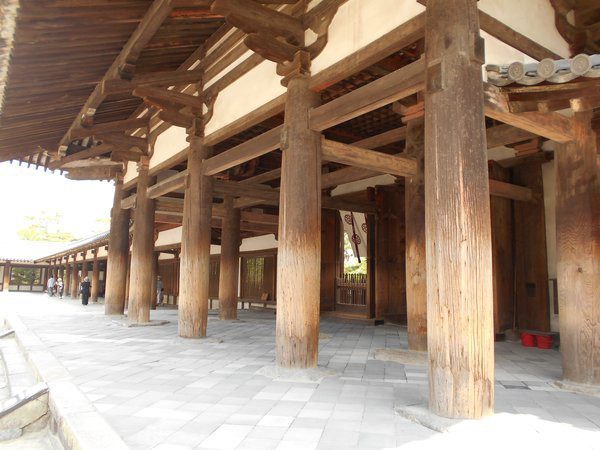
The bracket sets supporting the roofs use "kumoto" and "kumohijiki", brackets carved in the shape of clouds. This is the so-called Asuka style, which survives only at Horyu-ji and the temples around it. Also look at how the pillars of the Middle Gate swell slightly in the middle (the theory that this was influenced by the entasis of Greek temples is now viewed sceptically by many scholars).
26 January 1949: the Golden Hall fire
FactEarly on the morning of 26 January 1949 (Showa 24), fire broke out in the Golden Hall, which was being dismantled for repairs. The building itself survived because its upper parts had already been taken down, but the Golden Hall murals, painted around the end of the 7th century on the inner walls of the lower storey, were burned and lost their colour. They were a supreme treasure of Japanese art, compared even to the murals of the Ajanta Caves in India.
FactThis fire led to the Law for the Protection of Cultural Properties in 1950, and in 1955 26 January was named "Cultural Property Fire Prevention Day". Every year on this day, fire drills are held at temples and shrines across Japan.
The Yumedono and a hidden Buddha revealed
FactThe Yumedono (Hall of Dreams), the octagonal hall of the Eastern Precinct, was built around 739 by a monk named Gyoshin on the site of the Ikaruga Palace, where Prince Shotoku once lived. Its shrine cabinet holds the Guze Kannon, a statue said to be life-size to the prince himself.
LikelyFor a long time it was said that "opening it will bring a curse", and the statue was a hidden Buddha wrapped round and round in cloth. In 1884 (Meiji 17), the American Ernest Fenollosa, Okakura Tenshin and others are said to have persuaded the temple to open the cabinet and unwound as much as 500 yards of cloth. However, this story comes from Fenollosa's own recollections, and some point out that the cabinet had been opened before. Today the statue is shown for limited periods in spring and autumn.
Main sources: Horyu-ji official website / Agency for Cultural Affairs, Cultural Heritage Online, "Buddhist Monuments in the Horyu-ji Area" / Nara National Research Institute for Cultural Properties, dendrochronology reports / Nihon Shoki, entry for the 9th year of Emperor Tenji