Home / Muro-ji
Muro-ji
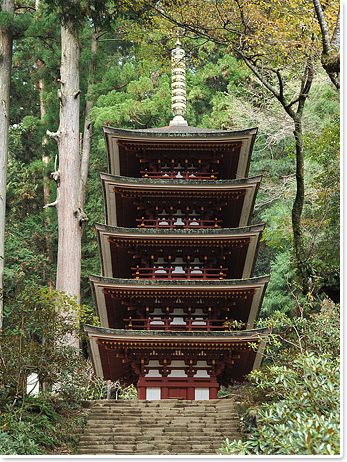
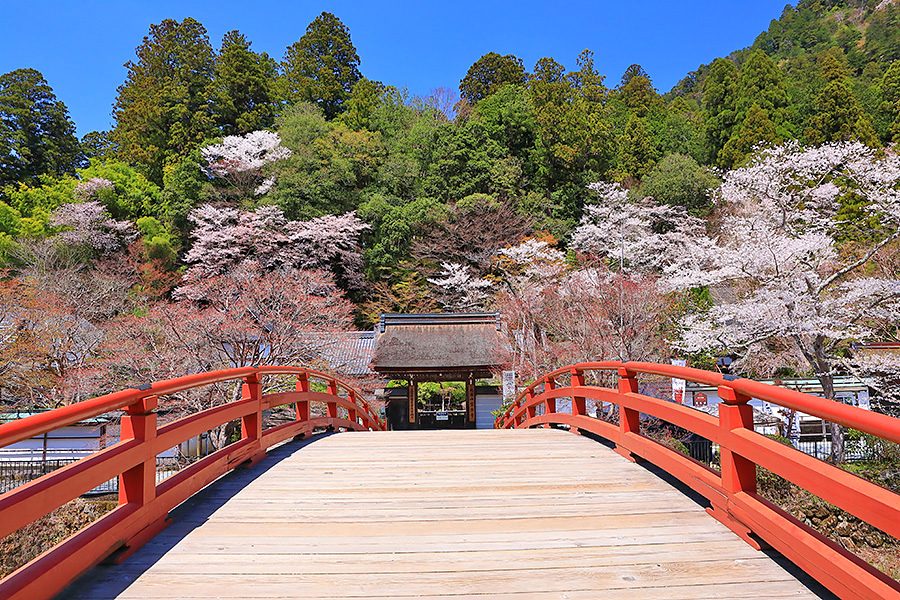
Deep in a mountain valley in Uda City, cross the vermilion arched bridge over the Muro River and the halls of Muro-ji appear beyond the stone steps and cedars. In an age when Mt. Koya would not admit women, this temple opened its gates to them. Halfway up the slope stands a small five-storey pagoda about 16 m tall, ringed by giant cedars.
Labels: Factdocumented Likelysupported by most sources Legendoral tradition Urban legendlocal lore and rumour
A temple in the valley of the dragon god
FactMuro has long been revered as a place where a dragon god lives. A cave upstream on the Muro River is called the "Ryuketsu" (dragon cave), and Muro Ryuketsu Shrine, which honours it, was a sacred site where the imperial court prayed for rain, or for rain to stop.
LikelyThe temple is said to have begun at the end of the Nara period, when Kenkei and other monks of Kofuku-ji held prayers here for the recovery of the crown prince (later Emperor Kanmu) from illness. It is thought that Kenkei's disciple Shuen actually built up the temple complex. There are also traditions that it was founded by En no Gyoja or revived by Kukai, but these appear to have been added in later times.
Why "Women's Koya"?
FactThrough the medieval period Muro-ji was closely tied to Kofuku-ji, but in the Genroku era of the Edo period (the 1690s) it became independent as a Shingon temple. Mt. Koya, the holy mountain of Shingon Buddhism, was closed to women until the Meiji period, but Muro-ji allowed women to worship. From the Edo period on, it came to be called "Nyonin Koya" (Women's Koya).
FactIts independence as a Shingon temple was backed by Keishoin, mother of the fifth shogun, Tokugawa Tsunayoshi. Keishoin also made large donations, and the halls and pagoda were repaired. Muro-ji's name spread as a temple that drew the faith of women.
A small pagoda's great ordeal
FactThe five-storey pagoda (a National Treasure) is thought to have been built around 800, making it the second oldest wooden five-storey pagoda in Japan after Horyu-ji's. At about 16 m tall, it is the smallest outdoor wooden five-storey pagoda in Japan designated a National Treasure or Important Cultural Property. Its roofs curve only gently and differ little in size from tier to tier, giving it a graceful look.
FactOn September 22, 1998, strong winds from Typhoon No. 7 brought down a cedar several hundred years old next to the pagoda, and it struck the roof. The roofs and eaves on the northwest side were badly broken and left hanging, but the pagoda's framework, including the central pillar, survived. Repairs were carried out from 1999 to 2000, and the pagoda regained its original form.
Look here: rhododendrons, and the temple Domon Ken loved
From late April to early May, rhododendrons bloom along the stone steps in the grounds, framing the five-storey pagoda. The photographer Domon Ken visited Muro-ji throughout his life and is said to have waited for years to photograph it in snow. National Treasure Buddhist statues of the early Heian period, such as the standing Shaka Nyorai and standing Eleven-Headed Kannon long enshrined in the Kondo (Golden Hall), and the seated Shaka Nyorai that was in the Miroku Hall, can be seen in the temple's Treasure Hall.
Main sources: Muro-ji official website / Uda City Tourism Association / Agency for Cultural Affairs, Database of National Cultural Properties / Nara Prefecture Cultural Properties Preservation Office, materials on the disaster restoration of the Muro-ji five-storey pagoda