Home / Legends and urban legends of Nara
Legends and Urban Legends of Nara
Nara, with 1,300 years of history piled up, has many strange tales handed down over time. How much is true, and where does tradition take over? Using labels to tell them apart, we have gathered Nara's "slightly scary" and "slightly strange" stories.
Labels: Factdocumented Likelysupported by most sources Legendoral tradition Urban legendlocal lore and rumour
A pillar hole the size of the Great Buddha's nostril
FactAt the base of one of the pillars in Todai-ji's Great Buddha Hall is a square hole about 37 cm high and about 30 cm wide, and crawling through it is said to bring good health and protection from illness (see Todai-ji).
Urban legendThe story that "this hole is the same size as the Great Buddha's nostril" is a standard bit of trivia on Japanese school trips. However, no record of measuring the Buddha's nostril and comparing the two has been made public, so whether they are really the same is unknown. One theory says the hole itself has to do with the building's orientation and warding off evil from the unlucky northeast direction (kimon).
The seven wonders of Sarusawa Pond
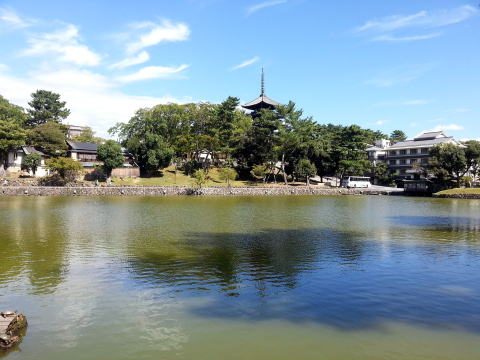
LegendSarusawa Pond, south of Kofuku-ji, has seven wonders handed down in a saying: "Never clear, never muddy, no water out, no water in, no frogs are born, no weeds grow, seven parts fish to three parts water." The water never becomes perfectly clear, yet never fully muddy. No stream flows out and none flows in, yet the water never drops. No frogs breed, no weeds grow, and there are so many fish that they outnumber the water.
FactIn reality, water is thought to flow in and out of Sarusawa Pond through underground channels and the like. The pond is man-made, dug in 749 for Kofuku-ji's hojoe (a ceremony of releasing living creatures into a pond).
A shrine with its back to the pond: Uneme Shrine
LegendOn the shore of Sarusawa Pond is a small shrine that stands with its back to the water: Uneme Shrine. In the Nara period, an uneme (a court lady) who served the emperor grieved that his affection for her had faded, and threw herself into Sarusawa Pond. A shrine was built to honour her, but her spirit could not bear to look at the pond where she had drowned, and in a single night the shrine turned itself around, so the story goes (the Yamato Monogatari and other works contain the tale it is based on).
FactEvery year on the night of the harvest moon, the "Uneme Festival" is held to console her spirit, and a music boat bearing a flower fan circles Sarusawa Pond.
The deer, the stone burial and the Thirteen Bells
LegendLong ago, a boy named Sansaku was practising calligraphy at Kofuku-ji's temple school when a deer grabbed his paper in its mouth. He threw his paperweight at it, struck it in the wrong place, and the deer died. For the crime of killing a deer, a messenger of the gods, Sansaku was punished by "ishikozume", buried alive in a pit together with the deer, so the story goes (see Deer).
LegendSansaku's mother, grieving her son's death, is said to have prayed for him every day at the bells of the seventh hour of dawn (around 4 a.m.) and the sixth hour of dusk (around 6 p.m.). For this reason, a bell called the "Thirteen Bells", six plus seven, hangs at nearby Bodai-in Odo. In the grounds is a mound said to be Sansaku's grave, and a maple tree said to have been planted by his mother.
The demon of Gango-ji, "Gagoze"
LegendThe Nihon Ryoiki tells of a demon that appeared every night in the bell tower of Gango-ji and killed the boys who rang the bell, until a boy of great strength (later the monk Dojo Hoshi) grappled with it and drove it off by tearing out its hair before dawn (see Gango-ji). After the temple's name, this demon was called "Gagoze", and the word spread across Japan as something to frighten children with. It is said that in some regions ghosts are still called "gagoji" or "gango" as a trace of this.
The seven wonders of Horyu-ji
LegendHoryu-ji has seven wonders too, such as "spiders do not spin webs in Horyu-ji's buildings", "sparrows do not leave droppings", "raindrops dripping from the eaves leave no holes in the ground" and "sickles are stuck on top of the five-storey pagoda".
FactOf these, the "sickles" are real: four sickles are attached to the spire of the five-storey pagoda. They are said to be a charm against lightning, and you can see them by looking up from close by. The other stories are Legend, told to express the sanctity of Prince Shotoku's temple (see Horyu-ji).
Look here: how to enjoy Nara's urban legends
For many of these legends, clues remain on the spot: the direction Uneme Shrine faces, the bell of the Thirteen Bells, the sickles on Horyu-ji's pagoda, the Gagoze charms at Gango-ji. Walk around as if checking whether the stories are true, and the town of Nara will look a little different.
Main sources: Todai-ji / Uneme Shrine / Kofuku-ji / Horyu-ji / Gango-ji / Yamato Monogatari / Nihon Ryoiki / Nara City Tourism Association