Home / Taima-dera and Mount Nijo
Taima-dera and Mt. Nijo
West of the Nara Basin, at the foot of twin-peaked Mt. Nijo, stands Taima-dera. This temple has a legend of a princess, tormented by her stepmother, who wove a picture of paradise in a single night from lotus threads. Beyond the setting sun in the west lies paradise: so the ancients prayed toward Mt. Nijo.
Labels: Factdocumented Likelysupported by most sources Legendoral tradition Urban legendlocal lore and rumour
The only temple with both east and west pagodas
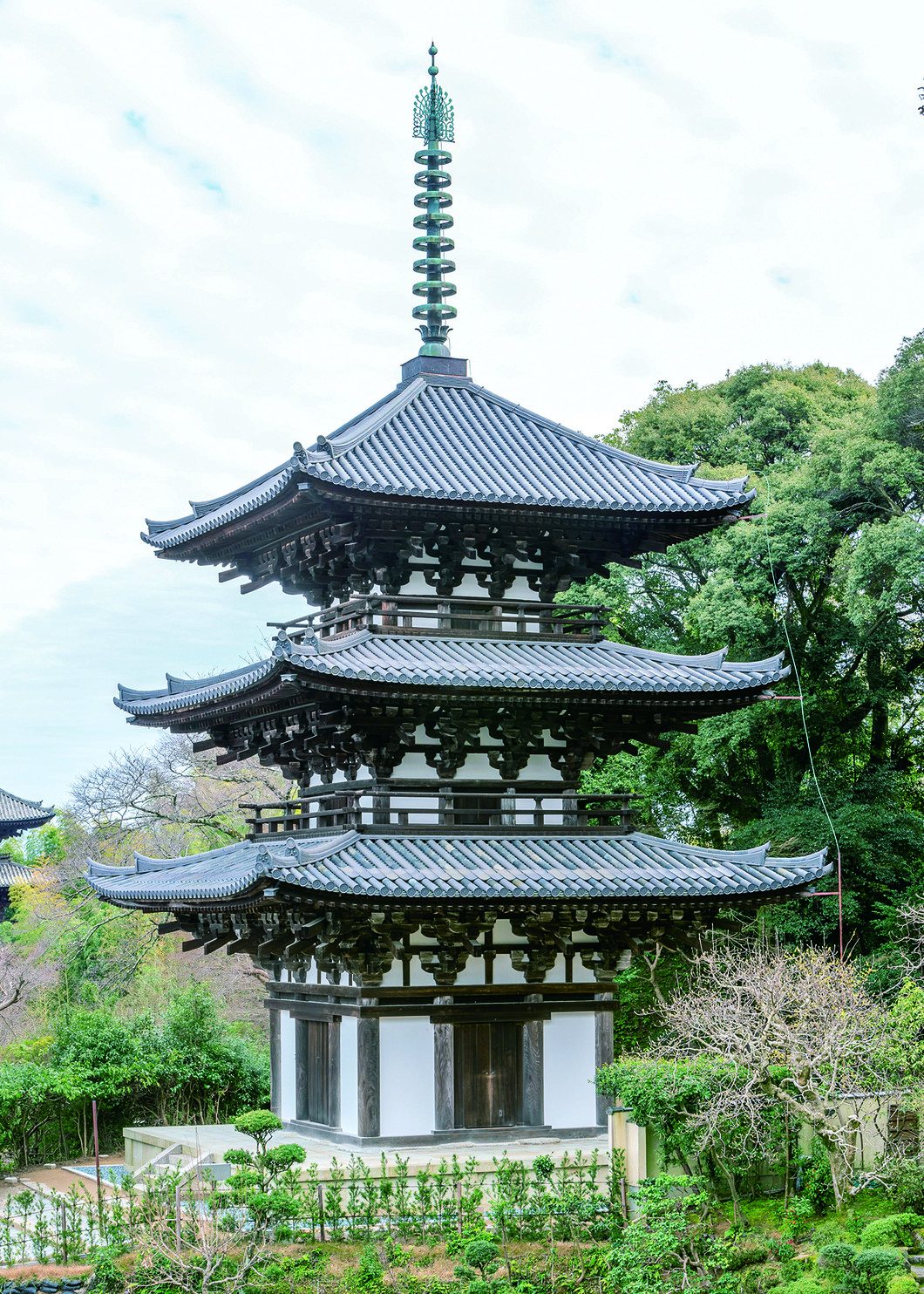
FactTaima-dera is an old temple said to have been founded in the 7th century. Its grounds hold two three-storey pagodas, the East Pagoda and the West Pagoda (both National Treasures). They were built between the Nara period and the early Heian period, and this is the only place in Japan where an ancient pair of east and west pagodas survives together.
Chujo-hime and the lotus-thread mandala
LegendIn the Nara period, Chujo-hime, daughter of Fujiwara no Toyonari, was beautiful and wise, but her stepmother sought her life, and she suffered hardships such as being abandoned in the mountains. Later she became a nun and entered Taima-dera. Wishing to see the form of the Buddha, she took thread from lotus stems, dyed it in five colours and, it is said, wove a picture of the Pure Land paradise in a single night. This is the "Taima Mandala" that hangs in the main hall.
FactThe actual Taima Mandala (the tapestry Taima Mandala, a National Treasure) is a large tapestry about 4 m square, thought to have been made in the 8th century. Studies have shown it is woven of silk thread, and it has been suggested that it may have been made in Tang China. It is now badly damaged, and copies such as the "Bunki version", made in the Muromachi period, hang in the main hall.
LegendChujo-hime is said to have departed for paradise alive at the age of 29, welcomed by Amida Buddha and the bodhisattvas. This scene is re-enacted every year on April 14 (formerly May 14) at the "Nerikuyo Eshiki". Twenty-five bodhisattvas in golden masks process along a long bridge laid from the main hall to the Shaba Hall, to welcome the princess to paradise.
Mt. Nijo: where a tragic prince lies
FactMt. Nijo has two peaks, Odake (517 m) and Medake (474 m). In 686, just after the death of Emperor Tenmu, his son Prince Otsu was arrested on a charge of treason and executed the next day. The prince was said to excel in both letters and arms and to be widely admired, and one view holds that the affair was engineered by the empress (later Empress Jito) to protect the position of her own son, Prince Kusakabe.
FactThe prince's body was moved and buried on Mt. Nijo, and his sister, Princess Oku, wrote: "Utsusomi no hito ni aru ware ya asu yori wa Futakamiyama wo irose to waga mimu" (I who remain among the living: from tomorrow I will gaze on Mt. Nijo as my brother). The Imperial Household Agency designates a tomb near the summit of Odake as Prince Otsu's grave.
Look here: the sun setting over Mt. Nijo
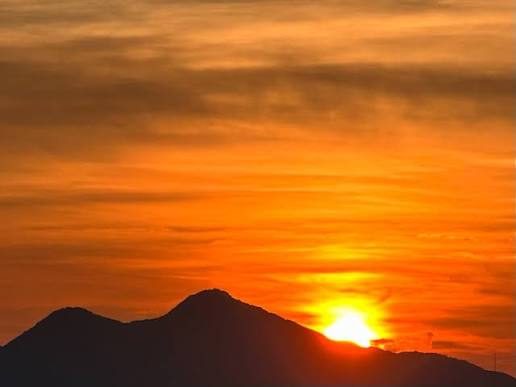
Around the spring and autumn equinoxes, the sun sets between the two peaks of Mt. Nijo as seen from the Nara Basin. For people who believed the Pure Land lay in the west, Mt. Nijo was like a gateway to paradise. Orikuchi Shinobu drew on the Chujo-hime legend and Prince Otsu to write his novel The Book of the Dead. The silhouette of Mt. Nijo stands out clearly when seen from the east side of the Nara Basin, such as from the Yamanobe-no-Michi.
Main sources: Taima-dera official websites (Naka-no-bo and others) / Katsuragi City Tourism Association / Agency for Cultural Affairs, Database of National Cultural Properties / Nihon Shoki, entry for the first year of Shucho / Man'yoshu, Book 2