Home / The palaces and temples of Asuka
Palaces and Temples of Asuka
Asuka Village is a peaceful place of rice fields and low hills. Yet from the late 6th century through the 7th, emperors' palaces were set up here one after another, Japan's first full-scale temple was built, and an incident occurred that led to the Taika Reforms: this was the "place where it all began" for the country of Japan. And all over the village lie stones whose purpose no one knows.
World HeritageAsuka-Fujiwara: Archaeological Sites of Japan's Ancient Capitals (2026)
Labels: Factdocumented Likelysupported by most sources Legendoral tradition Urban legendlocal lore and rumour
World Heritage in 2026
FactOn 26 July 2026, at UNESCO's World Heritage Committee meeting in Busan, South Korea, "Asuka-Fujiwara: Archaeological Sites of Japan's Ancient Capitals and Related Properties" was inscribed as a World Cultural Heritage site. It is Japan's 22nd World Cultural Heritage site. Of its 19 component parts, spread across Asuka Village, Kashihara City and Sakurai City, 15 are in Asuka Village, and together the palace sites, temple sites and kofun tell the story of "the birthplace of the ancient state".
Asuka-dera: Japan's first full-scale temple
FactIn 588, Soga no Umako invited temple-building engineers and tile makers from Baekje and began building Japan's first full-scale temple, Hoko-ji (Asuka-dera). Excavations in 1956–57 showed that the pagoda was completed in 596 and that a grand temple complex was built with three Golden Halls surrounding the pagoda.
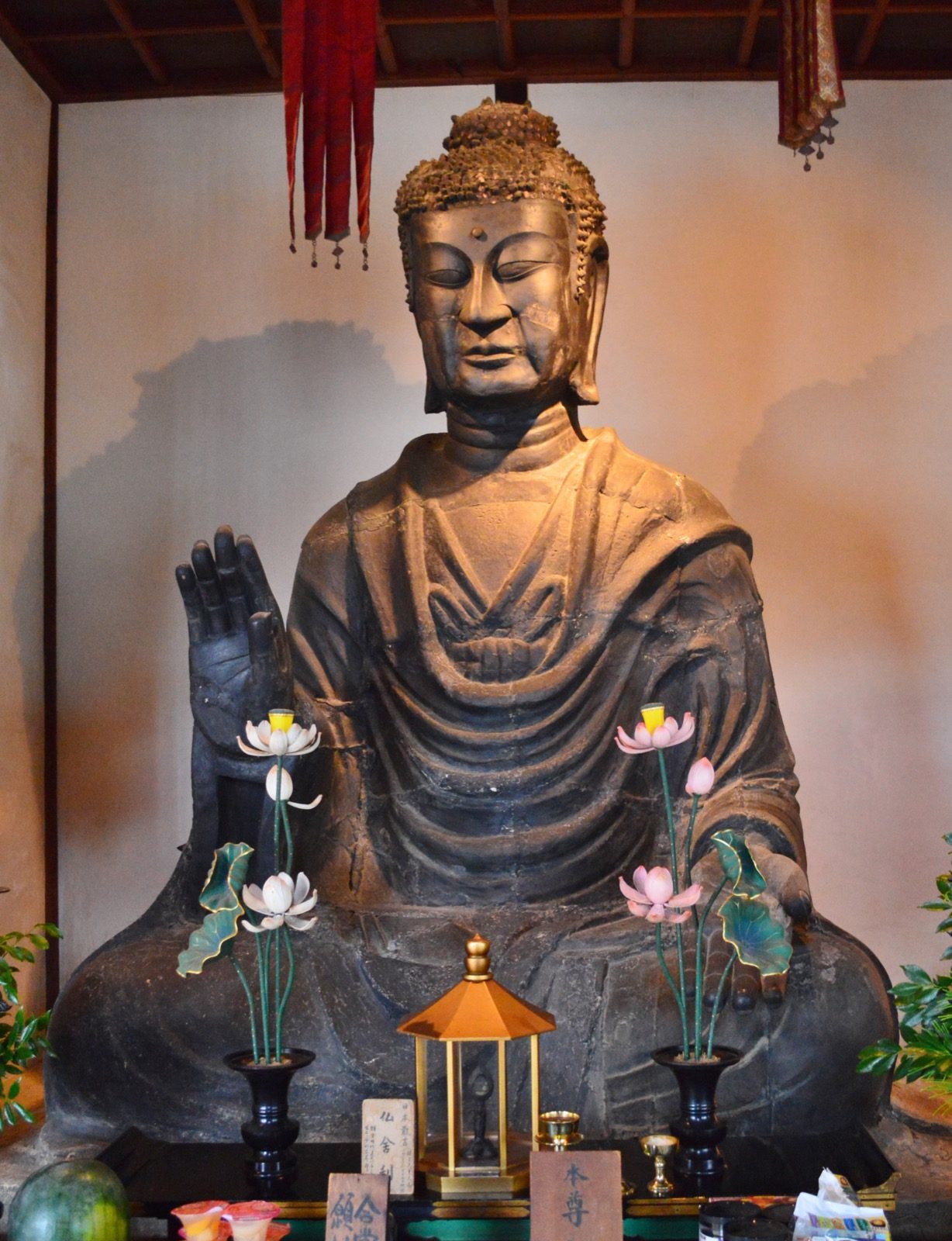
FactThe principal image, the Asuka Daibutsu (seated Shaka Nyorai, Important Cultural Property), is said to have been made in 609 by the sculptor Kuratsukuri no Tori, and is the oldest Buddhist statue in Japan with a known date of creation. It was badly damaged by fire in the Kamakura period and much of it is later repair, but parts such as some of the face are thought to remain from the Asuka period. It is also known as a statue that has never once moved from where it was made, and photography is permitted.
FactWith the move of the capital to Heijo-kyo, Asuka-dera moved to Nara and became Gango-ji, but a temple also remained in Asuka (see Gango-ji).
The Isshi Incident: an assassination in the palace
FactIn the 6th month of 645, at the Asuka Itabuki Palace of Empress Kogyoku, in the middle of a ceremony to receive foreign envoys, Prince Naka no Oe (later Emperor Tenji), Nakatomi no Kamatari and others cut down the all-powerful Soga no Iruka. The next day Iruka's father, Emishi, set fire to his own residence and killed himself, and the main line of the Soga clan was destroyed. The political reforms that began with this "Isshi Incident" are the Taika Reforms.
FactWest of Asuka-dera, a five-tiered stone stupa called the "Iruka no Kubizuka" (Iruka's Head Mound) stands in the rice fields, on the spot where the assassinated Iruka's head is said to have flown and landed (the story of the flying head is Legend). Excavation of the palace site, the "Asuka Palace Site", has advanced, and it has become clear that the palaces of several emperors were rebuilt one after another on the same spot.
What were these stones for?
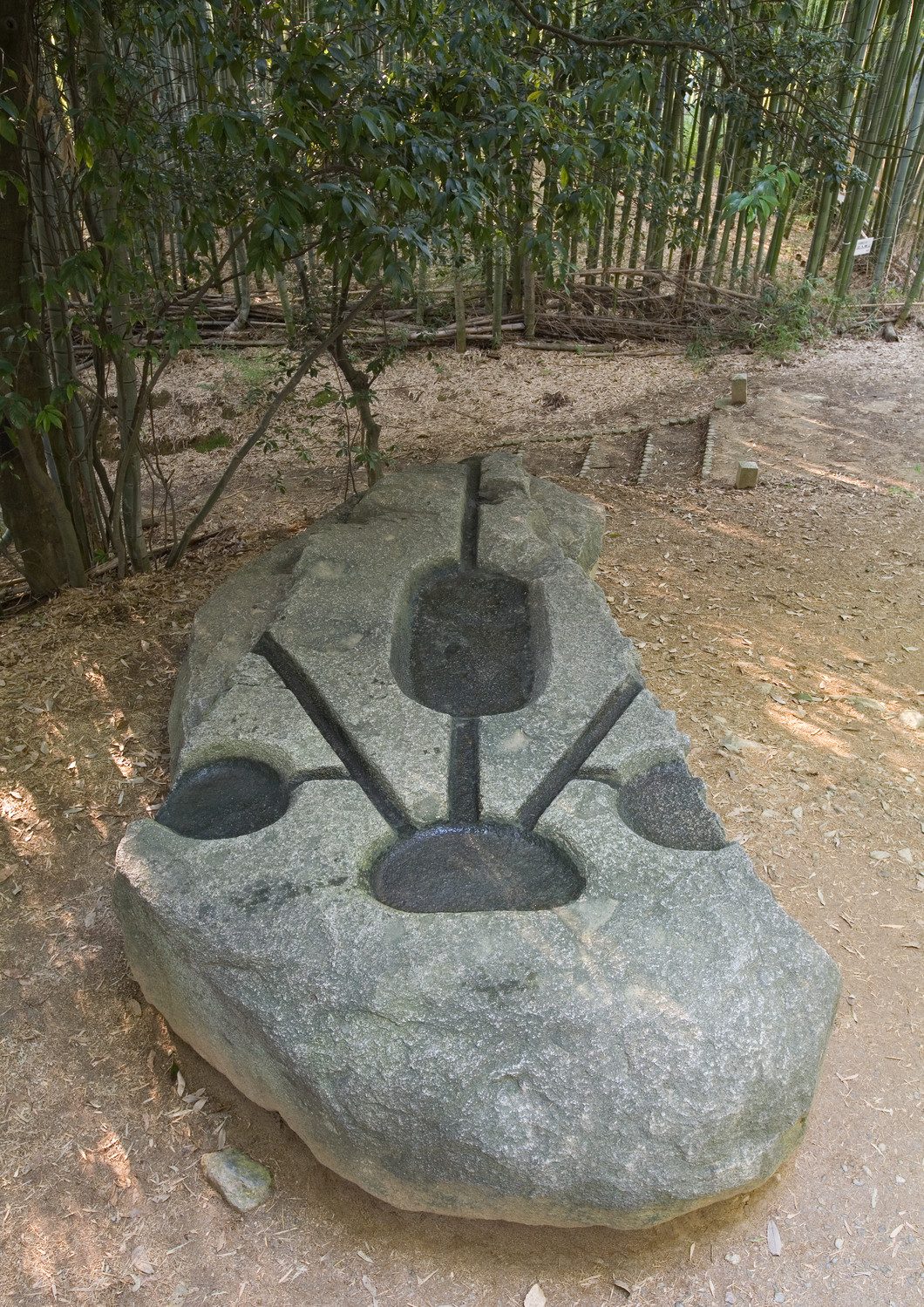
FactAsuka is dotted with stone objects whose purpose is not well understood. Sakafuneishi, on top of a hill, is a granite stone about 5.5 m long with round hollows and grooves carved into its surface. Theories abound: that it was used to make sake, to mix medicines, or as a water feature in a garden.
FactIn 2000, the "Kamegata Sekizobutsu" (turtle-shaped stone structure), combining a turtle-shaped stone basin with an oval basin, was excavated in the valley north of Sakafuneishi. The area around it was laid with paving stones and steps, and it is thought to have been a place for rituals using water. The leading view is that Sakafuneishi was part of the same facility.
LegendKameishi (Turtle Stone), in the west of the village, is a stone about 3.6 m long with a turtle-like face. Legend has it that "when Yamato was a lake, the snake of Taima and the catfish of Kawara fought; the Kawara side lost, its water was taken by Taima, and many turtles died. The stone was carved as a memorial to those turtles. If Kameishi ever faces west, all of Yamato will become a sea of mud." Today, Kameishi faces southwest.
Look for this: the Saruishi and the Oni no Manaita and Oni no Setchin
Next to the tomb of Emperor Kinmei, inside the fence of the tomb of Princess Kibihime, stand four stone statues with monkey-like faces called "Saruishi" (Monkey Stones). They were dug up from a rice field in the Edo period, and no one knows who made them or why. On a nearby hill lie the "Oni no Manaita" (Demon's Chopping Board) and "Oni no Setchin" (Demon's Toilet), huge stones placed like a chopping board and a toilet. In fact they are the floor stone and lid of a single kofun's burial chamber that came apart, and the story that a demon cooked travellers here is Legend.
Main sources: Asuka Village official website / Archaeological Institute of Kashihara, Nara Prefecture / Agency for Cultural Affairs, World Heritage nomination dossier for "Asuka-Fujiwara" / Nihon Shoki, chronicles of Sushun, Suiko and Kogyoku