Home / The Yagyu clan village
Yagyu Village
About 30 minutes east of central Nara by car, surrounded by tea fields and cedar forests, lies the mountain village of Yagyu, home of the Yagyu clan who taught swordsmanship to the Tokugawa shoguns. From lords of a small mountain domain to daimyo, raised up by the sword alone: their story has been told again and again in period dramas and novels.
Labels: Factdocumented Likelysupported by most sources Legendoral tradition Urban legendlocal lore and rumour
"Muto-dori": winning without a sword
FactThe Yagyu were small local lords who ruled the Yagyu estate in Yamato Province during the Warring States period. Yagyu Muneyoshi (known as Sekishusai) learned the Shinkage-ryu school of swordsmanship from the master Kamiizumi Nobutsuna and inherited its deepest secrets.
FactIn 1594, Muneyoshi was invited by Tokugawa Ieyasu in Kyoto and is said to have demonstrated "muto-dori", the technique of taking an opponent's sword without holding one himself. Impressed, Ieyasu wrote out a pledge on the spot to become his pupil and asked him to serve as his instructor. The aged Muneyoshi declined and recommended his fifth son, Munenori, in his place.
Yagyu Munenori, the man who became a daimyo by the sword
FactYagyu Munenori served Ieyasu, distinguished himself at the Battle of Sekigahara and regained the family's old lands at Yagyu. He was sword instructor to the second shogun Hidetada and the third shogun Iemitsu, and especially won Iemitsu's deep trust, being appointed the first Ometsuke (then called Sometsuke), the inspector of the daimyo. With repeated increases he became a daimyo of 12,500 koku, and the Yagyu domain was born.
FactMunenori's treatise on strategy, the Heiho Kadensho, presents swordsmanship not as "the sword that kills" but as "the sword that gives life" (katsujinken), and is known for raising swordsmanship into a discipline of the warrior's mind. Along with Miyamoto Musashi's The Book of Five Rings, it is one of Japan's great works on strategy.
Was Yagyu Jubei one-eyed?
FactMunenori's eldest son, Yagyu Jubei Mitsuyoshi, served as a page to Iemitsu, then left his post for unknown reasons and spent more than ten years in places such as Yagyu village. He wrote books on swordsmanship and died suddenly in 1650 at the age of 44.
Urban legendJubei is famous as a one-eyed swordsman with an eyepatch, but this image spread through storytelling from the Edo period on and through postwar novels and films. There is no reliable source showing he lost an eye, and surviving portraits show him with both eyes. The story that during his years away from his post he travelled the provinces as a secret agent was also born in fiction.
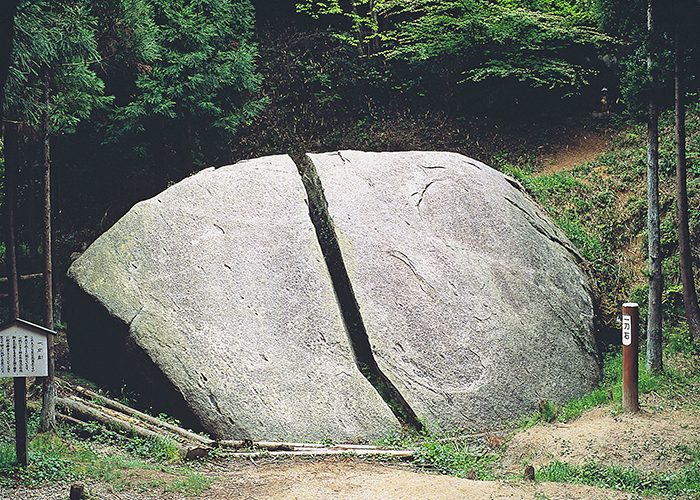
The "Itto-seki" that cut down a tengu
LegendDeep in Yagyu village, in the woods of Amano Iwatate Shrine, lies a huge boulder about 7 m long, split cleanly in two as if cut by a sword. It is called the "Itto-seki" (one-stroke stone). The story goes that Yagyu Muneyoshi fought a tengu (a mountain goblin) here and struck at it, but what he had taken for the tengu was this rock, which lay split in two.
A victory carved by farmers: the Yagyu debt stone
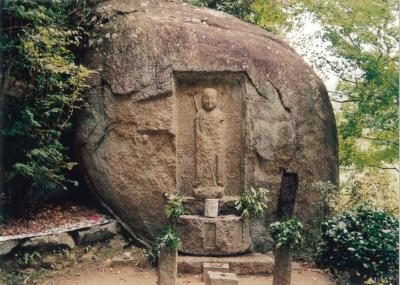
FactNear the entrance to Yagyu village, small characters are carved at the lower right of a Jizo figure cut into a large rock known as "Hoso Jizo". The inscription reads "Shocho gannen yori saki wa Kanbe yonkago ni oime arubekarazu", meaning that in the four villages of Kanbe there are no debts at all from before the first year of Shocho (1428).
FactIn 1428, the "Shocho Uprising", which began among the packhorse drivers of Omi, spread to Kyoto and Nara, and people attacked sake brewers and pawnbrokers, demanding the cancellation of debts (tokusei). The inscription is thought to record that, as a result of the uprising, the farmers around Yagyu won the cancellation of their debts. As a rare record carved by farmers of their own victory, it appears in Japanese school textbooks.
Look here: Hotoku-ji and the Masakizaka Dojo
Hotoku-ji, the Yagyu family temple, was built by Munenori to pray for the soul of his father Sekishusai, and the graves of the Yagyu clan line up behind it. Below the temple, the Masakizaka Kenzen Dojo carries on the name of the Yagyu family's old training hall. Yagyu village is not a big tourist spot, but traces of a small castle town remain, such as the former residence of a Yagyu domain chief retainer.
Main sources: Nara City Tourism Association, "Yagyu Village" / Hotoku-ji / Nara City Board of Education (Yagyu debt-cancellation inscription) / Tokugawa Jikki