Home / Mount Yoshino and the Southern Court
Mount Yoshino and the Southern Court
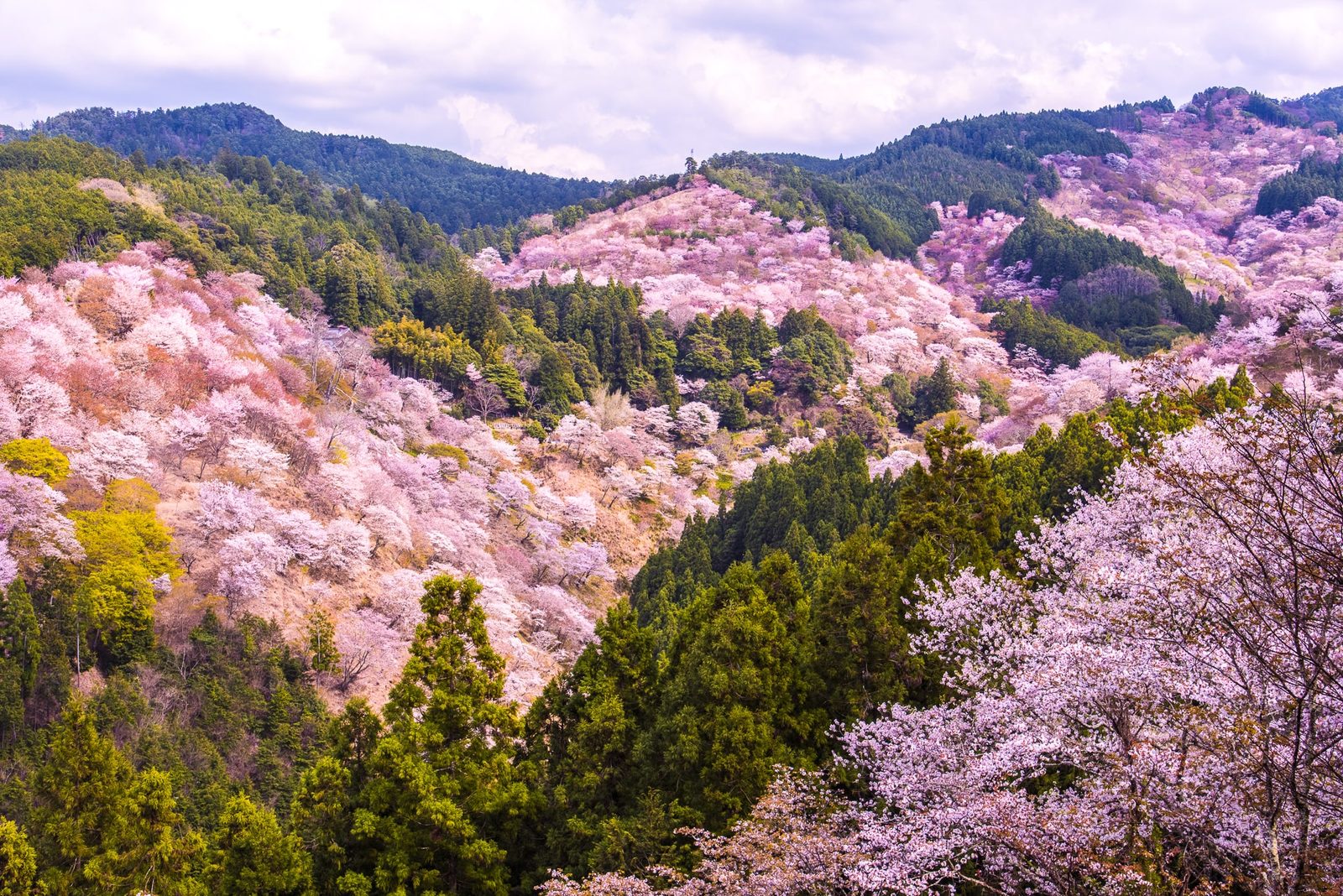
In spring, Mount Yoshino turns pink from the bottom up. These cherry trees, praised as "hitome senbon" (a thousand trees at a glance), were not planted by anyone for the view. People have planted them one by one for more than 1,000 years as prayers to the gods and Buddhas of the mountain. And on this mountain there was once a second imperial court.
World HeritageSacred Sites and Pilgrimage Routes in the Kii Mountain Range (2004)
Labels: Factdocumented Likelysupported by most sources Legendoral tradition Urban legendlocal lore and rumour
Cherry trees planted as prayers
LegendAt the end of the 7th century, En no Gyoja (En no Ozunu), regarded as the founder of Shugendo (Japanese mountain asceticism), practised in the mountains running from Yoshino to Mount Omine, and on Mount Sanjogatake is said to have had a vision of "Zao Gongen", a Buddha of fierce form. En no Gyoja carved this figure in the wood of a mountain cherry tree and enshrined it, and so the cherry came to be seen as the sacred tree of Zao Gongen (see Mount Omine).
FactEver since, people have continued "kenboku", donating cherry saplings as a sign of their faith in Zao Gongen, and Mount Yoshino became a mountain of cherry trees. Today there are about 30,000 trees, most of them the wild Shiroyamazakura (white mountain cherry). From the foot of the mountain upward, the areas are called Shimo Senbon, Naka Senbon, Kami Senbon and Oku Senbon, and from early to late April the blossoms open in order from the bottom up.
Kinpusen-ji's Zao-do: a 34 m wooden hall
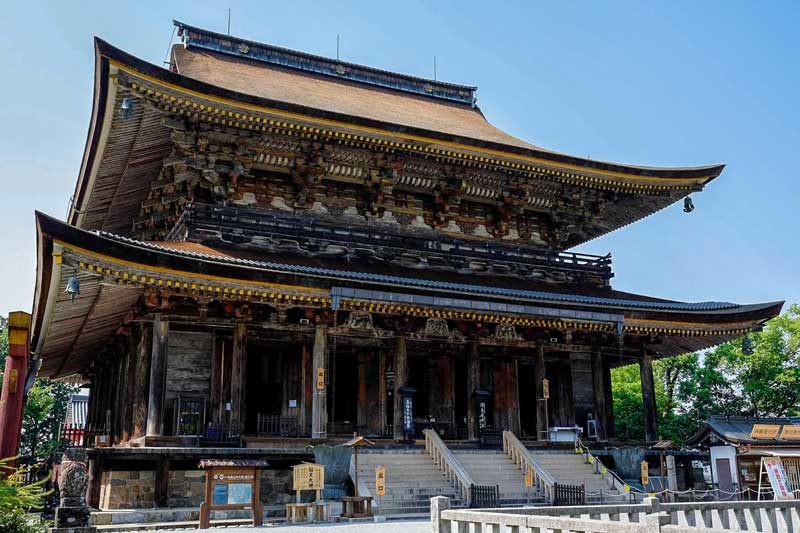
FactTowering at the centre of Mount Yoshino is the Zao-do (National Treasure), the main hall of Kinpusen-ji, head temple of Shugendo. The present building was rebuilt around 1590 with a donation from Toyotomi Hideyoshi. It is 34 m tall and about 36 m both deep and wide, one of the largest wooden Buddhist halls in Japan.
FactInside the hall stand three blue-black statues of Zao Gongen. The central statue is about 7.3 m tall, and those on either side are around 6 m. They raise their right hands and lift their right feet high, with expressions of fury. They are usually hidden Buddhas, shown only during special periods.
Two courts: nearly 60 years of the Southern Court
FactIn 1336, Emperor Go-Daigo, in conflict with Ashikaga Takauji, escaped from Kyoto, came to Yoshino and set up his court here. In Kyoto there was an emperor installed by Takauji (the Northern Court), and so began the "Northern and Southern Courts period", with two courts standing side by side. Emperor Go-Daigo died at Yoshino in 1339, still longing to return to Kyoto.
LegendThe Taiheiki records that Emperor Go-Daigo's last words were "Gyokkotsu wa tatoi nanzan no koke ni uzumoru tomo, konpaku wa tsune ni hokketsu no ten o nozoman" (Though my body be buried in the moss of Yoshino, my soul will always gaze toward the skies of Kyoto). It is said that, in keeping with his last wish, his tomb (the Tonoo Mausoleum) was built facing north toward Kyoto, which is unusual for an imperial tomb.
FactIn 1348, the army of Ko no Moronao of the Northern Court attacked and burned the temporary palace at Yoshino, and the Southern Court kept up its resistance while moving its base to places such as Ano (today's Gojo City). It was a conflict lasting nearly 60 years, until the Northern and Southern Courts were reunited in 1392.
Look for this: the shoin of Yoshimizu Shrine
At Yoshimizu Shrine (originally a monks' residence called Yoshimizu-in), which Emperor Go-Daigo used as his temporary palace, the room of the emperor's throne survives. In 1594 Toyotomi Hideyoshi held a grand cherry-blossom viewing here with about 5,000 people including Tokugawa Ieyasu and Date Masamune, and it served as his headquarters. From the veranda of the shoin (reception hall), the "hitome senbon" view opens out, taking in the cherry blossoms of Naka Senbon and Kami Senbon all at once.
Yoshitsune and Shizuka's parting
FactIn the winter of 1185, Minamoto no Yoshitsune, pursued by his elder brother Minamoto no Yoritomo, fled into Mount Yoshino with Benkei and others. Chased also by Yoshino's warrior monks, Yoshitsune parted from his beloved Shizuka Gozen in the snow and crossed the mountains. Shizuka was captured and sent to Kamakura, where she was ordered to dance before Yoritomo at Tsurugaoka Hachimangu.
LegendYoshimizu Shrine preserves items linked to Yoshitsune and his followers, such as a room where Yoshitsune and Shizuka are said to have hidden, and "Benkei's strength nails", said to have been driven in by Benkei to test his strength.
Main sources: Kinpusen-ji official website / Yoshino Town materials on the cherry blossoms of Mount Yoshino / Taiheiki / Agency for Cultural Affairs, Cultural Heritage Online, "Sacred Sites and Pilgrimage Routes in the Kii Mountain Range"