Home / Mount Omine and Shugendo
Mount Omine and Shugendo
The sound of conch-shell horns echoes through the mountains as yamabushi in white robes and yuigesa stoles climb the rocks. Mount Omine in southern Nara Prefecture is the head training ground of "Shugendo", a religion unique to Japan in which people shut themselves away in the mountains to practise and take on the power of nature. And it is also a mountain that women still cannot climb.
World HeritageSacred Sites and Pilgrimage Routes in the Kii Mountain Range (2004)
Labels: Factdocumented Likelysupported by most sources Legendoral tradition Urban legendlocal lore and rumour
What is Shugendo?
FactShugendo is a faith born when Japan's ancient mountain worship blended with elements of Buddhism (especially esoteric Buddhism), Taoism and Shinto. Yamabushi (shugenja, mountain ascetics) walk through the mountains and undergo harsh training on rock faces and under waterfalls in order to gain spiritual power. In 1872, in the Meiji era, an order abolishing Shugendo was issued and many yamabushi became Buddhist monks or Shinto priests, but after the war it was revived as a religious sect.
FactIts founder, En no Ozunu (En no Gyoja), was a real person of the late 7th century; the Shoku Nihongi records that he was exiled to Izu in 699 for leading people astray. Stories that he commanded demons and flew through the air are later Legend.
Mount Sanjogatake and the "Nishi no Nozoki"
FactWhat is generally called "Mount Omine" is Mount Sanjogatake (1,719 m), with the main hall of Omine-sanji (an Important Cultural Property) standing near the summit. The hall is open every year from 3 May to 23 September. During this period, ko (associations of believers) from all over Japan come to climb and worship.
FactOne of the most famous training spots is the "Nishi no Nozoki" (Western Peek). Practitioners are tied to a lifeline and made to lean out head-first over the edge of a sheer cliff, where they are asked "Will you be good to your parents?" and "Will you work hard at the family business?", and shout their vows.
FactThe training route that runs south along the ridges of the Omine Mountains from Yoshino to Kumano Hongu is the "Omine Okugake-michi". It crosses peaks of around 1,000 to 1,900 m, and in 2004 it became part of the World Heritage site "Sacred Sites and Pilgrimage Routes in the Kii Mountain Range".
A ban on women that has lasted 1,300 years
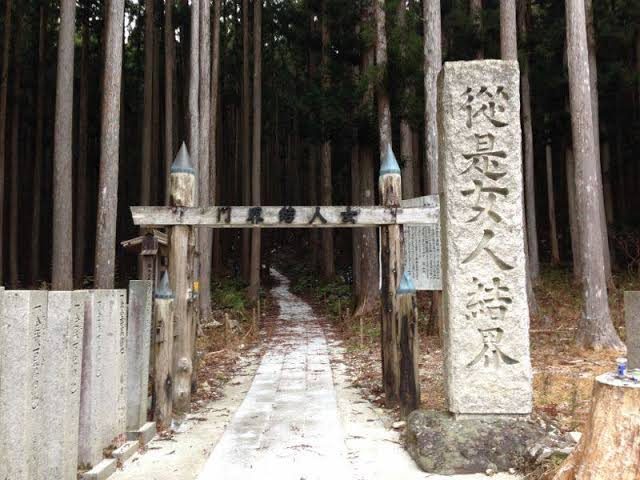
FactMount Omine is one of the few mountains in Japan that still keeps a "nyonin kekkai" (women's boundary), banning women from entering the area around Mount Sanjogatake. At the trailhead stands the "Nyonin Kekkai Gate", with a stone monument inscribed "Kore yori nyonin kekkai" (Women's boundary from this point). In the Meiji era the ban on women was lifted on many sacred mountains, and at Mount Omine the boundary was reduced in 1970, but the boundary around Mount Sanjogatake remains.
FactThe World Heritage inscription in 2004 sparked debate in Japan and abroad over whether "shutting women out of a heritage shared by all humanity is discrimination", with petitions against the ban and attempts by women's groups to climb the mountain. The temple and local believers' associations, on the other hand, have made clear that they will keep the boundary as a "religious tradition". How to weigh tradition against equality is a question that remains unanswered.
Look for this: Dorogawa Onsen and darani-suke
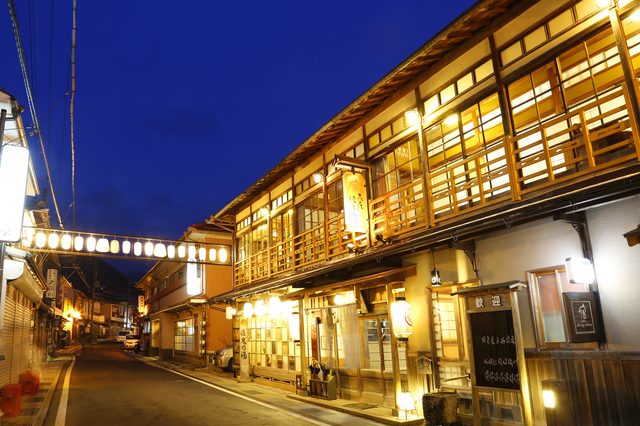
Dorogawa in Tenkawa Village, at the trailhead for Mount Omine, is a post town that has long lodged yamabushi and members of the ko. Wooden inns line the street, and at night lanterns glow under the eaves. The local speciality, "darani-suke", is a bitter stomach medicine made by boiling down the bark of the Amur cork tree and other ingredients, and Legend says it was first made by En no Gyoja. The name is also said to come from practitioners chanting darani (sutras) to bear its bitterness.
Tenkawa Daibenzaiten Shrine: home of the god of the performing arts
FactTenkawa Daibenzaiten Shrine (Tenkawa Shrine) in Tsubonouchi, Tenkawa Village, is said to have begun when En no Gyoja enshrined the goddess Benzaiten as the guardian of Mount Omine. Because Benzaiten is regarded as a goddess of the performing arts and music, the shrine has deep ties to the Kanze family of Noh theatre, and many Noh masks and costumes have been handed down here. Even today it is known for visits by musicians and actors.
LikelyDuring the Northern and Southern Courts period, emperors and members of the imperial family of the Southern Court are said to have taken refuge in Tenkawa, and the area has deep links with the Southern Court (see Mount Yoshino).
Main sources: Omine-sanji / Tenkawa Village tourism materials on Dorogawa Onsen / Agency for Cultural Affairs, Cultural Heritage Online, "Sacred Sites and Pilgrimage Routes in the Kii Mountain Range" / Shoku Nihongi, entry for the 5th month of Monmu 3