Home / Todai-ji and the Great Buddha
Todai-ji and the Great Buddha of Nara
In the Nara period, with the country shaken by epidemic, famine and rebellion, Emperor Shomu declared he would build a Great Buddha "even if it meant melting down all the copper in the land". It was a national project said to have involved a total of 2.6 million people. The Great Buddha has burned twice, and each time it has risen again through people's donations.
World HeritageHistoric Monuments of Ancient Nara (1998)
Labels: Factdocumented Likelysupported by most sources Legendoral tradition Urban legendlocal lore and rumour
"It is We who possess the wealth of the realm"
FactIn the 10th month of Tenpyo 15 (743), Emperor Shomu issued his edict to build the Great Buddha from the Shigaraki Palace in Omi. The edict declares his own power, "Tenka no tomi o tamotsu mono wa chin nari, tenka no ikioi o tamotsu mono mo chin nari" (It is We who possess the wealth of the realm, and We who possess its power), and then includes a line saying that anyone who wishes to help, even by bringing "a single blade of grass or a handful of earth", should be allowed to. The idea was that this Buddha would be made not just by state order but with the people taking part.
FactAt this time Japan had been hit by a great smallpox epidemic (735–737) that killed even the four Fujiwara brothers, and in Kyushu the Rebellion of Fujiwara no Hirotsugu (740) had broken out. Emperor Shomu moved the capital from Kuni-kyo to Naniwa-kyo to the Shigaraki Palace before finally returning to Heijo-kyo in 745, where he began building the Great Buddha in earnest on the site of today's Todai-ji.
FactThe monk Gyoki, popular among ordinary people, had once been banned by the court from his activities, but he was appointed to lead the fundraising (kanjin) for the Great Buddha and later became Japan's first Daisojo (Grand Archbishop).
A golden Buddha in a land without gold
FactCovering the Great Buddha in gold required a huge amount of the metal, but at the time it was thought that no gold could be mined in Japan. In 749 word arrived that gold had been found in Mutsu Province (today's Miyagi Prefecture), and the provincial governor, Kudara no Konikishi Kyofuku, presented 900 ryo of gold (about 13 kg). Emperor Shomu was so delighted that he even changed the era name to "Tenpyo Kanpo".
FactOn the 9th day of the 4th month of Tenpyo Shoho 4 (752), the eye-opening ceremony was held. The Indian monk Bodhisena painted in the Buddha's eyes with a brush, and the crowds gathered there are said to have held a cord tied to that brush to share in the merit. This cord (the kaigen-ru) still survives in the Shoso-in (see Shoso-in).
Two fires and an Edo-period revival
FactIn 1180 (Jisho 4), during the Genpei War, the army of Taira no Shigehira burned Nanto (Nara), and both the Great Buddha Hall and the Great Buddha were destroyed. The monk Chogen travelled the country collecting donations and, with the help of the Song Chinese craftsman Chen Heqing, achieved the eye-opening of the Buddha in 1185 and the dedication of the Great Buddha Hall in 1195.
FactIn 1567 (Eiroku 10), the Great Buddha Hall burned again in fighting between Matsunaga Hisahide and the Miyoshi Triumvirate. The Buddha's head was temporarily patched with copper sheets and covered with a temporary hall, but after that hall was blown down in a storm in 1610, the Buddha sat exposed to the rain for nearly 80 years. In the Edo period, the monk Kokei ran fundraising campaign after campaign, finally achieving the Buddha's eye-opening in 1692 and the dedication of today's Great Buddha Hall in 1709.
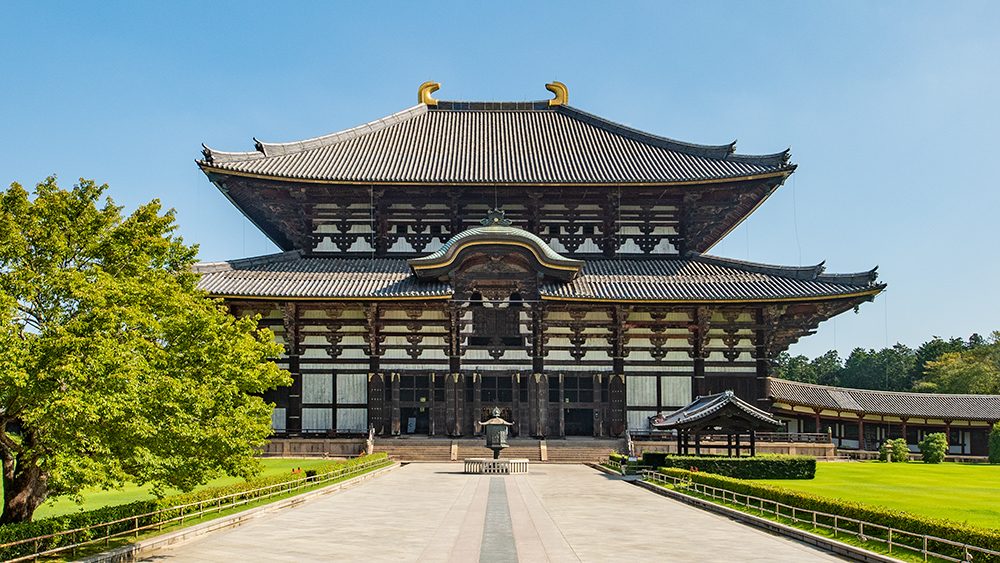
FactToday's Great Buddha Hall is about 49 m tall to the ridge and about 57 m wide at the front, one of the largest wooden buildings in the world. Even so, there was not enough money, and its front was reduced to about two-thirds the width of the Nara-period hall. The Buddha, too, keeps Nara-period parts in its pedestal and some of its body, but the head dates from the Edo period.
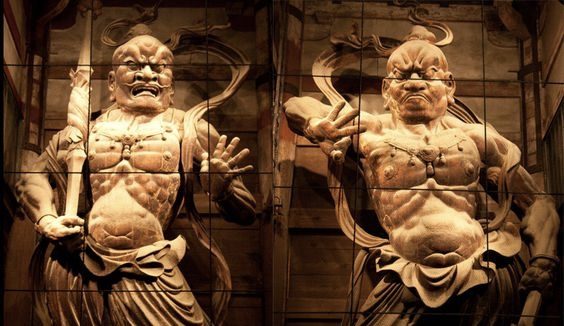
The Nio guardians of the Great South Gate, made in 69 days
FactThe Great South Gate was rebuilt in the Kamakura period and is the classic example of the "Daibutsuyo" style, which drew on the architecture of Song China. The Kongo Rikishi statues (Nio guardians), about 8.4 m tall and standing on either side of the gate, were completed by Unkei, Kaikei and others in 1203 in just 69 days. During restoration work in 1988–93, ink inscriptions bearing the names of Unkei, Kaikei and others were found inside the statues.
Look for this: crawling through the pillar
At the base of a pillar in the northeast of the Great Buddha Hall is a square hole. Crawling through it is said to bring good health, and school-trip students and overseas visitors line up to try. The story that "the hole is the same size as the Great Buddha's nostril" is famous, but there is no record of anyone checking (see Legends).
Omizutori at Nigatsu-do: over 1,270 times, never once interrupted
FactAt Nigatsu-do, the hall on the high ground east of the Great Buddha Hall, the "Shuni-e", commonly called Omizutori, is held every year from 1 to 14 March. It is said to have been started in 752 by the Todai-ji monk Jitchu, and it was not interrupted even in the years when war burned the Great Buddha Hall. By 2026 it had been held more than 1,270 times. It is called "the ritual that never retreats".
FactAt night, huge torches (taimatsu) that light the monks' way as they climb to the hall are run along the balcony railing, scattering sparks: a seasonal sight that tells Nara spring is coming. Late on the night of the 12th comes the "Omizutori" (water-drawing) rite itself, in which water is drawn from the Wakasai well below the hall as an offering to Kannon.
LegendThe story goes that when the gods of the whole country were summoned at the start of the first Shuni-e, only Onyu Myojin of Wakasa Province (Fukui Prefecture) arrived late, having been too absorbed in fishing, and promised to send water from Wakasa as an apology. That, it is said, was the origin of the Wakasai well. In Obama City, Fukui Prefecture, the "Omizuokuri" (water-sending) ceremony, which sends water to Nara, is still held every year on 2 March.
Main sources: Todai-ji official website / Shoku Nihongi, entries for the 10th month of Tenpyo 15 and the 4th month of Tenpyo Shoho 4 / Agency for Cultural Affairs, Database of National Cultural Properties / Nara National Museum