Home / Prince Shotoku and Ikaruga
Prince Shotoku and Ikaruga
The farmland spreading east and north of Horyu-ji is Ikaruga, the village where Prince Shotoku built his palace at the start of the 7th century. Temples now stand on the sites of the palaces where the prince's family lived, and three pagodas still rise beyond the rice fields.
World HeritageBuddhist Monuments in the Horyu-ji Area (1993)
Labels: Factdocumented Likelysupported by most sources Legendoral tradition Urban legendlocal lore and rumour
Why Ikaruga, so far from the capital?
FactAccording to the Nihon Shoki, Prince Shotoku (Prince Umayado, 574–622) began building a palace at Ikaruga in the 9th year of Suiko (601) and moved there in 605. The capital at the time was Asuka, about 20 km to the southeast. The prince was a central figure in government: he established the twelve-level cap rank system (603) and the Seventeen-Article Constitution (604), and in 607 sent Ono no Imoko as envoy to Sui China.
LikelyIkaruga lay on the banks of the Yamato River, a key point on the river and land routes from the port of Naniwa (Osaka) to Asuka. The prince is thought to have placed his base where it was easy to receive envoys and goods from the Asian mainland and the Korean Peninsula. Another view is that he wanted to keep a little distance from Asuka, the home base of the Soga clan.
The tragedy of the prince's family
FactIn 643, 21 years after the prince's death, soldiers of Soga no Iruka attacked the Ikaruga Palace. The Nihon Shoki tells us that the prince's son, Prince Yamashiro no Oe, first fled to Mount Ikoma, but to avoid dragging the common people into war he returned to Ikarugadera (Horyu-ji), where he and his whole family took their own lives. The prince's bloodline ended there.
FactThe Eastern Precinct of Horyu-ji (the Yumedono) was later built on the site of the Ikaruga Palace (see Horyu-ji).
Hokki-ji: the oldest surviving three-storey pagoda
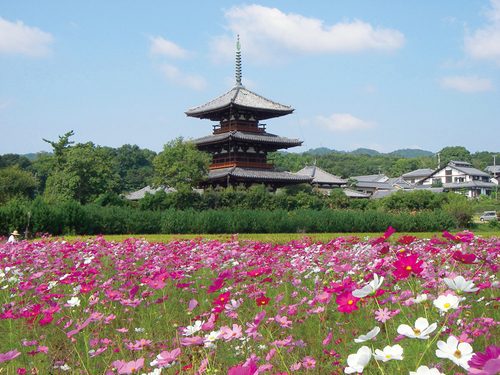
FactAbout 1.5 km northeast of Horyu-ji stands Hokki-ji, said to have been converted into a temple from the Okamoto Palace, where the prince lectured on the Lotus Sutra. Its three-storey pagoda (about 24 m tall) is the oldest surviving three-storey pagoda in Japan. It is said to have been completed in 706, but the inscription on the pagoda's roof base that recorded this has been lost, and the date rests on records copied into later books. Hokki-ji is a component of the World Heritage site along with Horyu-ji.
FactIts layout is unusual too. It is a mirror image of Horyu-ji, which has its Golden Hall in the east and pagoda in the west: here the pagoda is in the east and the Golden Hall in the west, an arrangement known as the "Hokki-ji style".
Chugu-ji: a smile with a finger to the cheek
FactChugu-ji, a nunnery just east of the Yumedono, is said to have been converted into a temple from the palace of the prince's mother, Empress Anahobe no Hashihito. Its principal image, a half-seated bodhisattva (National Treasure, known at the temple as Nyoirin Kannon), is a wooden statue with the right foot resting on the left knee, smiling with the fingertips of the right hand gently touching the cheek.
Urban legendThe statue's expression is held up as a classic "archaic smile", and it is sometimes introduced as one of the "three great smiles of the world", alongside the Mona Lisa and the Sphinx of Egypt. But who decided on these "three great" smiles, and when, is unclear.
Horin-ji: the pagoda a writer rebuilt
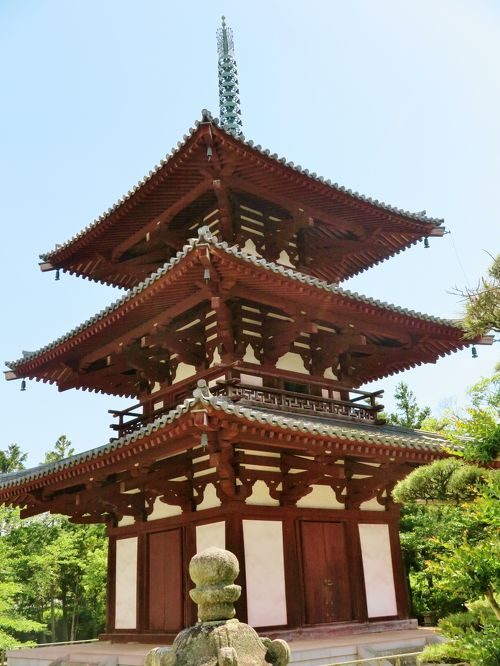
FactHorin-ji, west of Hokki-ji, also once had an Asuka-style three-storey pagoda (a National Treasure). But in July 1944 (Showa 19) it was struck by lightning and burned down.
FactThe person who worked hardest to raise money for its rebuilding was the writer Koda Aya (daughter of Koda Rohan). In the hands of the temple carpenter Nishioka Tsunekazu and others, the pagoda was reborn in 1975. Of Ikaruga's three pagodas, one came back thanks to the passion of people after the war.
Look for this: the road where you can see three pagodas
Walk the road through the rice fields from Horyu-ji's Eastern Precinct to Horin-ji and Hokki-ji, and Ikaruga's three pagodas come into view one after another. In autumn, cosmos flowers bloom around Hokki-ji, and people gather to photograph the pagoda among the flowers.
Did Prince Shotoku really exist?
LikelyIn the 1990s, a theory that the superhuman figure of "Prince Shotoku" was created in later times attracted attention. Today, many scholars accept that a royal named Prince Umayado really existed and was deeply involved in government. On the other hand, stories such as "he could listen to ten people's petitions at once and tell them all apart" are Legend, born from the later cult of devotion to the prince.
Main sources: Official information from Hokki-ji, Chugu-ji and Horin-ji / Ikaruga Town, "History of Ikaruga" / Nihon Shoki, chronicles of Suiko and Kogyoku / Agency for Cultural Affairs, Database of National Cultural Properties