Home / Nara Park and its deer
Nara Park and Its Deer
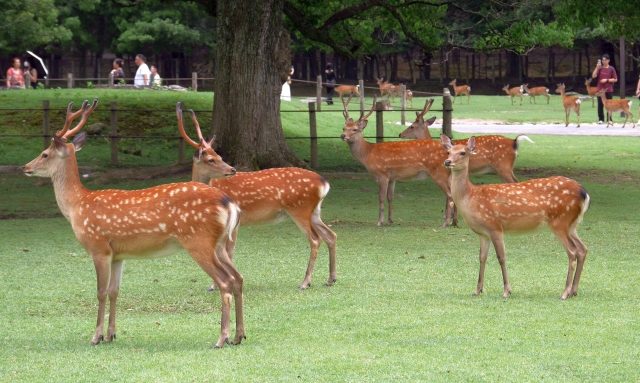
In Nara Park, deer cross the road, poke their heads into shops and bow to anyone holding deer crackers. They are used to people, but nobody keeps them. All of the roughly 1,700 deer are wild animals and a national Natural Monument. There is hardly anywhere else in the world where people and wild animals live side by side like this in the middle of a city.
Labels: Factdocumented Likelysupported by most sources Legendoral tradition Urban legendlocal lore and rumour
Sacred deer, messengers of the gods
LegendWhen Kasuga Taisha was founded in 768, the god Takemikazuchi no Mikoto, welcomed from Kashima Jingu in Hitachi Province, is said to have come to Mt. Mikasa in Nara riding a white deer (see Kasuga Taisha). For this reason the deer of Nara have long been cherished as divine messengers, "shinroku" (sacred deer).
FactIn the medieval period, under the power of Kasuga Taisha and Kofuku-ji, the deer were strictly protected, and anyone who hurt or killed one faced severe punishment. In the Edo period, too, the deer continued to be protected under the Nara magistrate.
The tale of "ishikozume"
LegendNara has a sad tale of a child who accidentally killed a deer and was punished by "ishikozume": he was put into a pit with the deer's body and buried under stones. Near the grounds of Kofuku-ji is the "Sansaku Ishikozume Site", said to mourn that child, Sansaku. There is no reliable record that such a punishment was ever actually carried out (see Legends).
Antler cutting since the Edo period
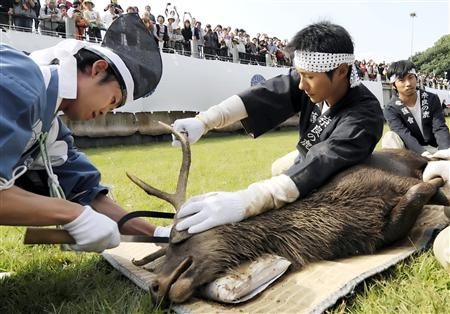
FactIn autumn, the antlers of stags grow hard, and the risk of them injuring people rises. In 1671, the Nara magistrate Mizoguchi Nobukatsu began cutting the deer's antlers to protect the townspeople. This is the origin of the "Shika no Tsunokiri" (deer antler cutting), still held every October at the Rokuen deer enclosure in the grounds of Kasuga Taisha. Handlers called seko catch the stags with ropes, and a Shinto priest cuts off the antlers.
Deer crackers and the "bow"
FactShika senbei (deer crackers) are sugar-free snacks made just for deer from rice bran and wheat flour. Part of the sales goes to running the Nara Deer Preservation Foundation, which protects the deer. The deer's main food is the park's grass and tree leaves; the crackers are only a treat. Feeding them human food or sweets can make them ill.
LikelyShow a deer a cracker and it will nod its head up and down in a "bow". It looks polite, but one view is that the movement comes from a stag thrusting out its antlers to threaten a rival, or from sizing up the other party. It has also been observed that when people bow, the deer bow back, so perhaps it is a kind of "conversation" born from the long relationship between people and deer.
Look here: "Shika-yose" (deer calling)
At the "shika-yose" held by the Nara Deer Preservation Foundation on winter mornings and at other times, a natural horn plays a passage from Beethoven's Sixth Symphony, the "Pastoral", and deer come running out of the depths of the forest. It is said to have begun in 1892, when deer were gathered with a bugle, and today it takes place at Tobihino on set dates.
Too many deer, and the future
FactIn 1945, at the end of the war, poaching rose amid food shortages, and the deer are recorded to have fallen to just 79. Protection after the war brought their numbers back, and the July 2026 survey counted 1,687, 222 more than the year before and a record high.
FactAt the same time, problems have grown: deer eating crops in fields, young trees failing to grow in the Kasugayama Primeval Forest, and accidents in which tourists are bitten or butted. In 2017 Nara Prefecture began capturing deer, but only around farmland outside the park. How should people live with deer that have been protected as messengers of the gods? A relationship that has lasted more than 1,000 years is entering a new phase.
Main sources: Nara Deer Preservation Foundation / Nara Prefecture, Nara Park Office / Kasuga Taisha official website / Agency for Cultural Affairs, Database of National Cultural Properties, "Deer of Nara"