Home / Persimmon-leaf sushi, narazuke and Miwa somen
Kakinoha Sushi, Narazuke and Miwa Somen
"There is nothing good to eat in Nara": this phrase, often quoted, is attributed to the writer Shiga Naoya, who lived in Nara. Yet the dishes born in this mountainous, landlocked land, from temple kitchens and the wisdom of ordinary people, are full of a history of preserving and ingenuity.
Labels: Factdocumented Likelysupported by most sources Legendoral tradition Urban legendlocal lore and rumour
Kakinoha sushi: mackerel from Kumano over the mountains
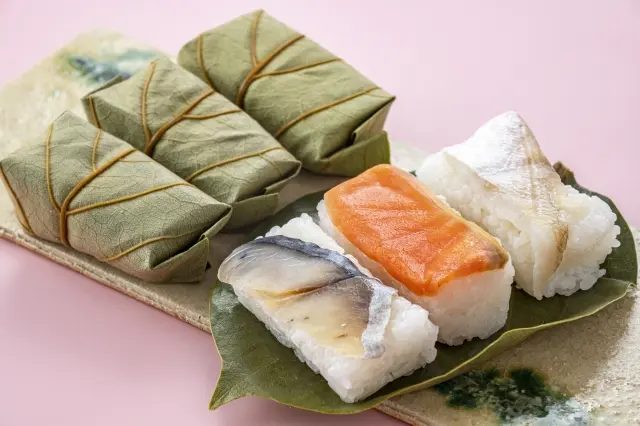
FactKakinoha sushi is bite-sized vinegared rice topped with a thin slice of salted mackerel, wrapped in a persimmon leaf and pressed. It has long been made as a festive dish for summer festivals along the Yoshino River in southern Nara Prefecture, in places such as Yoshino and Gojo.
LikelyIn the Edo period, mackerel caught in the Kumano Sea was cured with salt and carried over the mountains to landlocked Yoshino. It is thought the dish began when people sliced this salted mackerel thinly, laid it on vinegared rice and wrapped it in persimmon leaves, believed to have antibacterial properties, so that it would keep longer. Nara happened to be one of Japan's leading persimmon-growing areas, so there were plenty of leaves to go around. Today there are versions with salmon or sea bream too, and it is one of Nara's signature souvenirs.
Narazuke: did Prince Nagaya eat it too?
FactNarazuke is made by pickling melons and other vegetables in sake lees, changing the lees again and again. Among the wooden tablets excavated from the site of Prince Nagaya's residence in Heijo-kyo is one inscribed "kasuzuke uri" (melon pickled in lees), showing that melons were already being pickled in sake lees in the Nara period. The sake lees from Nara's temples, where brewing thrived, were put to use in pickles (see Born in Nara).
LikelyIn the Edo period, white melons pickled in lees came to be sold as a product in the town of Nara, and became known across Japan as "narazuke". Those pickled for years deepen to a tortoiseshell colour and carry the aroma of sake.
Miwa somen: noodles shaped by the winter cold
LegendMiwa (Sakurai City) is said to be the birthplace of hand-stretched somen, first made by a descendant of the god of Omiwa Shrine for people suffering from famine (see Mt. Miwa). The craft born in Miwa is said to have spread to places such as Banshu (Hyogo Prefecture), Shodoshima and Shimabara, carried by travellers such as pilgrims to Ise.
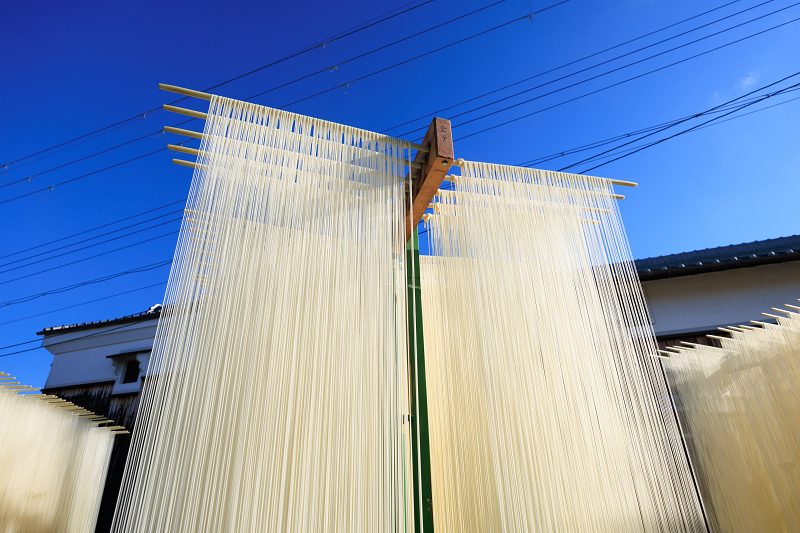
FactSomen is made in the cold of winter, when the air is dry. Wheat flour and salt water are kneaded, then stretched a little thinner at a time while being coated with oil and left to rest, again and again, before being hung on bamboo rods to dry. Noodles stored in a warehouse through the rainy season after being made are called "hinemono" (aged noodles) and are prized for their firmer texture.
Chagayu: mornings of "okaisan"
LikelyIn Nara homes, rice porridge cooked in hojicha or bancha tea is called "okaisan" and has long been a familiar breakfast. Some say it was a way to save rice; others that it comes from the porridge eaten by monks during the Omizutori ceremony at Todai-ji's Nigatsu-do Hall (see Todai-ji). The thin tea porridge is eaten with narazuke or pickled plums.
Look here: Yoshino hon-kuzu
In the Yoshino area, "Yoshino hon-kuzu", pure white starch drawn from the roots of wild kudzu growing in the mountains, has long been made. In "Yoshino-zarashi", the roots are crushed and soaked in water, and the starch that settles is washed in cold water and left to settle again and again; it is done in winter, when the water is cold. Kudzu is essential not only for kuzumochi, kuzukiri and kuzuyu (a hot kudzu drink) but also as a refined thickener in Japanese cuisine.
Main sources: Nara Prefecture, "Delicious Foods of Nara" / Ministry of Agriculture, Forestry and Fisheries, "Our Regional Cuisines" (Nara Prefecture) / Nara Prefecture Miwa Somen Industrial Cooperative / Nara National Research Institute for Cultural Properties, Wooden Tablet Database