Home / Yakushi-ji
Yakushi-ji
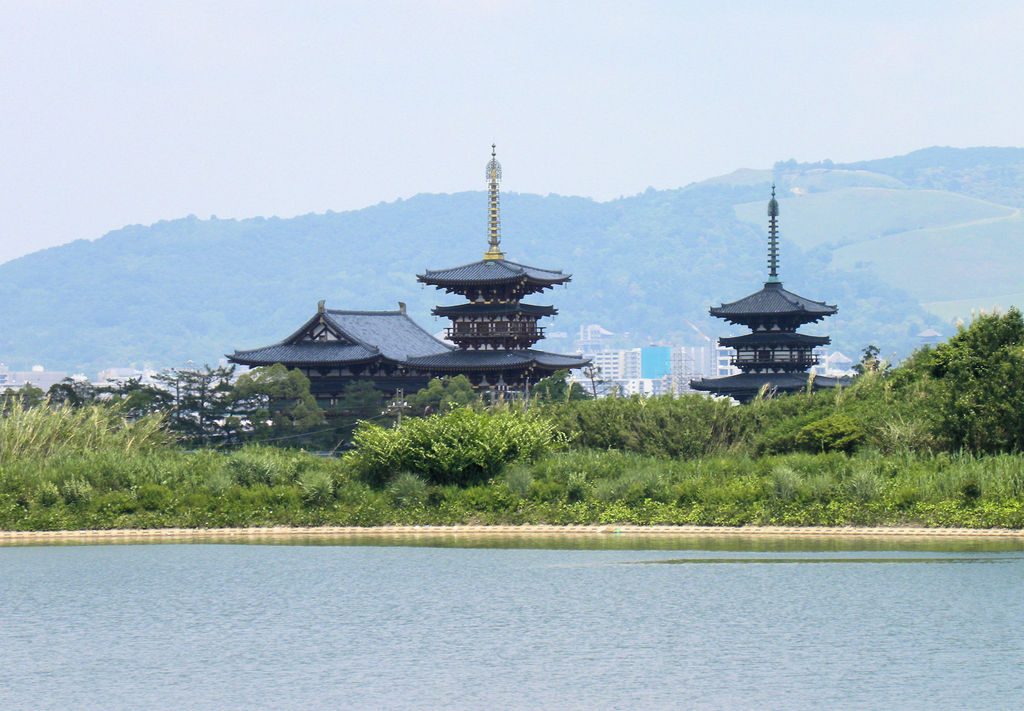
In Nishinokyo, Nara, two pagodas of different colours stand side by side. The weathered East Pagoda is the only building still standing from the Nara period, while the bright vermilion West Pagoda was built in 1981. The money that rebuilt the temple in the Showa era came from sutras hand-copied by more than a million people, one scroll at a time.
World HeritageHistoric Monuments of Ancient Nara (1998)
Labels: Factdocumented Likelysupported by most sources Legendoral tradition Urban legendlocal lore and rumour
A temple a husband built for his wife
FactIn Tenmu 9 (680), Emperor Tenmu vowed to build Yakushi-ji, praying for the recovery of his empress (later Empress Jito) from illness. The empress recovered, but Emperor Tenmu died in 686 without seeing the temple finished, and Empress Jito took over the work. The temple was first built in Fujiwara-kyo (Moto-Yakushiji, see Fujiwara-kyo), and after the move of the capital to Heijo-kyo it was relocated to its present site in Nishinokyo.
A three-storey pagoda that looks like six
FactAt first glance, the East Pagoda looks like a six-storey pagoda with six roofs. In fact each storey has a small extra roof called a "mokoshi" (pent roof), and structurally it is a three-storey pagoda. The large and small roofs alternate, creating a unique rhythm.
FactThe spire at the top of the pagoda carries an openwork ornament called the "suien" (water smoke). It is carved with flying celestial maidens (hiten) playing flutes and scattering flowers as they dance in the heavens.
LegendIt is said that although the ornament is shaped like flames, it is called "water smoke" because "fire" was avoided, so that the pagoda would not catch fire.
FactIn 2009 the East Pagoda began its first full dismantling repair in about 110 years. The work finished in December 2020, and a dedication ceremony was held in April 2023.
Whose words were "frozen music"?
Urban legendThe beauty of the East Pagoda has been praised as "frozen music", and the phrase is often introduced as the words of the American Ernest Fenollosa, who came to Japan in the Meiji era. However, no record of Fenollosa saying this has been confirmed. The expression "architecture is frozen music" itself is known to have been used in 19th-century Germany by the philosopher Schelling, the writer Goethe and others, and it is thought to have become attached to descriptions of the East Pagoda and spread from there.
A temple rebuilt with hand-copied sutras
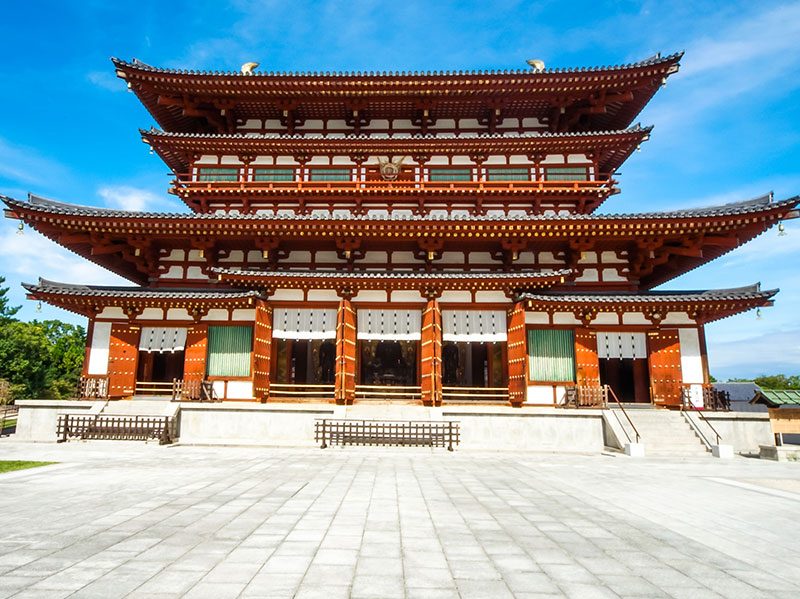
FactYakushi-ji lost its Golden Hall, West Pagoda and other buildings to fire during fighting in 1528, and for a long time made do with a temporary Golden Hall. Takada Koin, who became chief abbot (kanshu) in 1967, preached that "a people who prosper in things will perish in spirit", and launched a sutra-copying campaign, asking people across Japan to hand-copy the Heart Sutra, one scroll each, and offer it to the temple. The offering fee was 1,000 yen per scroll (at first). Takada, popular for his witty sermons to school-trip students, travelled all over the country calling for people to copy sutras.
FactWhen the copied sutras reached one million scrolls, the Golden Hall was rebuilt in 1976, followed by the West Pagoda in 1981. The revival of the Nara-period temple has continued since then with the Middle Gate, corridors, Great Lecture Hall and Refectory. Many of the buildings are the work of the master temple carpenter Nishioka Tsunekazu and others.
LikelyThe new West Pagoda was built about 30 cm taller than the East Pagoda. The explanation is that it was calculated so that, as the timber shrinks over the years, it will be the same height as the East Pagoda several hundred years from now.
Look for this: the Yakushi Triad in the Golden Hall
The Golden Hall's principal image, Yakushi Nyorai, and the Nikko and Gakko Bodhisattvas on either side (National Treasures) are bronze statues with a glossy black sheen. They took on this colour when fire stripped away their gold surface. The pedestal is carved with Greek-style grapevine scrolls, Persian-style patterns and the Four Guardian Beasts, showing how culture spread along the Silk Road.
Main sources: Yakushi-ji official website / Nihon Shoki, entry for the 11th month of Tenmu 9 / Nara Prefecture Office for the Preservation of Cultural Properties, materials on the conservation and repair of Yakushi-ji's East Pagoda / Agency for Cultural Affairs, Database of National Cultural Properties