Home / Toshodai-ji and Ganjin
Toshodai-ji and Ganjin
Ganjin (Jianzhen), a revered senior monk in Yangzhou in Tang China, answered the plea of two young monks from Japan and decided to cross the sea. Storms, betrayal, shipwreck: he failed five times, and finally set foot in Japan 12 years later, at the age of 66. Toshodai-ji is where Ganjin spent his last years.
World HeritageHistoric Monuments of Ancient Nara (1998)
Labels: Factdocumented Likelysupported by most sources Legendoral tradition Urban legendlocal lore and rumour
In search of someone who could make "proper monks"
FactIn Nara-period Japan, there was no end of people who became monks on their own to escape taxes and forced labour. To become a proper monk required "jukai", receiving the precepts before ten qualified monks, but Japan did not have enough monks able to perform the ceremony.
FactIn 733, two young monks, Yoei and Fusho, joined an embassy to Tang China, charged with inviting a master of the precepts to Japan. After searching in China for nearly ten years, in 742 they reached Daming Temple in Yangzhou and found Ganjin (688–763), who was already 55. It is said that Ganjin asked his disciples, "Will anyone go?", and when no one came forward, decided to go himself.
Five failures
FactThe first plan failed when a disciple who disapproved of the voyage informed the authorities. When they rebuilt a ship, they met a storm; they were stopped and held for trying to leave the country; and on the fifth attempt, in 748, they drifted for 14 days before washing up on Hainan Island, far to the south. On the way back, Yoei fell ill and died.
LikelyThrough these repeated hardships, Ganjin is said to have suffered an eye disease and lost his sight. However, there are records that seem to show Ganjin signing documents after he came to Japan, so whether he was completely blind is debated.
FactIn 753, Ganjin secretly boarded a ship carrying the Japanese embassy home, and on his sixth attempt he finally landed at Akitsumaya-no-ura in Satsuma Province (today's Akime, Bonotsu-cho, Minamisatsuma City, Kagoshima Prefecture). The following year, 754, he entered Heijo-kyo, and at an ordination platform set up in front of Todai-ji's Great Buddha Hall he gave the precepts to the retired Emperor Shomu, Empress Dowager Komyo and others.
"The Tang shodai": a temple where monks gather from all directions
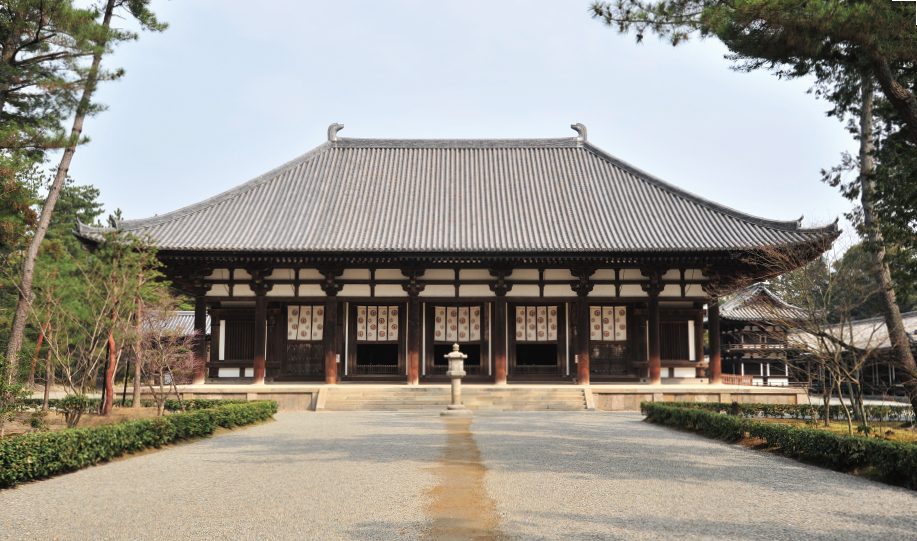
FactIn 759, Ganjin opened a training hall for studying the precepts on the site of the former residence of Prince Niitabe, granted to him by the court. This was Toshodai-ji. "Shodai" is a phonetic rendering of a Sanskrit word meaning "the four directions", and refers to a place where monks gathered from all directions live and practise. "Toshodai-ji" means "the shodai of the Tang monk (Ganjin)".
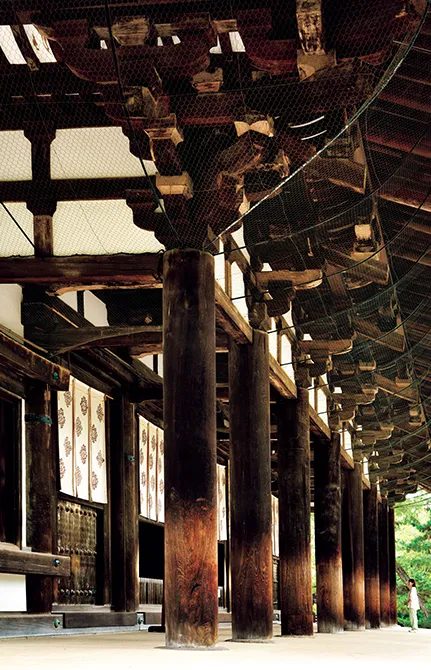
FactThe Golden Hall (National Treasure) was built in the late 8th century, after Ganjin's death (a tree-ring survey of its timbers found wood felled in 781), and it is the only surviving Golden Hall of a temple built in the Nara period. Its signature feature is the open space at the front lined with eight thick round columns, and it was dismantled and repaired in the "Great Heisei Restoration" of 2000–2009. The Lecture Hall was moved from the Chosyuden (assembly hall) of the Heijo Palace, and is the only surviving building of the Heijo Palace.
Look for this: the seated statue of Ganjin and the Mieido
The dry-lacquer seated statue of Ganjin (National Treasure), made by his disciples in their master's likeness just before he died in 763, is considered the oldest portrait sculpture in Japan. Its quiet figure with closed eyes moved Matsuo Basho to write the haiku "Wakaba shite / onme no shizuku / nuguwabaya" (With young green leaves, I would wipe the tears from your eyes). The statue is kept in the Mieido hall and shown only for three days around the founder's memorial in June each year. Since 2013, an "omigawari-zo", a replica made in almost the same form, has been on permanent display in the Kaizando hall.
The bond with China continues
FactIn 1980, the seated statue of Ganjin made a "homecoming" to China and was shown in Yangzhou and Beijing. At Daming Temple in Yangzhou, where Ganjin decided to come to Japan, stands the Jianzhen Memorial Hall, modelled on the Golden Hall of Toshodai-ji. In the grounds of Toshodai-ji grows a qionghua tree presented by Yangzhou, which blooms with white flowers every spring.
Main sources: Toshodai-ji official website / To Daiwajo Toseiden (by Omi no Mifune) / Shoku Nihongi, entry for the 5th month of Tenpyo Hoji 7 / Agency for Cultural Affairs, Database of National Cultural Properties