Home / Fujiwara-kyo
Fujiwara-kyo
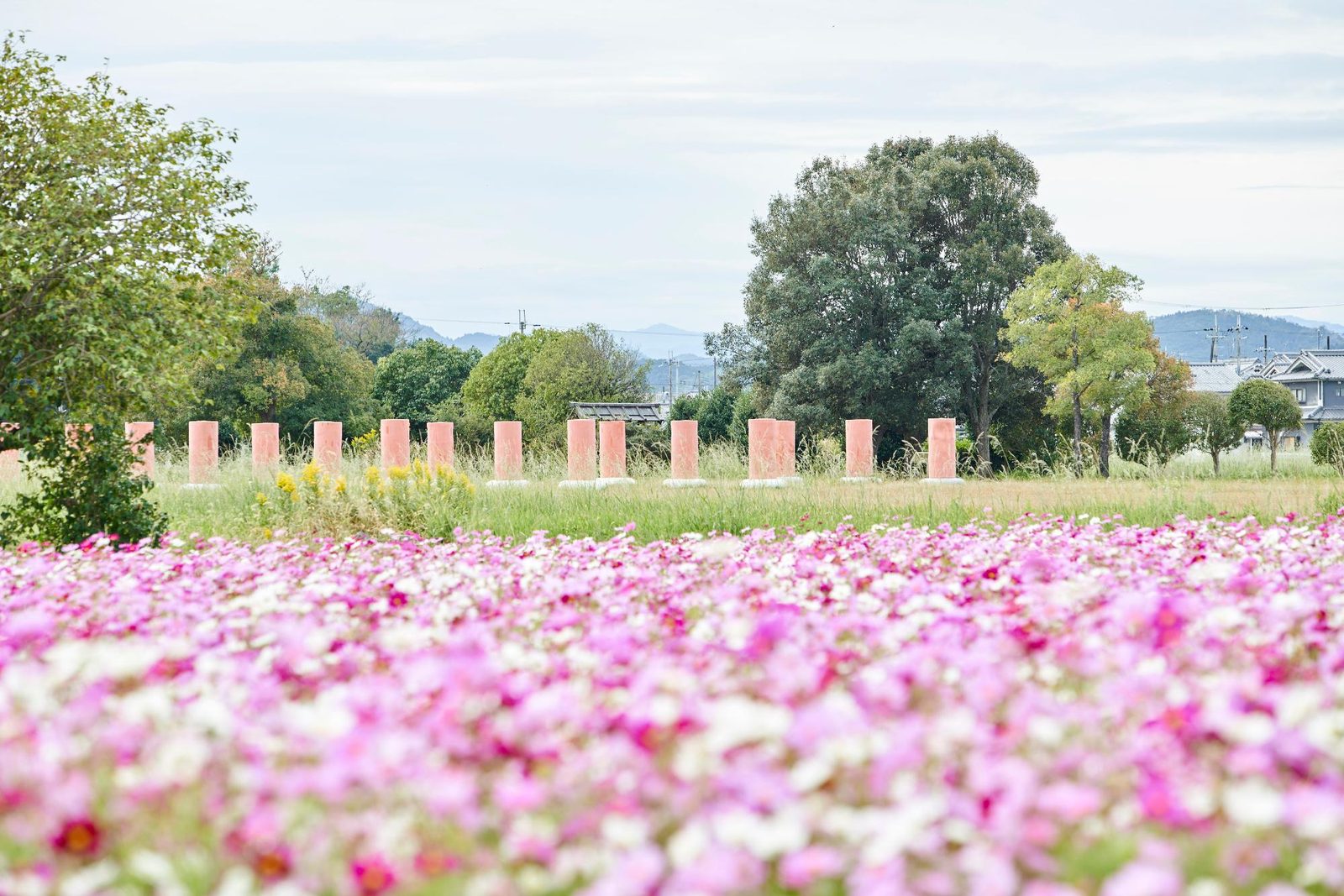
Amid the farmland of Kashihara lies a wide grassy field with rows of posts marking where pillars once stood. This is the Fujiwara Palace Site. In 694, Empress Jito built Japan's first true capital here, with streets laid out in a grid. Yet this capital was abandoned after just 16 years.
World HeritageAsuka-Fujiwara: Archaeological Sites of Japan's Ancient Capitals (2026)
Labels: Factdocumented Likelysupported by most sources Legendoral tradition Urban legendlocal lore and rumour
A capital that did not move with each new ruler
FactUntil then, in the Asuka period, it was normal for the sovereign's palace to move to a new site with each new reign (see Asuka). Emperor Tenmu planned a permanent capital suited to a centralised state governed by ritsuryo (written law codes). After Tenmu's death, Empress Jito took over the plan and moved the capital to Fujiwara-kyo in the 12th month of 694.
FactFujiwara Palace, the heart of the capital, was placed among the "Three Mountains of Yamato": Mt. Kagu, Mt. Unebi and Mt. Miminashi. At its centre stood buildings such as the Daigokuden (Great Audience Hall), with tiled roofs and pillars set on foundation stones. Earlier palaces had pillars sunk straight into the ground and roofs of boards or cypress bark; this was the first palace with tiled roofs.
Bigger than Heijo-kyo?
LikelyFujiwara-kyo was once thought to measure about 2 km east to west and about 3 km north to south. In the 1990s, however, traces of the capital's roads kept turning up outside that area, and the "Greater Fujiwara-kyo" theory gained ground: the city was a square about 5.3 km on each side, with the palace at its centre. If so, Fujiwara-kyo was larger than Heijo-kyo or Heian-kyo, the largest capital of ancient Japan.
LikelyPlacing the palace in the middle of the city is thought to follow the ideal capital described in the Chinese classic Rites of Zhou. It differed from Tang-dynasty Chang'an, which put the palace at the northern end.
Why was it abandoned after 16 years?
FactIn 710, Empress Genmei moved the capital to Heijo-kyo (see Heijo-kyo). Japan's first true capital had served its purpose for only 16 years.
LikelySeveral reasons have been suggested. An envoy to Tang China sent in 702 came back having seen the Tang capital of Chang'an for the first time in more than 30 years. One theory is that a layout like Chang'an's, with the palace at the northern end, was felt to better display the authority of the emperor. Other theories say the palace at the city's centre sat on lower ground with poor drainage, so that the capital's waste water flowed into it, or that new political leaders such as Fujiwara no Fuhito had their own aims.
Daikan-daiji and Moto-Yakushiji: ruins of the capital's great temples
FactFujiwara-kyo had great temples such as Daikan-daiji, a state temple, and Yakushi-ji, founded by vow of Emperor Tenmu. At the Daikan-daiji site, the platform of a huge pagoda thought to have had nine storeys has been found. Yakushi-ji moved to Heijo-kyo (see Yakushi-ji), and the temple site left behind in Fujiwara-kyo is called the Moto-Yakushiji Site, where foundation stones of the main hall and the east and west pagodas remain among the rice fields. Both are World Heritage component sites.
Look here: a palace site ringed by the Three Mountains of Yamato
Stand on the site of the Daigokuden platform at the Fujiwara Palace Site, and you can see Mt. Kagu to the east, Mt. Miminashi to the north and Mt. Unebi to the west. The Man'yoshu poetry anthology contains many poems about this place, including Empress Jito's "Haru sugite natsu kitarurashi shirotae no koromo hoshitari Ame no Kaguyama" (Spring has passed and summer seems to have come; white robes are hung out to dry on heavenly Mt. Kagu). In season, part of the palace site becomes fields of cosmos or rapeseed flowers.
Main sources: Nara National Research Institute for Cultural Properties, Fujiwara Palace Site Exhibition Room / Kashihara City, materials on the Fujiwara Palace Site / Nihon Shoki, 12th month of the 8th year of Empress Jito / Agency for Cultural Affairs, World Heritage nomination dossier for "Asuka-Fujiwara: Archaeological Sites of Japan's Ancient Capitals"