Home / Tama and Musashino
19 — TAMA
Tama and Musashino
The Tama area makes up about half of Tokyo's land area. In ancient times it was home to the provincial capital of Musashi; in the Edo period it was the shoguns' falconry ground; and at the end of the shogunate it produced the Shinsengumi. Then, in the Meiji era, Tama was moved from Kanagawa Prefecture to Tokyo "to protect Tokyo's water". This is the history of another Tokyo, with a flavour quite different from the 23 wards.
Labels: Factdocumented Likelysupported by most sources Legendoral tradition Urban legendlocal lore and rumour
Fuchu and Kokubunji: an ancient capital
FactIn the Nara period, the kokufu (provincial government office) of Musashi Province — which covered today's Tokyo and Saitama and part of Kanagawa — was located in what is now Fuchu City. The place name "Fuchu" comes from this: "the place where the provincial capital is". Fuchu's Okunitama Shrine is the soja, the shrine that brings together the gods of Musashi Province, and its "Kurayami Matsuri" ("darkness festival") every May is known for its procession of mikoshi (portable shrines) through the dark of night.
FactOf the kokubunji (provincial temples) built across the country on the orders of Emperor Shomu, the one for Musashi Province stood in what is now Kokubunji City. The site of the vast temple has been excavated and is a national historic site. In ancient times, the centre of Tokyo's history lay in Tama.
Tama was originally part of Kanagawa
FactIn the early Meiji era, the Tama area (the "Santama", or three Tamas: Nishitama, Minamitama and Kitatama) belonged to Kanagawa Prefecture. But in 1893 the Santama were transferred to Tokyo Prefecture.
LikelyOne of the main reasons is thought to have been protecting Tokyo's water source. With the upper reaches of the Tama River — the source of the Tamagawa aqueduct that carried Tokyo's drinking water — lying in Kanagawa Prefecture, managing the water was difficult. At the same time, the Santama were then a stronghold of the Freedom and People's Rights Movement, and it is said there was also a political aim of weakening its influence.
The Tamagawa aqueduct and the Tamagawa brothers
FactIn 1653 the Tamagawa aqueduct was completed, drawing water about 43 km from Hamura on the Tama River to Yotsuya Okido. The work is said to have been contracted to the brothers Tamagawa Shoemon and Seiemon, who made use of a very slight difference in height to carry the water by natural gradient alone, without pumps. Its water sustained the daily lives of the people of Edo (the Life in a City of a Million room).
Home of the Shinsengumi
FactMany of the leading figures of the Shinsengumi, the special police force active in Kyoto at the end of the shogunate, came from Tama. Its commander Kondo Isami was from what is now Chofu City, and its vice-commander Hijikata Toshizo from what is now Hino City; Okita Soji's family and Inoue Genzaburo also had ties to Hino. Farmers in Tama studied the Tennen Rishin-ryu school of swordsmanship, and chose to live as samurai even though they were farmers. Hino City has the Shinsengumi Furusato History Museum.
FactIn the Edo period, Hachioji was home to the Hachioji Sennin Doshin ("Thousand Men of Hachioji"), who guarded the Koshu approach and kept order. Half farmers, half samurai, they also served as fire wardens at Nikko Toshogu.
Mt Takao and Okutama
FactMt Takao (599 metres) in Hachioji City can be reached from central Tokyo in about an hour by train. In 2007 it was awarded the top rating of three stars in the French Michelin travel guide, and hikers began coming from all over the world. Its annual number of climbers is said to be among the highest of any mountain in the world.
FactLake Okutama, created by the Ogochi Dam in Okutama Town (completed in 1957), is one of Tokyo's reservoirs. When the dam was built, many of the village's houses were submerged at the bottom of the lake.
Look here: the green path along the Tamagawa aqueduct
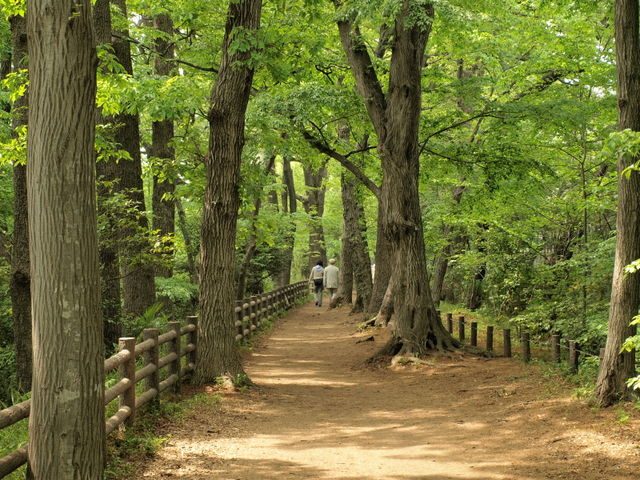
In places such as Kodaira and Mitaka, a green footpath runs alongside the Tamagawa aqueduct. This Edo-period man-made channel now looks like a brook flowing through woodland. Along the aqueduct in Mitaka there are also places associated with the writer Dazai Osamu.
Main sources: Tokyo Metropolitan Government, "The Transfer of the Santama to Tokyo Prefecture" / Tokyo Waterworks Historical Museum, "Tamagawa Aqueduct" / Hino City, "Shinsengumi Furusato History Museum" / Hachioji City / Fuchu City Kyodo-no-mori Museum