Home / Nihonbashi and the Five Highways
03 — NIHONBASHI
Nihonbashi and the Five Highways
In the Edo period, every road in the country began at this bridge. And even today, distances on Japan's national highways are measured from it. The bustle of the fish market, the trade of Echigoya, and an expressway that blocks out the sky overhead: this is the story of the bridge at the centre of Japan.
Labels: Factdocumented Likelysupported by most sources Legendoral tradition Urban legendlocal lore and rumour
1603: Japan's starting point
FactNihonbashi is said to have been first built in 1603, the year Ieyasu became shogun. The following year, 1604, the shogunate made Nihonbashi the starting point of the Five Highways (the Tokaido, Nakasendo, Nikko Kaido, Oshu Kaido and Koshu Kaido). Along the highways, ichirizuka distance mounds were built every ri (about 4 kilometres), and all distances were measured from Nihonbashi.
LikelyThere are several theories about the origin of the name "Nihonbashi" ("Japan Bridge"): that it was a bridge where people from all over Japan gathered, or that it was a bridge made of two logs (ni-hon, "two") laid across the river, among others. Nothing is known for certain.
The road zero marker — still the centre of Japan
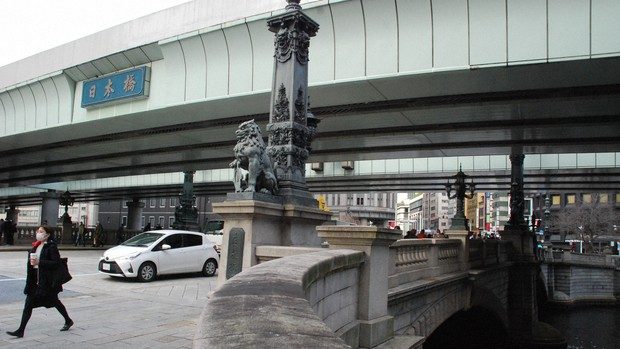
FactToday's Nihonbashi is a double-arched stone bridge built in 1911, and it is an Important Cultural Property of Japan. Set into the road in the middle of the bridge is the "Nihon Kokudo Genpyo", Japan's road zero marker, which marks the starting point of the national road network. Distances on the national highways from Tokyo to other parts of the country are counted from here.
Look here: the kirin, the lions and a replica of the zero marker
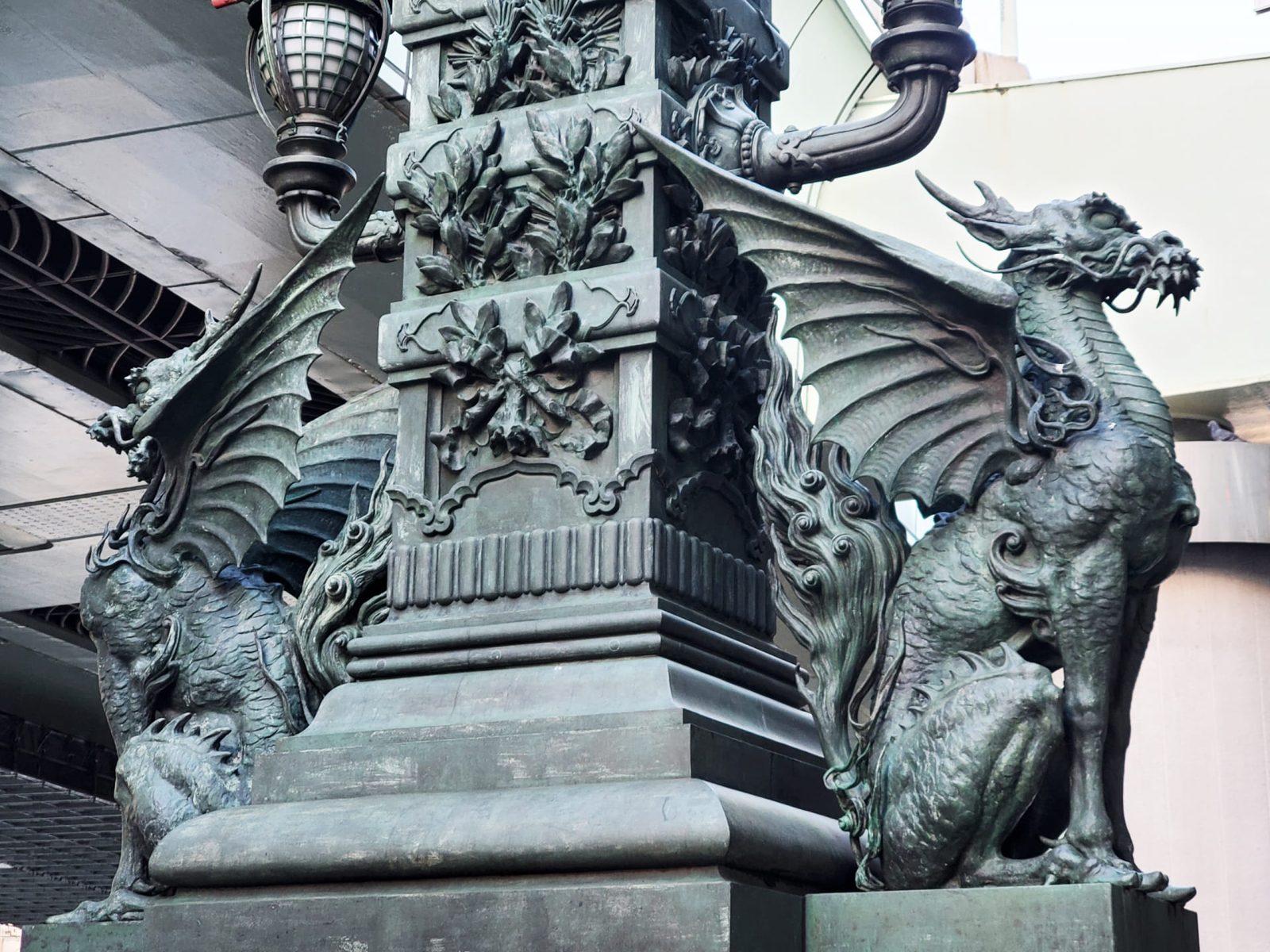
On the bridge's parapets are bronze statues of kirin (mythical beasts) and lions. The kirin have wings, which are said to express a wish to "take flight from Nihonbashi to the whole country." You cannot get close to the marker in the roadway, but a replica stands in the small square at the foot of the bridge, where you can see it up close.
The fish market and Echigoya
FactFrom the Edo period, there was a fish market (uogashi) at the foot of Nihonbashi. It is said to have begun when fishermen whom Ieyasu had brought from Tsukuda village in Osaka sold the fish left over after presenting their catch to the shogun. It was so busy that it was said "a thousand ryo in gold change hands here every day." After the Great Kanto Earthquake the fish market moved to Tsukiji, and in 2018 it moved to Toyosu (the Taste of Edo-mae room).
FactNorth of Nihonbashi stood Echigoya, the Mitsui family's kimono-fabric shop. It prospered with a way of selling that was new at the time — "cash, no mark-up" (genkin kakene nashi): selling for cash over the counter, with no haggling. Echigoya later became Mitsukoshi.
A bridge beneath the expressway
FactIn 1963, in preparation for the 1964 Tokyo Olympics, the Metropolitan Expressway was built directly above Nihonbashi. With neither the time nor the money to acquire land, the space above rivers was a convenient route for an expressway (the Rivers and Moats room).
FactCalls to "bring back the sky over Nihonbashi" continued for many years, and work to move the Metropolitan Expressway underground around Nihonbashi is now under way. Once the underground route is completed, the elevated road above the bridge is due to be removed.
"Leaving Nihonbashi at the seventh hour"
In the Edo period, travellers are said to have set out from Nihonbashi at the "seventh hour" of the morning (around 4 a.m.) and headed west along the Tokaido. This is sung about in the folk song "O-Edo Nihonbashi" ("O-Edo Nihonbashi nanatsu-dachi" — "Leaving Edo's Nihonbashi at the seventh hour"). Utagawa Hiroshige's ukiyo-e series The Fifty-three Stations of the Tokaido also begins, in its very first print, at Nihonbashi.
Main sources: Chuo City, "Nihonbashi" / Ministry of Land, Infrastructure, Transport and Tourism and Metropolitan Expressway Company, "Nihonbashi Section Undergrounding Project" / Isetan Mitsukoshi, "History of Mitsukoshi"