Home / From Edo to Tokyo
08 — FROM EDO TO TOKYO
From Edo to Tokyo
Fifteen years after the arrival of the Black Ships, the shogunate that had lasted 260 years fell, and Edo became "Tokyo." Why was a town of a million people spared from the flames of war? And how did Tokyo become Japan's capital? We trace Edo through the turbulent final years of the shogunate, the Bakumatsu.
Labels: Factdocumented Likelysupported by most sources Legendoral tradition Urban legendlocal lore and rumour
The Black Ships and Odaiba
FactIn 1853, a squadron of four ships led by the American Commodore Perry appeared off Uraga. Edo was thrown into such an uproar that a comic poem (kyoka) went the rounds: "Waking us from the sleep of great peace, the fine Jokisen tea — just four cups, and we cannot sleep at night" (泰平の眠りを覚ます上喜撰 たった四杯で夜も眠れず), a pun in which "Jokisen" also means "steamships" and "four cups" also means "four ships." To strengthen the defences of Edo Bay, the shogunate hurriedly built the Shinagawa Daiba, islands for gun batteries, off Shinagawa (the Reclaimed Land room).
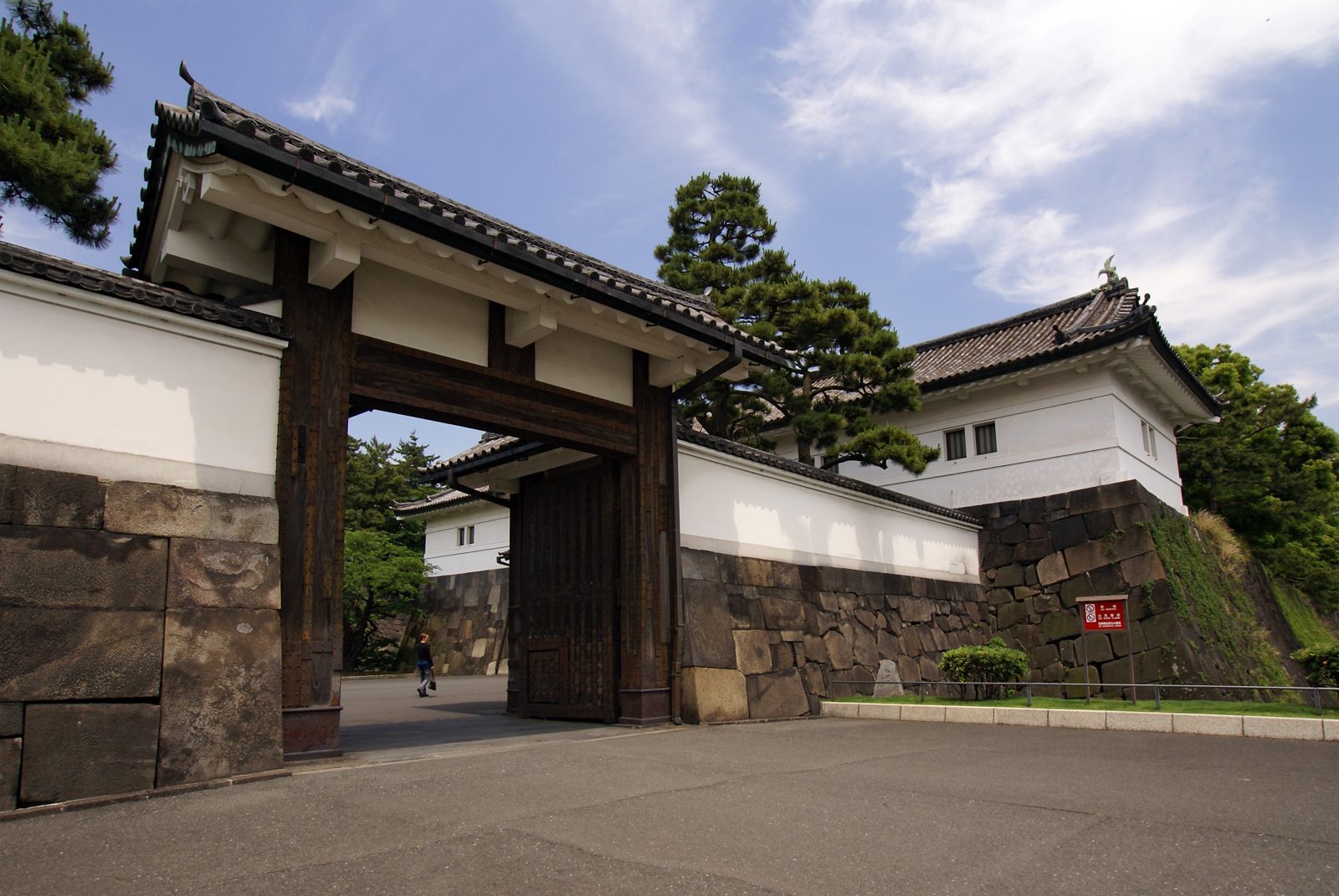
The Sakuradamon Incident
FactOn a snowy morning in March 1860, outside the Sakuradamon gate of Edo Castle, the chief minister (tairo) Ii Naosuke was attacked and killed by masterless samurai (ronin) from the Mito domain and others. They acted in anger at Ii, who had concluded a treaty with the United States without the Emperor's permission and had harshly punished those who opposed him. The killing of the shogunate's highest official on the shogun's very doorstep badly shook the shogunate's authority.
The bloodless surrender of Edo Castle
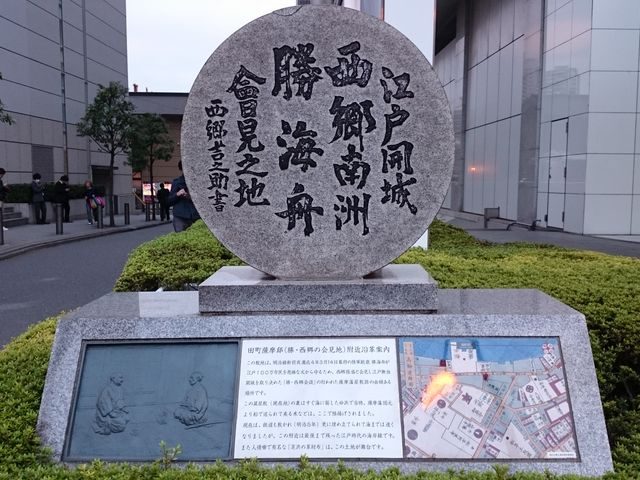
FactIn 1868, having won the Battle of Toba-Fushimi, the new government's army marched on Edo and set 15 March as the date for an all-out attack on Edo Castle. Just before that, on 13 and 14 March, Katsu Kaishu, for the shogunate, and Saigo Takamori, for the new government's army, held talks at the Satsuma domain's residence in Edo.
FactAs a result of their talks, the all-out attack was called off, and on 11 April, Edo Castle was handed over to the new government without a fight. This is known as the bloodless surrender of Edo Castle (Edo muketsu kaijo). The town of Edo, home to a million people, was spared from war.
Look here: the "meeting place" monument near Tamachi Station
Near JR Tamachi Station stands a monument inscribed "Site of the Meeting of Saigo Nanshu and Katsu Kaishu". At the time, this area was the Satsuma domain's warehouse residence, and the sea lay right in front of it. It was in this corner, now surrounded by office buildings, that the fate of Edo was decided.
The Shogitai and the Battle of Ueno
FactFormer retainers of the shogunate who could not accept the surrender formed the Shogitai and barricaded themselves inside Kan'ei-ji temple in Ueno. On 15 May 1868, the new government's army defeated the Shogitai in just one day, but many of Kan'ei-ji's buildings burned in the fighting. The burned-out grounds were later reborn as Ueno Park (the Ueno room).
The birth of "Tokyo," and the decree that never came
FactIn July 1868, Edo was renamed "Tokyo", meaning "the eastern capital" — the capital in the east, as opposed to Kyoto in the west. In September the era name changed to Meiji, and in October Emperor Meiji entered Tokyo for the first time. The Emperor returned to Kyoto for a while, then moved to Tokyo again in 1869 and remained there.
FactAt this time, no formal imperial decree was ever issued transferring the capital from Kyoto to Tokyo. For this reason, the event is sometimes called not a sento (transfer of the capital) but a tento, meaning "establishing an additional capital."
"The capital is actually still Kyoto"
Every so often, the story does the rounds that since no decree transferring the capital was ever issued, the legal capital is still Kyoto.
No law defines the capital
It is true that Japan has no law that directly states where the capital is. However, since the Diet, the government and the Imperial Palace are all in Tokyo, and it functions in practice as the capital, the general understanding is that Tokyo is the capital.
Main sources: National Archives of Japan, "From Edo to Tokyo" / Minato City, "Site of the Saigo–Katsu Meeting" / Tokyo Metropolitan Archives / Taito City, "The Battle of Ueno"