Home / Edo Castle and the Imperial Palace
01 — EDO CASTLE
Edo Castle and the Imperial Palace
Including its outer moat, Edo Castle is said to have measured some 16 kilometres around, making it one of the largest castles in Japan. Yet today there is no keep to be seen in the woods of the Imperial Palace. Why did the castle of the realm spend more than 200 years without one?
Labels: Factdocumented Likelysupported by most sources Legendoral tradition Urban legendlocal lore and rumour
A castle town that spirals out like a hiragana letter
FactOver three generations — Tokugawa Ieyasu, Hidetada and Iemitsu — Edo Castle was built up into a gigantic fortress. With the main enclosure (honmaru) at the centre, the inner and outer moats were laid out as if in a spiral, and around them were placed daimyo estates, the residences of the shogun's direct retainers (hatamoto), the townspeople's districts, and temples and shrines.
LikelyIt is said that the spiralling moats, shaped like the hiragana character no (の), were designed so that the castle town could keep expanding outwards. Part of the outer moat still survives, and between Iidabashi and Yotsuya on the JR Chuo Line you can see its water from the train window.
Built three times, different each time
FactEdo Castle's keep was built in the time of Ieyasu, of Hidetada and of Iemitsu, and was rebuilt on each occasion. The keep completed in 1638, under Iemitsu, is said to have stood about 58 metres high (including its stone base), making it one of the largest of any Japanese castle.
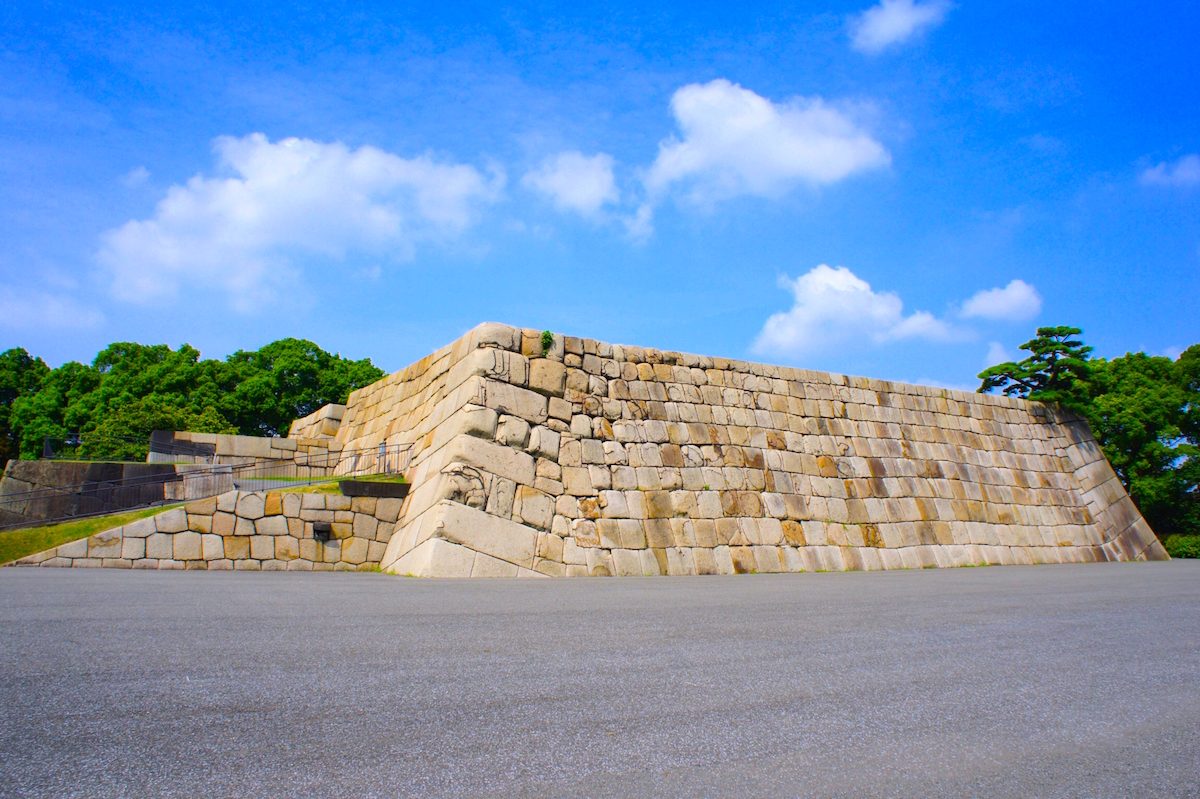
FactIn 1657, however, this keep too burned down in the Great Meireki Fire, which destroyed most of Edo. The following year, the Maeda family of the Kaga domain built the stone walls of a new keep base, but the keep itself was never built.
Look here: the "burned stones" of the keep base
Look closely at the stone walls of the keep base in the East Gardens of the Imperial Palace, and you will find stones that are blackened and seem to be cracked. They are said to be scars left by the heat of the fires that broke out at Edo Castle many times. Climb to the top of the keep base, and you get a good sense of how vast the main enclosure once was.
Rebuild the town, not the keep
FactThe man who called off the rebuilding of the keep is said to have been Hoshina Masayuki, who was assisting the fourth shogun, Ietsuna. His judgement was that in an age without war there was no need for a keep, and that the money should instead go to the lives of those who had lost their homes and to rebuilding the town. From then until the end of the shogunate, Edo Castle remained a castle without a keep.
From Edo Castle to the Imperial Palace
FactIn 1868, Edo Castle was handed over to the new government without a fight (the From Edo to Tokyo room) and renamed "Tokyo Castle." The following year Emperor Meiji took up residence, and it came to be called "Kojo," and later "Kyujo" (the Imperial Castle). The present name, Kokyo (the Imperial Palace), dates from 1948.
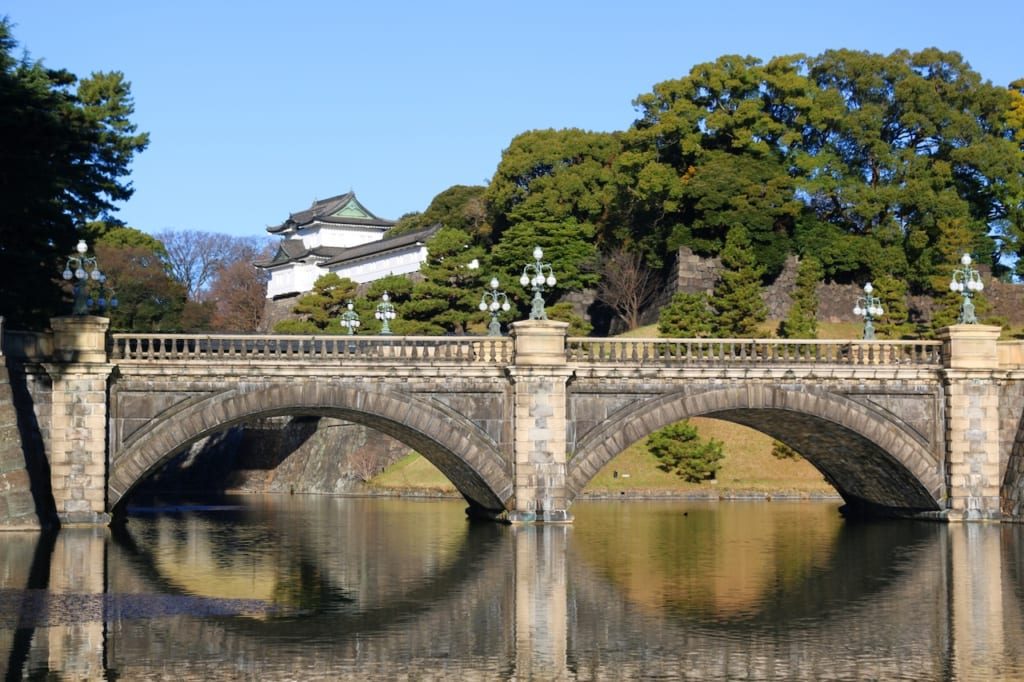
FactParts of the main, second and third enclosures have been laid out as the East Gardens of the Imperial Palace and are open to the public. Several of Edo Castle's buildings also survive, including the Doshin-bansho and Hyakunin-bansho guardhouses and the Fujimi-yagura turret.
The gates became place names
Edo Castle had many gates, and their names survive today as place names and station names: Otemachi (from the Ote-mon gate), Toranomon, Hanzomon, Sakuradamon, Akasaka-mitsuke, Yotsuya, Ichigaya, the Ushigome-mitsuke near Iidabashi, and more. A mitsuke was a gate with a guardhouse for keeping watch. Follow the subway station names, and you can go all the way round the gates of Edo Castle (the Place-Name Trivia room).
The Imperial Palace runners
One lap of the Imperial Palace is about 5 kilometres. With no traffic lights and a clear sense of distance, it has become a course for large numbers of runners. Running anticlockwise is considered good manners. The moat-side paths once travelled by daimyo processions are now run by people from all over the world.
Main sources: Imperial Household Agency, "East Gardens of the Imperial Palace" / Chiyoda City, "Site of the Edo Castle Outer Moat" / Tokyo Metropolitan Archives