Home / Place-Name Trivia
06 — PLACE NAMES
Place-Name Trivia
People in Tokyo say its place names almost every day, yet surprisingly few know where they come from. There is no silver in Ginza, Ebisu is named after a beer, and Akihabara was a field set aside against fire. We introduce the stories of Edo and Tokyo hidden in its place names, separating historical fact from popular belief.
Labels: Factdocumented Likelysupported by most sources Legendoral tradition Urban legendlocal lore and rumour
From Edo's offices and trades
FactGinza: The name comes from the shogunate's silver mint, the "Ginza" ("silver guild"), which was moved here from Sunpu (Shizuoka) in 1612. The mint moved to Kakigaracho (Nihonbashi) in 1800, but the name stayed behind. No silver is made in today's Ginza. Incidentally, the "Kinza," which made gold coins, stood on the site of today's Bank of Japan head office.
FactOkachimachi: From the group residences of the okachi, low-ranking samurai who guarded the shogun on foot when he went out.
FactBakurocho: Because many bakuro — horse dealers and brokers — lived here. The shogunate's riding ground was also nearby.
FactHatchobori: From a moat (hori) about eight cho (about 870 metres) long. In the Edo period, the group residences of the town magistrate's officers (yoriki and doshin) were concentrated here, and "the gentleman of Hatchobori" meant a doshin police officer.
From daimyo and samurai
FactKioicho: In the Edo period, this area held the estates of the Kii Tokugawa family, the Owari Tokugawa family and the Ii family of the Hikone domain, and the place name combines the first character of each of the three houses' names.
LikelyHanzomon: Said to come from the residence of Hattori Hanzo Masanari, who served Tokugawa Ieyasu, which stood near the gate.
FactJinbocho: From the residence of Jinbo Nagaharu, a hatamoto (a direct retainer of the shogun). Shinjuku comes from "Naito-Shinjuku," a new (shin) post town (juku) created on the Koshu Kaido highway. The post town was made by having the Naito family of the Takato domain in Shinano give up part of their estate (the Shinjuku room).
Was Yurakucho the site of Oda Urakusai's residence?
A widely known theory holds that the name "Yurakucho" comes from the residence of Oda Urakusai (Nagamasu), tea master and younger brother of Oda Nobunaga.
There is no reliable record
No reliable historical source has been found showing that Urakusai had a residence here, and many researchers doubt it. The name was given in the Meiji era, and its origin is unclear.
Roppongi and the "six daimyo"
It is often said that the name "Roppongi" ("six trees") comes from the estates of six daimyo families whose names contain the character for "tree" (ki): the Uesugi, Kutsuki, Aoki, Katagiri, Hitotsuyanagi and Takagi.
Or there were six pine trees
The daimyo-estate story includes families whose dates do not match, and it is widely regarded as a later invention. Another theory says there were once six great pine trees here; neither explanation is conclusive.
From the sea and the land
LikelyHibiya: The leading theory is that when the area was still sea, it was lined with hibi — stakes of bamboo or branches set up in the water to farm seaweed or catch fish.
FactTsukiji means "built land" (reclaimed land), Odaiba comes from the "gun batteries" built against the Black Ships, and Marunouchi means "inside the moats" (the Reclaimed Land room). Sukiyabashi, Kyobashi and Shinbashi are the names of bridges that crossed moats that no longer exist.
LikelyIt is certain that Shibuya takes its name from its valley (tani/ya) landscape, but there are various theories about the "Shibu": that it comes from the Shibuya clan who once ruled the area, or that the river water was a rusty "shibu colour," among others (the Shibuya room).
From beer, fire and faith
FactEbisu: In the Meiji era, a brewery making "Yebisu Beer" was built here, and the station for shipping the beer out was named "Ebisu." Later, the neighbourhood around the station was also named Ebisu. It is a rare case of a product name becoming a station name, and then a place name.
FactAkihabara: After a great fire in 1869, the Meiji government made this area a firebreak and built a shrine to the god of fire. People called this shrine after "Akiba Daigongen" (Akiba-sama), the deity known for protecting against fire, and the open field came to be called "Akiba no hara" (read "Akibappara"), "Akiba's field." The station built in 1890 was read "Akihabara," and that reading stuck (the Akihabara room).
LikelyKanda: Said to come from a "sacred rice field" (mita, written 神田) where rice was grown to be offered to Ise Grand Shrine. Meguro and Mejiro take their names from the Fudo-son (Fudo Myo-o) temples of each area (the Urban Legends room).
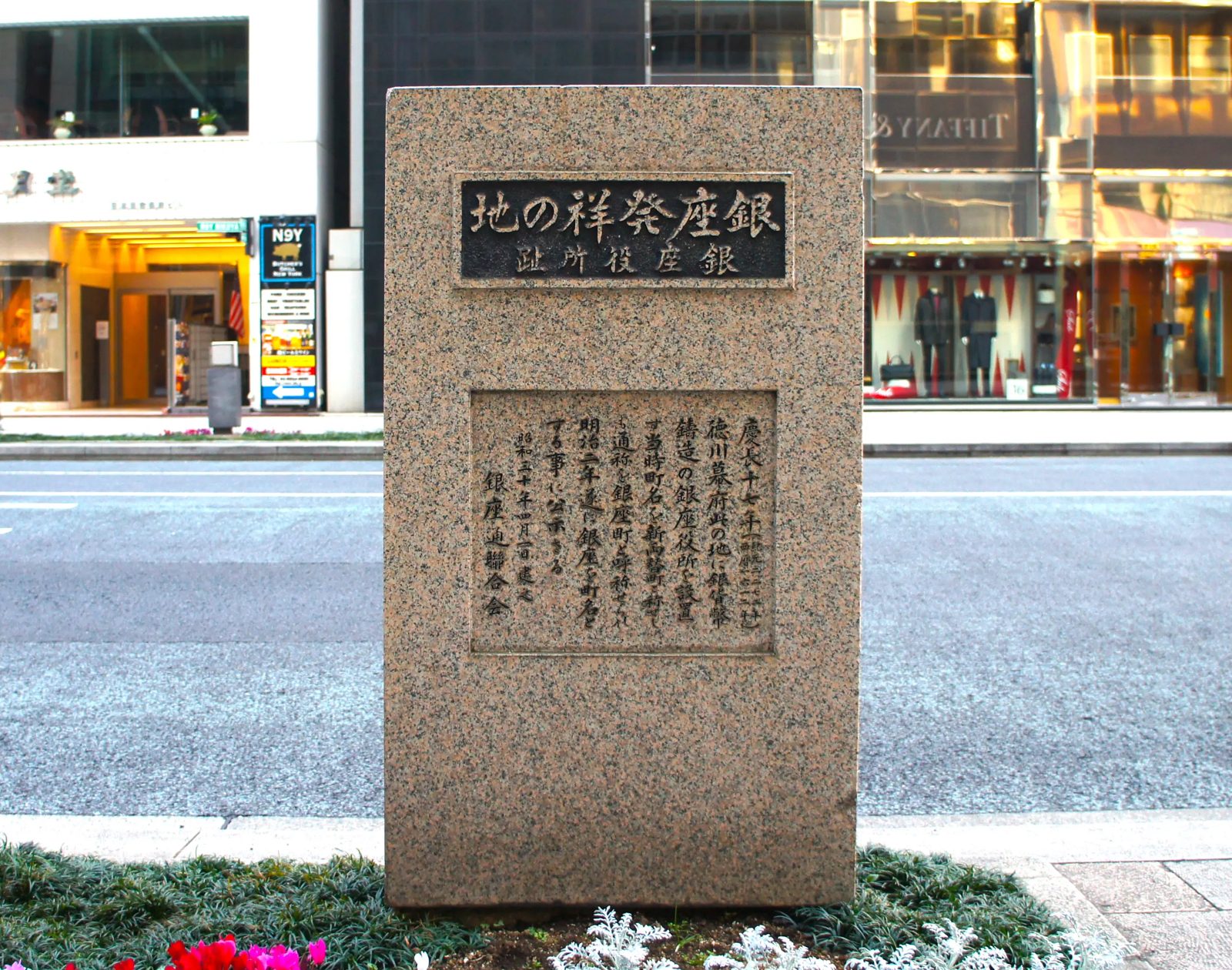
Look here: the "Birthplace of Ginza" monument in Ginza 2-chome
On the corner of the Ginza 2-chome crossing stands a stone monument inscribed "Birthplace of Ginza — Site of the Ginza Office". At the feet of a street lined with luxury-brand shops, it quietly tells passers-by that this was once the Edo shogunate's mint.
Main sources: Chuo City, "History of Ginza" / Chiyoda City, "Street-Name Origin Boards" / Shibuya City, "The Place Name Ebisu" / Kadokawa Dictionary of Japanese Place Names: Tokyo