Home / Shibuya: A Town in a Valley
17 — SHIBUYA
Shibuya: A Town in a Valley
Walk towards Shibuya Station and you will notice that, whichever way you come from, you are heading downhill. True to its name ("the valley of Shibu"), Shibuya sits at the bottom of a bowl-shaped valley. The true story of Hachiko, a river that vanished underground, and the most famous crossing in the world: we trace how the valley town of Shibuya took shape.
Labels: Factdocumented Likelysupported by most sources Legendoral tradition Urban legendlocal lore and rumour
All roads lead down to the valley floor
FactShibuya lies at the bottom of a valley carved into the Musashino plateau by the Shibuya River and its tributaries. Dogenzaka, Miyamasuzaka, Koen-dori, Konnozaka: every road leading to the station runs downhill. This is also why the Shibuya station of the Ginza Line subway sits on the third floor of a building — the line emerges from inside the plateau towards the valley floor.
LikelyThe origin of the name "Shibuya" is uncertain. One theory says it comes from the Shibuya clan who ruled the area; another says the river running through the valley was a reddish-brown "shibu" colour from its iron content (the Place-Name Trivia room).
The true story of Hachiko, the faithful dog
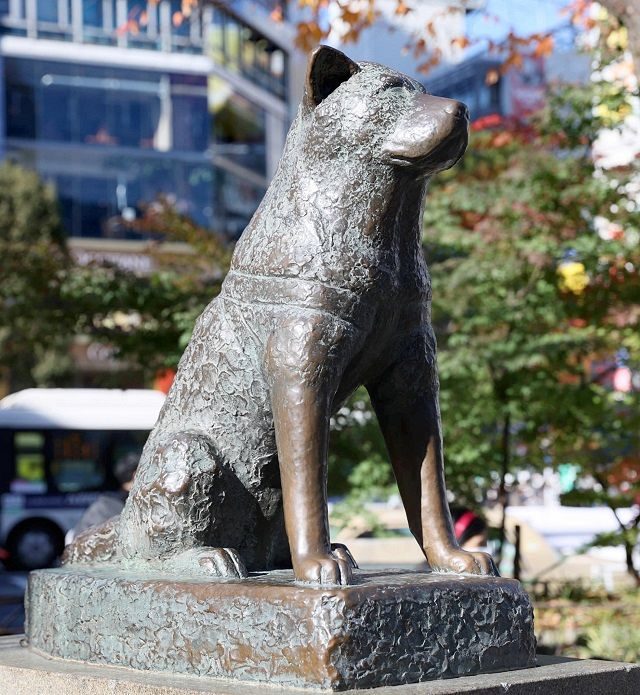
FactHachi, an Akita dog, was born in 1923 and kept by Ueno Hidesaburo, a professor in the Faculty of Agriculture at Tokyo Imperial University. Every day Hachi went to Shibuya Station to meet Ueno, but in 1925 Ueno died suddenly at the university. Even after that, Hachi kept going to Shibuya Station for about ten years.
FactWhen a newspaper told the story, Hachi became famous overnight, and in 1934 a bronze statue was put up in front of Shibuya Station. Hachi himself attended the unveiling. He died the following year, in 1935. The first statue was lost when metal was requisitioned during the war; the present statue was rebuilt in 1948.
"Hachi was only after the yakitori"
It is sometimes whispered that Hachi went to the station not to wait for his master, but for the yakitori he was given at the food stalls in front of the station.
We cannot say either way
It is considered certain that Hachi was fussed over by people around the station and given food. But whether that was why he kept going there is unknown. It is also said that yakitori skewers were found in his stomach at the post-mortem after his death, but that does not show why he kept coming.
The Shibuya River, vanished underground
FactAround the time of the 1964 Tokyo Olympics, the Shibuya River, which flowed past Shibuya Station, was covered over upstream of Miyamasu Bridge and became an ankyo, a buried culvert. The Kohone River, said to be the model for the school song "Haru no Ogawa" ("The Little Brook in Spring"), is also a tributary of the Shibuya River (the Rivers, Moats and Buried Streams room).
FactIn 2018, as part of redevelopment on the south side of the station, a stretch of the Shibuya River was restored as a waterside space with a promenade.
The Scramble Crossing
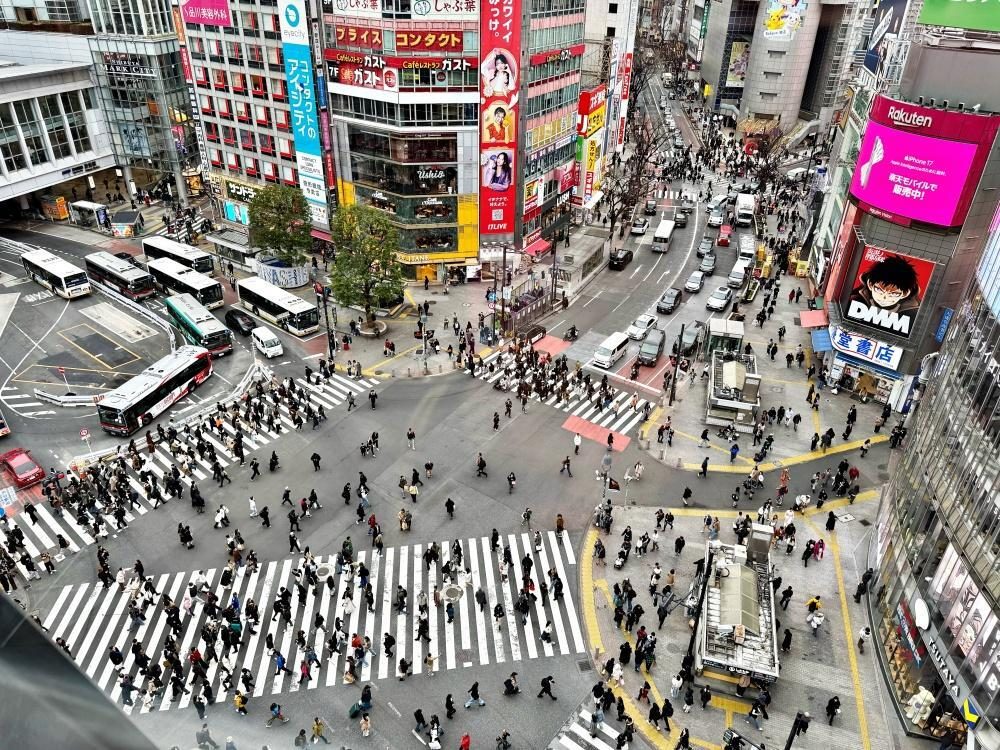
FactAt the Scramble Crossing in front of Shibuya Station, the traffic lights turn red for vehicles in every direction at once, and pedestrians cross all together — straight across and diagonally. At its busiest, several thousand people are said to cross on a single green light. The orderly waves of people passing one another have appeared again and again in films and music videos, and the crossing is now a "sight" that people come from all over the world to see (the Surprising Spots Visitors Love room).
Look here: feel the "valley floor"
Look down towards the station from the top of Miyamasuzaka, or stand at the Scramble Crossing and look around. Both Dogenzaka and Miyamasuzaka slope down towards the crossing. The flow of people through Shibuya is shaped by the land itself.
Main sources: Shibuya Folk and Literary Shirane Memorial Museum / Faculty of Agriculture, University of Tokyo, "Hachiko and Dr Ueno Hidesaburo" / Bureau of Construction, Tokyo Metropolitan Government, "Shibuya River"