Home / The Yamanote and the Daimyo Estates
15 — YAMANOTE
The Yamanote and the Daimyo Estates
The Musashino plateau spreads across the west of Tokyo. In the Edo period, this hilly "Yamanote", with its slopes up and down, was lined with the estates of daimyo (feudal lords) from all over Japan. In the Meiji era their broad grounds were reborn as universities, parks, hotels and government offices. Many of today's "big open spaces" in Tokyo are former daimyo estates.
Labels: Factdocumented Likelysupported by most sources Legendoral tradition Urban legendlocal lore and rumour
A city of plateaus and valleys
FactTokyo's landforms divide broadly into the Musashino plateau in the west and the lowlands along the rivers in the east. The eastern edge of the plateau is cut by many narrow valleys, giving it the shape of an open hand with fingers spread. That is why the Yamanote has so many slopes.
FactIn the Edo period, samurai residences spread across the plateau, with its good views and good drainage, while the townspeople's districts spread over the lowlands. This was the origin of the "Yamanote" (the uptown hills) and the "Shitamachi" (the low city). The slopes were given names inspired by their views or atmosphere, such as "Shiomizaka" (Sea-View Slope), "Fujimizaka" (Fuji-View Slope), "Kurayamizaka" (Darkness Slope) and "Yureizaka" (Ghost Slope), and marker posts still stand on them today.
Alternate attendance and the daimyo estates
FactIn the Edo period, daimyo from across Japan travelled back and forth between Edo and their home domains under the system of sankin-kotai (alternate attendance), and their wives and children were required to live in Edo. So each daimyo held several estates in Edo: the kami-yashiki (upper residence), where the lord lived; the naka-yashiki (middle residence), for retired lords and family members; and the shimo-yashiki (lower residence), used as a villa or storehouse. Samurai land is said to have taken up more than 60 percent of Edo's area.
When the daimyo disappeared with the Meiji Restoration, the sites of these large estates were put to use for the new nation's institutions. This is one reason why universities, parks and government offices are concentrated in central Tokyo.
What became of the daimyo estates?
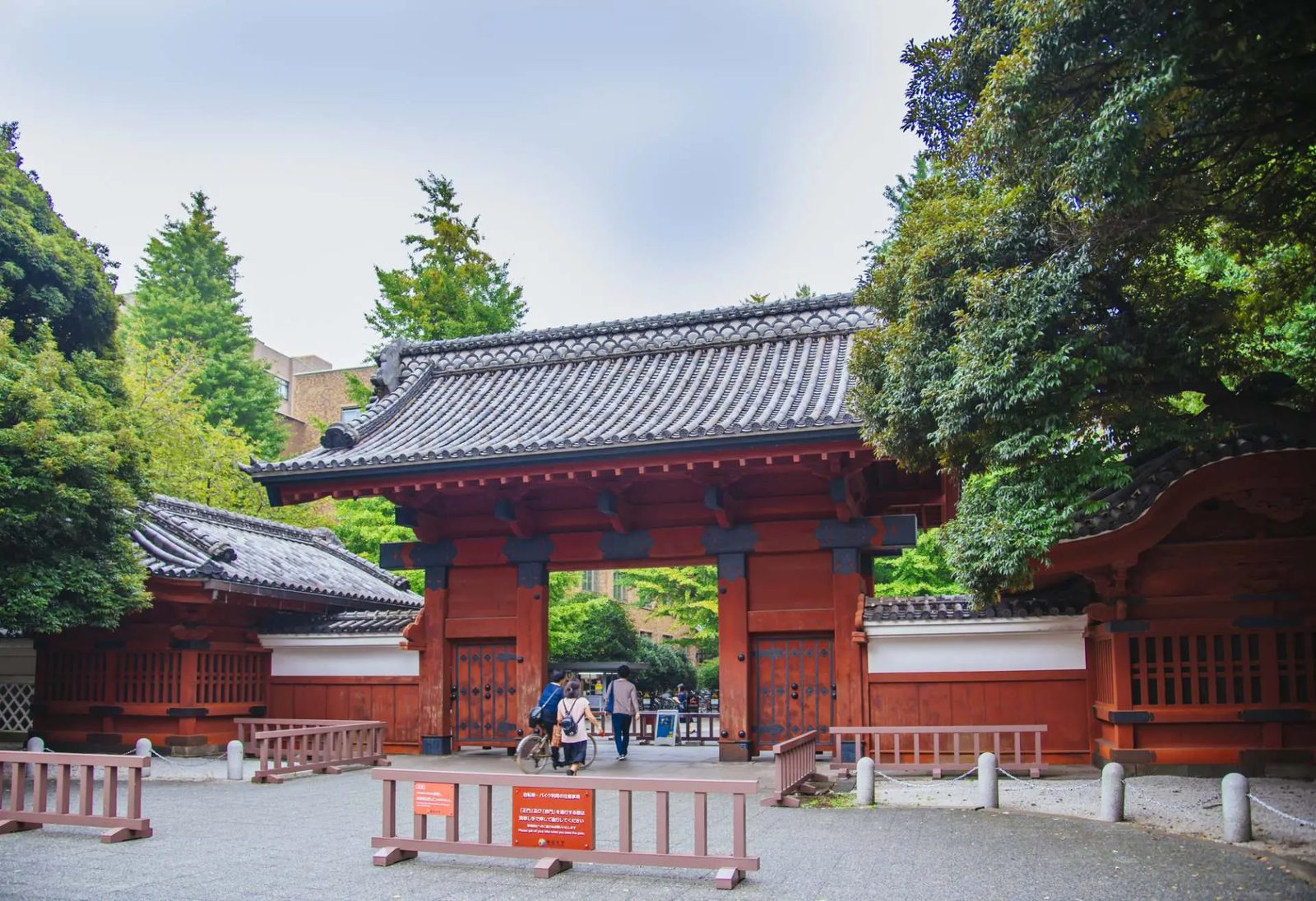
FactThe University of Tokyo (Hongo): the upper residence of the Maeda family of the Kaga domain. The famous Akamon (Red Gate) was built in 1827 when Princess Yo, daughter of the 11th shogun Ienari, married into the Maeda family. It was customary for a daimyo receiving a shogun's daughter to build a vermilion-lacquered gate. The Akamon is a national Important Cultural Property.
FactShinjuku Gyoen: the lower residence of the Naito family of the Takato domain in Shinano. In the Meiji era it became an agricultural experiment station, later an imperial garden, and finally a national garden open to the public.
FactThe Mori Garden at Roppongi Hills: the remains of the garden of the upper residence of the Mori family of the Chofu domain, a branch of the Choshu domain. Ten of the Ako ronin (the 47 Ronin) were placed in custody at this residence and committed seppuku here. It was also the birthplace of Nogi Maresuke, a general of the Russo-Japanese War.
FactKoishikawa Korakuen: the garden of the upper residence of the Mito Tokugawa family. The name "Korakuen" comes from a saying in a Chinese classic: "Be the first to worry about the world's troubles, and the last to enjoy its pleasures."
Look here: Mt Hakone in Toyama Park
Toyama Park in Shinjuku City is home to Mt Hakone, 44.6 metres above sea level. It is the highest point inside the Yamanote Line, but it is an artificial hill, heaped up from the soil dug out for a pond in Toyama-so, the garden of the Owari Tokugawa family's lower residence. The Owari family are even said to have built a streetscape within the garden modelled on a post town of the Tokaido highway, and to have invited the shogun to enjoy it.
Main sources: University of Tokyo, "Akamon" / Ministry of the Environment, "History of Shinjuku Gyoen" / Tokyo Metropolitan Park Association, "Koishikawa Korakuen" / Shinjuku City, "Toyama Park" / Minato City, "Mori Garden"