Home / Edo, a Village on an Inlet
00 — ORIGINS
Edo, a Village on an Inlet
It is sometimes said that when Ieyasu arrived, Edo was "a desolate, poor village." But was that really so? We trace how a stretch of inlet, tangled with sea and marshland, became the foundation of one of the world's great cities.
Labels: Factdocumented Likelysupported by most sources Legendoral tradition Urban legendlocal lore and rumour
The Edo clan and "the entrance to the inlet"
FactFrom the end of the Heian period into the Kamakura period, a samurai family, the Edo clan, had its residence here. The place name "Edo" already appears in records from this time.
LikelyThere are several theories about the origin of the name "Edo," but a well-known one holds that e (江) means an inlet or river and to (戸) means an entrance, so that the name refers to a place at the entrance to the inlet. At the time, an arm of the sea called the Hibiya inlet cut deep into the land east of today's Imperial Palace.
1457: Ota Dokan's Edo Castle
FactIn 1457, Ota Dokan, a retainer of the Ogigayatsu Uesugi family who governed the Kanto region, built Edo Castle on the edge of a plateau overlooking the inlet. Dokan was a warrior also distinguished in learning and in waka poetry. Edo Castle is said to have flourished as a base commanding key transport routes, with ships gathering beneath it from many places.
FactIn 1486, however, Dokan was killed by his own lord. Edo Castle later came under the control of the Hojo clan.
The girl of "Yamabuki-no-sato"
Caught in the rain while out hawking, Dokan tried to borrow a straw raincoat (mino), and a girl held out a single spray of yamabuki (Japanese kerria) flowers. She was alluding to an old poem — "Though its flowers bloom sevenfold, eightfold, how sad that the yamabuki bears not a single seed" (七重八重花は咲けども山吹の実の一つだになきぞ悲しき) — in which "not a single seed" (mino hitotsu) doubles as "not a single raincoat," a hint at her poverty. When Dokan realised this, he was ashamed of his own ignorance and set about studying poetry — or so the story goes.
Dokan the poet
Whether the story is true is unknown, but it is certain that Dokan was a cultured man well versed in waka. Shinjuku, Toshima and other wards have several places that claim to be the "Yamabuki-no-sato" of the legend.
1590: Ieyasu arrives
FactIn 1590, after destroying the Hojo clan, Toyotomi Hideyoshi ordered Tokugawa Ieyasu to move his domain to the Kanto region. Rather than Odawara or Kamakura, Ieyasu chose Edo as his base. He is said to have entered Edo Castle on the first day of the eighth month (hassaku), and throughout the Edo period this day was kept as an important holiday.
"Edo was an empty, poor village"
Books from later periods often wrote that when Ieyasu came, Edo was a poor fishing village of only a hundred or so thatched houses, with a castle fallen into ruin.
In fact, a key hub of water transport
Recent research suggests that from the Middle Ages, Edo, together with Shinagawa and Asakusa, was a key transport hub where ships came and went. The prevailing view is that the "poor village" story may be an exaggeration meant to make Ieyasu's achievements look greater.
Levelling hills, filling in the sea
FactIeyasu set to work on major construction straight away. He dug the Dosanbori canal to carry supplies to the castle and the Onagi River canal to carry salt from Gyotoku. After becoming shogun in 1603, he mobilised daimyo from all over the country to level Kandayama hill (around today's Surugadai) and used its earth to fill in the Hibiya inlet.
On the land created in this way, townspeople's districts and daimyo estates were built. Today's Marunouchi, Hibiya and Shinbashi were once sea (the Reclaimed Land room).
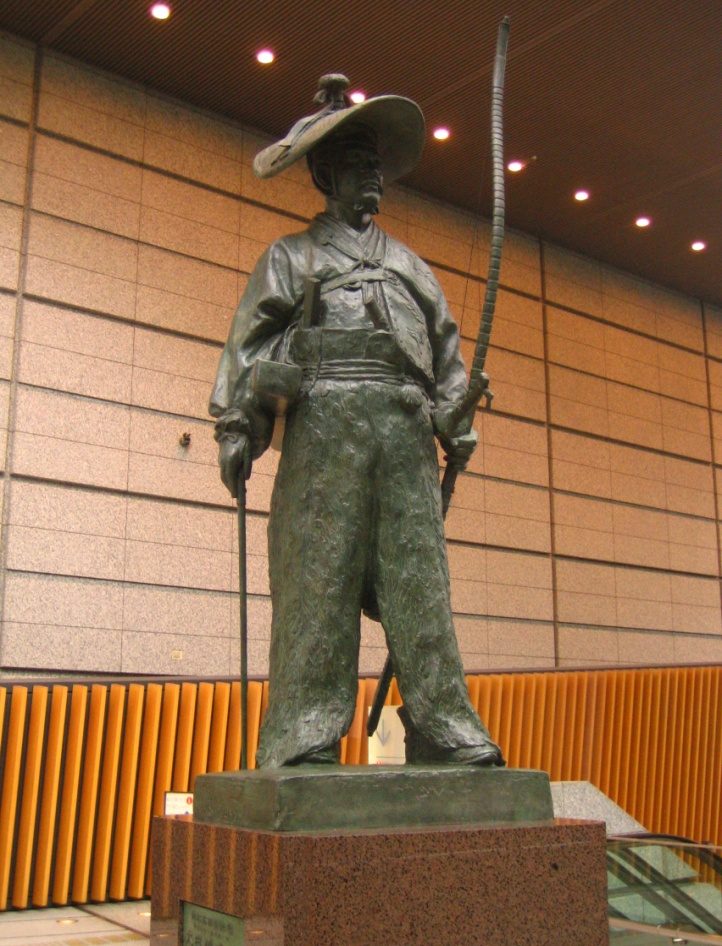
Look here: the statue of Dokan at Tokyo International Forum
Inside the glass hall of Tokyo International Forum in Yurakucho stands a statue of Ota Dokan dressed for hawking. It originally stood in front of the old Tokyo Metropolitan Government building and was moved here when the government offices relocated. Tokyo's "first developer" still stands in the heart of the city.
Main sources: Tokyo Metropolitan Archives / Chiyoda City, History of Chiyoda Ward / National Archives of Japan, "Maps of Edo"