Home / Tsugaru and Nanbu
02 — TSUGARU & NANBU
Tsugaru and Nanbu
Aomori is a single prefecture with two faces: "Tsugaru" in the west and "Nanbu" in the east. Their dialects differ, their festivals differ, and so does the temperament of their people. It all began in the Sengoku period, when one retainer broke away from the house he served. A rivalry more than 400 years old still lives on in local conversation today.
Labels: Factdocumented Likelysupported by most sources Legendoral tradition Urban legendlocal lore and rumour
A retainer breaks away: Tsugaru Tamenobu
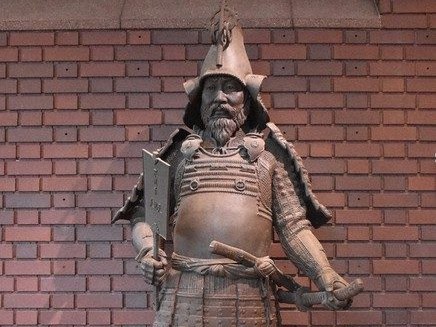
FactIn the Sengoku (Warring States) period, most of today's Aomori Prefecture was under the sway of the Nanbu clan, based at Sannohe. Oura Tamenobu, a member of the clan and one of its retainers, began by capturing a Nanbu castle in 1571 and went on to seize the Tsugaru region piece by piece.
FactAs Toyotomi Hideyoshi pressed on with unifying the country, Tamenobu sent envoys to him before the Nanbu clan did, and in 1590 his rule over Tsugaru was recognised. He changed his family name to "Tsugaru", and so began the history of the Hirosaki domain (the Tsugaru domain). From the Nanbu clan's point of view, however, Tamenobu was a traitor who had stolen their land.
A 200-year grudge: the Soma Daisaku incident
FactThroughout the Edo period, relations between the Hirosaki domain and the Morioka (Nanbu) domain stayed cold. In 1821, Shimotomai Hidenoshin, a samurai of the Morioka domain, plotted to ambush and kill Tsugaru Yasuchika, lord of Hirosaki, at the Yatate Pass as he returned from his alternate-attendance duty in Edo. The plan leaked in advance and failed, and Hidenoshin was captured and executed.
LikelyThe background is thought to have been a question of rank: resentment that the court rank and standing of the Tsugaru lords, whose house had once been mere retainers, had risen to match those of the Nanbu house. Under the name "Soma Daisaku", Hidenoshin became the hero of storytellers' tales and plays, and was a sensation in Edo.
The Boshin War, and a single prefecture
FactIn the Boshin War of 1868, the Hirosaki domain at first joined the Northern Alliance (the alliance of domains of Ou and Etsu), but later switched to the side of the new government. The Morioka domain stayed with the alliance, and the two domains' troops exchanged fire at Noheji (the Battle of Noheji).
FactWith the abolition of the domains in 1871, the prefectures of Hirosaki, Kuroishi, Hachinohe, Shichinohe, Tonami and others were merged into one, and the prefectural office was moved from Hirosaki to Aomori. In this way Tsugaru and part of Nanbu (today's Hachinohe, Towada, Shimokita and so on) became the same "Aomori Prefecture".
"The prefectural office couldn't go to either side"
It is sometimes said, half in jest, that the office could be put neither in Hirosaki, the heart of Tsugaru, nor in Hachinohe, the heart of Nanbu, so it ended up in Aomori, near the border between the two.
Near the centre of the prefecture, and with a port
Aomori lay almost in the middle of the prefecture and had a port for crossing to Hokkaido. Its importance as a transport hub is thought to have been a major reason for moving the prefectural office there (the Port room).
"Tsugaru" and "Nanbu" today
FactThe people of Tsugaru describe their own character as "joppari" (stubborn, obstinate). The dialects, too, are very different between Tsugaru and Nanbu (the Dialect room). Even the summer festivals differ: Tsugaru has its "nebuta" and "neputa", while Hachinohe in Nanbu has the "Sansha Taisai" (the Festivals room and the Hachinohe room).
Look here: the Hankyozuka border mounds
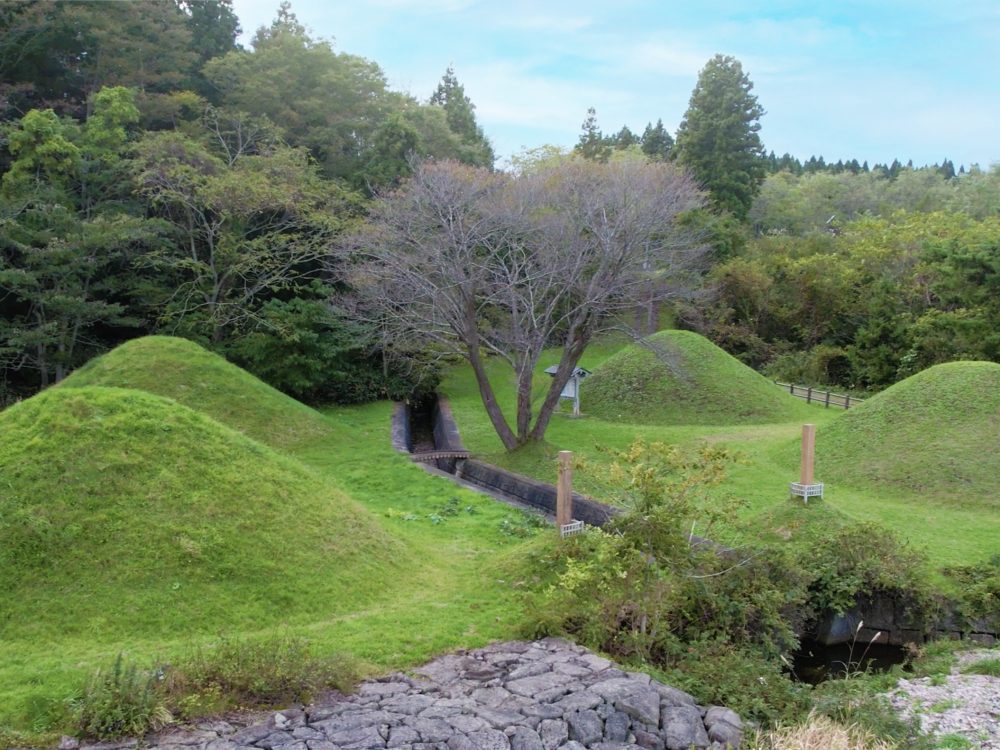
Between Karibazawa in Hiranai and Mamaya in Noheji survive the Hankyozuka, mounds built to mark the border between the Tsugaru and Nanbu domains. The two domains heaped up their earth mounds facing each other across a small stream. A single little stream was once a "national border".
Main sources: Hirosaki City, "History of the Hirosaki Domain" / History of Aomori Prefecture / Morioka City Memorial Museum of Local Notables / Noheji Town, "Hankyozuka"