Home / Hirosaki: Castle, Blossoms and Western Buildings
10 — HIROSAKI
Hirosaki: Castle, Blossoms and Western Buildings
Hirosaki, the castle town of the Tsugaru clan, is Aomori Prefecture's other centre. A keep that has survived since the Edo period, cherry blossoms hailed as the finest in Japan, Western-style buildings put up by a Meiji master carpenter, and modernist architecture. Walk through a surprising town where a keep moved house along with its stone walls, and where apple-growing know-how is used to protect the cherry trees.
Labels: Factdocumented Likelysupported by most sources Legendoral tradition Urban legendlocal lore and rumour
The only Edo-period keep in Tohoku
FactHirosaki Castle was planned by Tsugaru Tamenobu and completed in 1611 by the second lord, Nobuhira (the Tsugaru and Nanbu room). At first it had a five-storey keep, but this burned down after being struck by lightning in 1627.
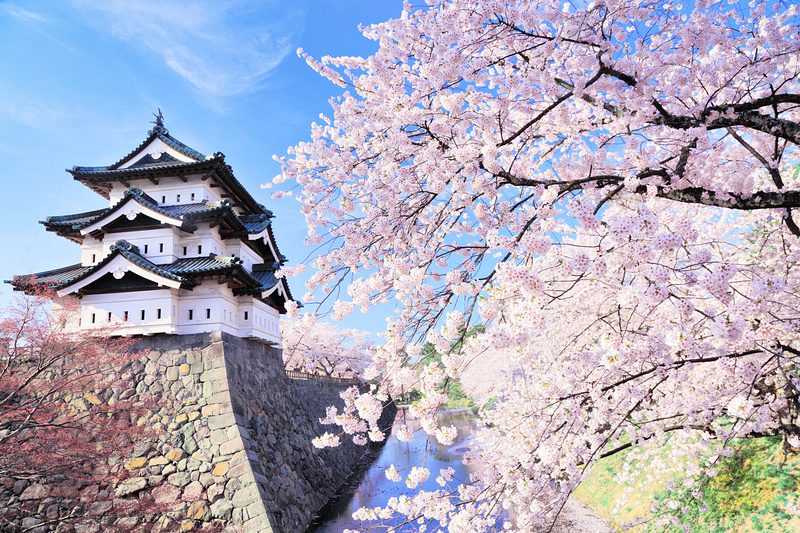
FactThe present three-storey keep was built in 1810, officially as a rebuilding of a corner turret of the Honmaru (inner citadel). It is one of the "12 original keeps" that survive from the Edo period, and the only one in the Tohoku region. Many of the castle's gates and turrets also survive and are designated Important Cultural Properties of Japan.
The keep that moved
FactThe stone wall beneath the keep had begun to bulge and was in danger of collapsing, so in 2015 major works began to rebuild it. Before that, the keep, weighing about 400 tonnes, was lifted up intact and moved along rails in a process known as hikiya (building relocation), and it was shifted about 70 metres to the inner side of the Honmaru.
FactWith the wall repairs progressing, preparations are under way for the "hikimodoshi", the move that will return the keep to its original position. Public access to the interior of the keep has been suspended since November 2025. Please check Hirosaki City's official information for visiting arrangements.
Protecting cherries with apple-growing skills
FactHirosaki Park has about 2,600 cherry trees, and many people come to view the blossoms in spring. The grounds also contain a tree planted in 1882 that is said to be the oldest surviving Somei-yoshino cherry in Japan.
FactAs the proverb "Sakura kiru baka, ume kiranu baka" ("A fool cuts a cherry, a fool fails to cut a plum") suggests, cherry branches were traditionally not meant to be cut. In Hirosaki, however, after the war people began to prune the branches and feed the trees, applying apple-pruning techniques to save cherry trees that were weakening (the Apples room). The result was long-lived trees that bear masses of blossom on each branch. This method of care is known as the "Hirosaki method" and has become a model for cherry-tree management across Japan.
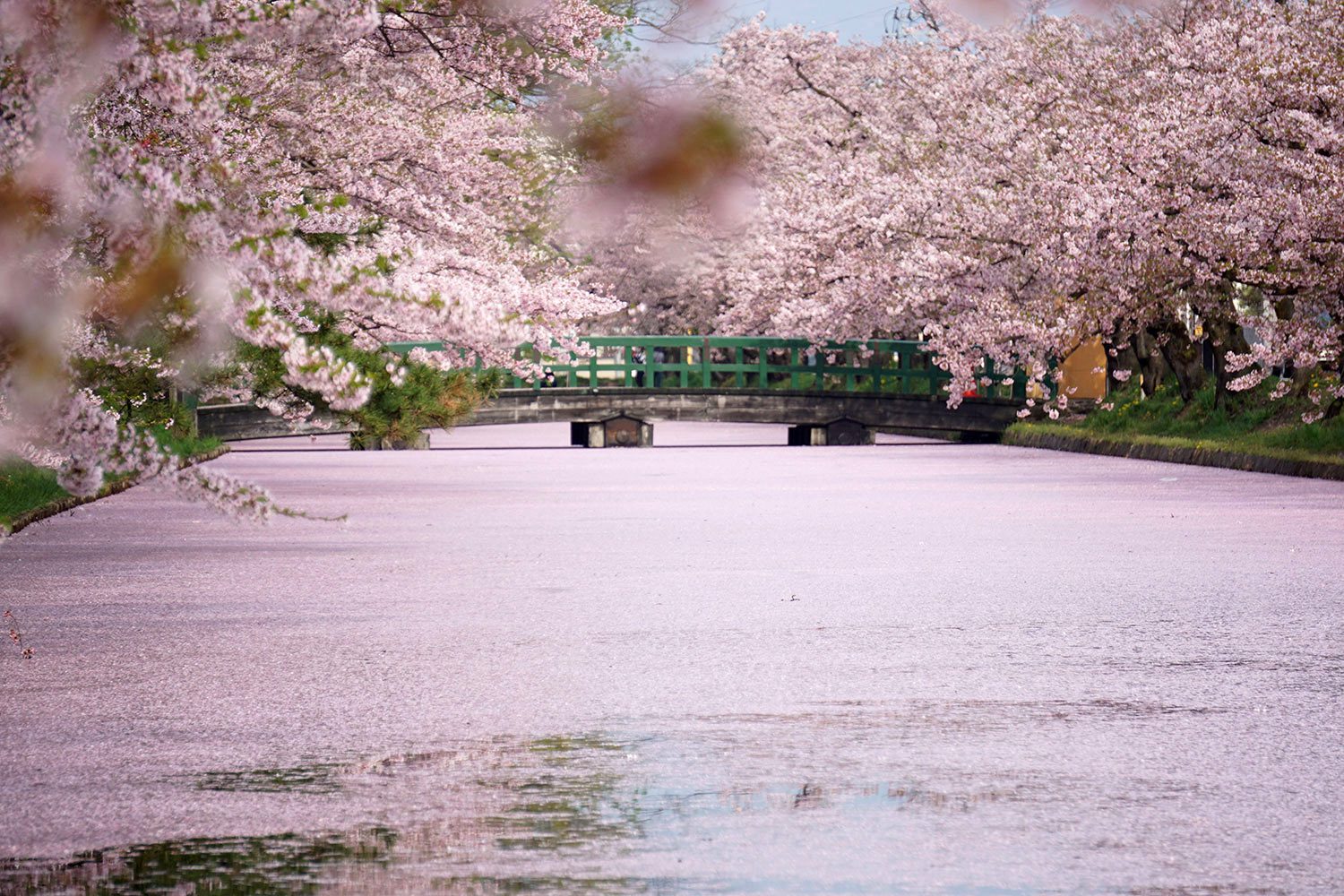
Look for this: hanaikada
As the blossoms begin to fall, the surface of the outer moat is covered in pink with fallen petals. This is hanaikada ("flower rafts"). Many people look forward to it even more than to the trees in full bloom: a sight unique to Hirosaki.
Meiji Western-style buildings, and Maekawa Kunio
FactMany Western-style buildings from the Meiji and Taisho periods survive in Hirosaki. The local master carpenter Horie Sakichi learned by studying Western buildings, and went on to build the former head office of the Fifty-Ninth Bank of 1904 (now the Aomori Bank Memorial Hall, an Important Cultural Property of Japan) and the former Hirosaki City Library, among others.
FactMaekawa Kunio, a master of modern architecture, left many buildings in the town, as his mother's family home was in Hirosaki. The Kimura Industrial Research Institute of 1932 was the first work he undertook after returning from France, where he had studied under Le Corbusier. With Hirosaki City Hall, Hirosaki Civic Hall and more, Hirosaki is also known as "the town of Maekawa architecture".
Main sources: Hirosaki City, "Hirosaki Castle Honmaru Stone Wall Repair Project" / Hirosaki Midori Association, "The Cherry Blossoms of Hirosaki Park" / Aomori Bank Memorial Hall / Hirosaki City, "The Architecture of Maekawa Kunio"