Home / Towada and Oirase
13 — TOWADA
Towada and Oirase
In the south of Aomori Prefecture, the centre of Towada City is laid out in a neat grid. This was once a wasteland without water. The man who brought a river here and built a town was none other than the grandfather of Nitobe Inazo. This is the story of Towada: a lake and a gorge made by a volcano, and a town that has become a home for contemporary art.
Labels: Factdocumented Likelysupported by most sources Legendoral tradition Urban legendlocal lore and rumour
Water for a wasteland: Nitobe Tsutau
FactThe area around Towada City was once a broad plateau known as Sanbongihara. The rivers flowed below the plateau, so their water could not be drawn up, and the volcanic-ash soil was a wasteland where crops would not grow.
FactTo open up this plateau, Nitobe Tsutau, a samurai of the Morioka domain, began work in 1855 on an irrigation canal to bring water from the Oirase River. Tunnels were dug through the hills, and in 1859 water at last flowed onto Sanbongihara. The canal was later named the Inaoi River.
FactThe work of settlement passed to Tsutau's son Jujiro and then to his grandson Shichiro, and a grid of streets modelled on Kyoto was laid out. Jujiro's third son was Nitobe Inazo, author of Bushido, whose portrait once appeared on the 5,000-yen note. The character "ina" (rice plant) in Inazo's name is said to recall the first rice harvested thanks to this settlement.
Kanchogai-dori and the Contemporary Art Museum
FactFrom the Meiji period onwards, Towada was home to an army facility for raising military horses, and it also flourished as a horse town. Kanchogai-dori (Government Office Street), which runs across the former site, is a beautiful avenue lined with pines and cherry trees, and has been chosen as one of "Japan's 100 Best Roads".
FactIn 2008 the Towada Art Center opened on this street. The building is designed like a scattering of white, glass-walled boxes, and it is the centrepiece of the "Arts Towada" project, which treats the whole street as a museum. Large works stand outdoors along the avenue.
A lake made by a volcano
FactLake Towada is a double caldera lake created by volcanic eruptions. The eruption of around 915, in the Heian period, is considered one of the largest in Japan in the past 2,000 years, and its ash fell over a wide area of the Tohoku region.
FactOriginally there were no fish in Lake Towada. Wainai Sadayuki spent more than 20 years trying to stock it, and after repeated failures, in 1903 he succeeded in releasing kokanee salmon (himemasu) brought from Lake Shikotsu in Hokkaido. Kokanee is still a speciality of Lake Towada today.
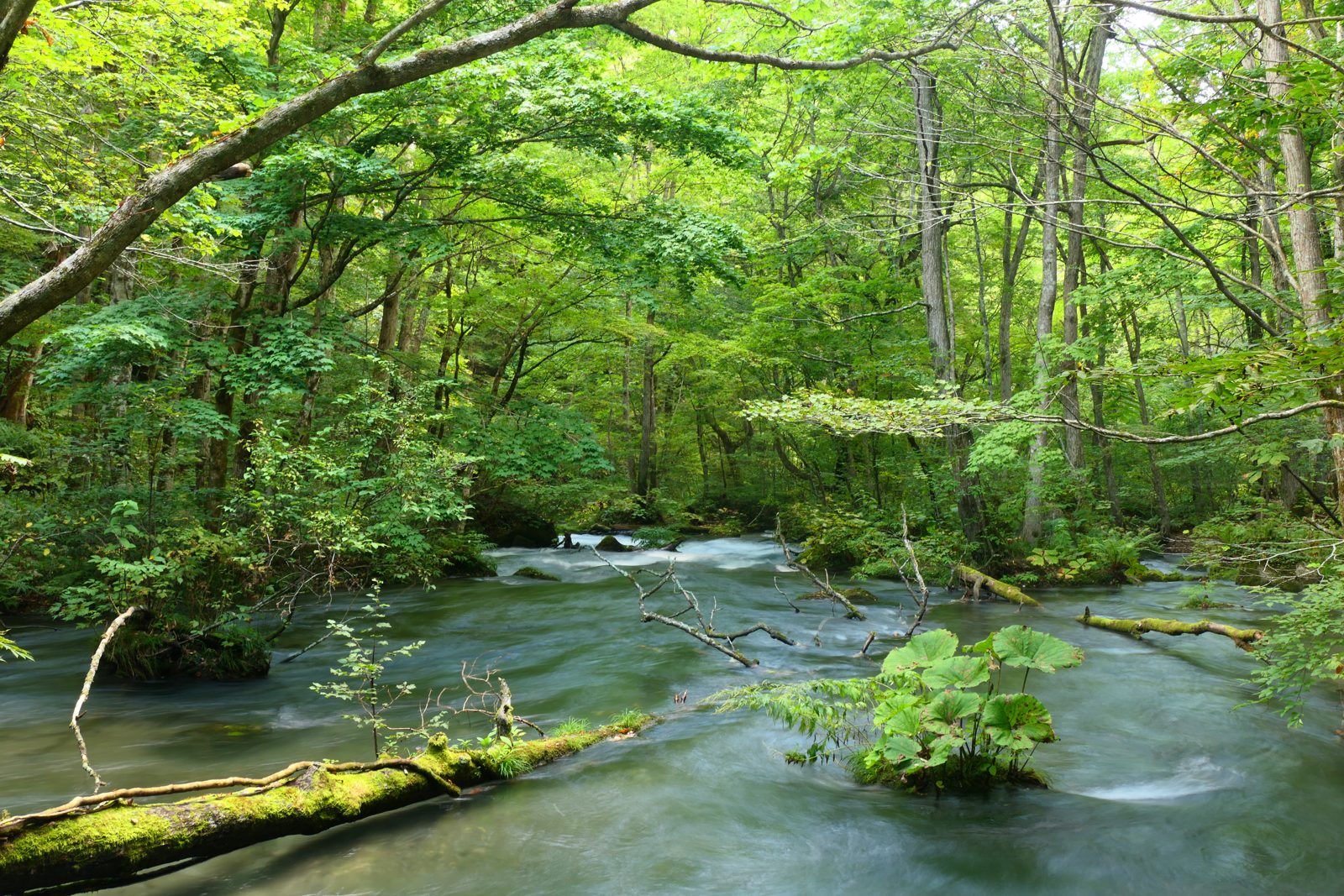
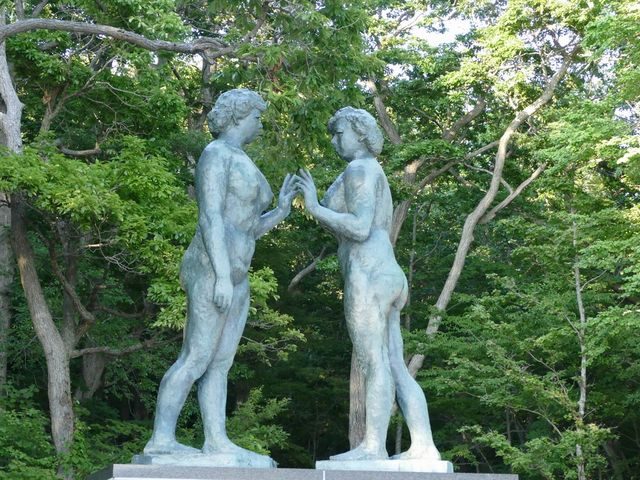
FactFlowing out of the lake at Nenokuchi on its eastern shore, the Oirase Gorge is a valley where a clear stream runs for about 14 kilometres between moss-covered rocks and waterfalls large and small. On the lakeshore stands the "Statue of Maidens", made in 1953 by the sculptor and poet Takamura Kotaro.
Look for this: the flow of the Inaoi River
Walking through central Towada, you still come across the Inaoi River. Flowing across the top of the plateau, it is not a natural river but a man-made canal. Seen together with the grid of streets, it shows clearly how settlers built a town from nothing in the wasteland.
Main sources: Towada City, "Three Generations of the Nitobe Family and the Inaoi River" / Towada Art Center / Towada Lake National Park Association / Japan Meteorological Agency, "Towada"