Home / Sannai-Maruyama
00 — ORIGINS
Sannai-Maruyama
On the outskirts of Aomori City, on land meant for a baseball stadium, something extraordinary came to light: the remains of a great Jomon-period village that lasted for 1,700 years from about 5,900 years ago. Were the Jomon people poor hunters, always on the move? Sannai-Maruyama overturned that common assumption.
Labels: Factdocumented Likelysupported by most sources Legendoral tradition Urban legendlocal lore and rumour
A village that emerged from beneath a baseball stadium
FactPeople had known since the Edo period that there were ancient remains at Sannai-Maruyama, but the full picture only emerged from excavations that began in 1992. A survey carried out ahead of the construction of a prefectural baseball stadium uncovered the remains of a settlement on a scale far beyond anything imagined.
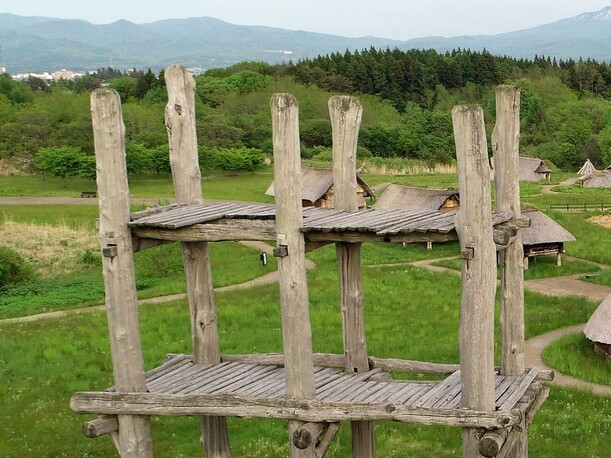
FactIn 1994, the remains of a huge six-pillar building, raised on chestnut posts about 1 metre in diameter, were found. After this discovery, construction of the stadium was halted and the site was preserved. In 2000 it was designated a national Special Historic Site.
What were the six giant pillars?
FactThe six post holes were set at equal intervals of about 4.2 metres. This spacing attracted attention as a possible sign that the Jomon people had a unit of length.
LikelyHowever, nobody knows what the building looked like or what it was used for. There are many theories: a watchtower, a structure for festivals, a large roofed building and more. The building of about 15 metres now reconstructed at the site is just one of the possible forms.
Settled, and growing chestnuts
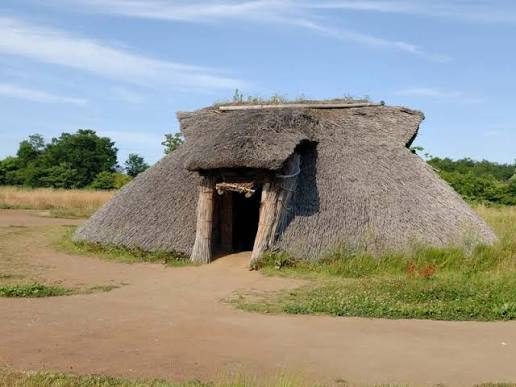
FactThe site has yielded the remains of pit dwellings, large pit buildings more than 30 metres long, pillar-supported buildings thought to be storehouses, graves, and "mounds" where pottery and stone tools were discarded. Adults' graves were lined up along a path, and children were buried in pottery vessels.
LikelyResearch on the DNA of excavated chestnuts suggests that the Jomon people managed and cultivated chestnut trees around the settlement. The image of the Jomon people living on the move, hunting and gathering, was transformed by Sannai-Maruyama.
FactThe site has also yielded jade from around Itoigawa in Niigata Prefecture, and obsidian from Hokkaido. The Jomon people traded even with people in distant lands.
Look here: the "Jomon pochette"
The site's visitor centre, the Sanmaru Museum, displays a small bag woven from tree bark. Inside it were fragments of walnut. Known as the "Jomon pochette", this little bag brings the daily life of people 5,000 years ago astonishingly close.
The prefectural art museum next door
Right next to Sannai-Maruyama stands the Aomori Museum of Art, opened in 2006. Designed by the architect Aoki Jun, it features spaces inspired by the earthen walls of archaeological trenches. A village of 5,000 years ago and contemporary art sit side by side on the same hill (the Arts room).
Main sources: Sannai-Maruyama Site Center / Aomori Prefectural Board of Education, "Special Historic Site Sannai-Maruyama" / Jomon Prehistoric Sites in Northern Japan official website