Home / Hakata ramen and tonkotsu
Hakata Ramen and Tonkotsu
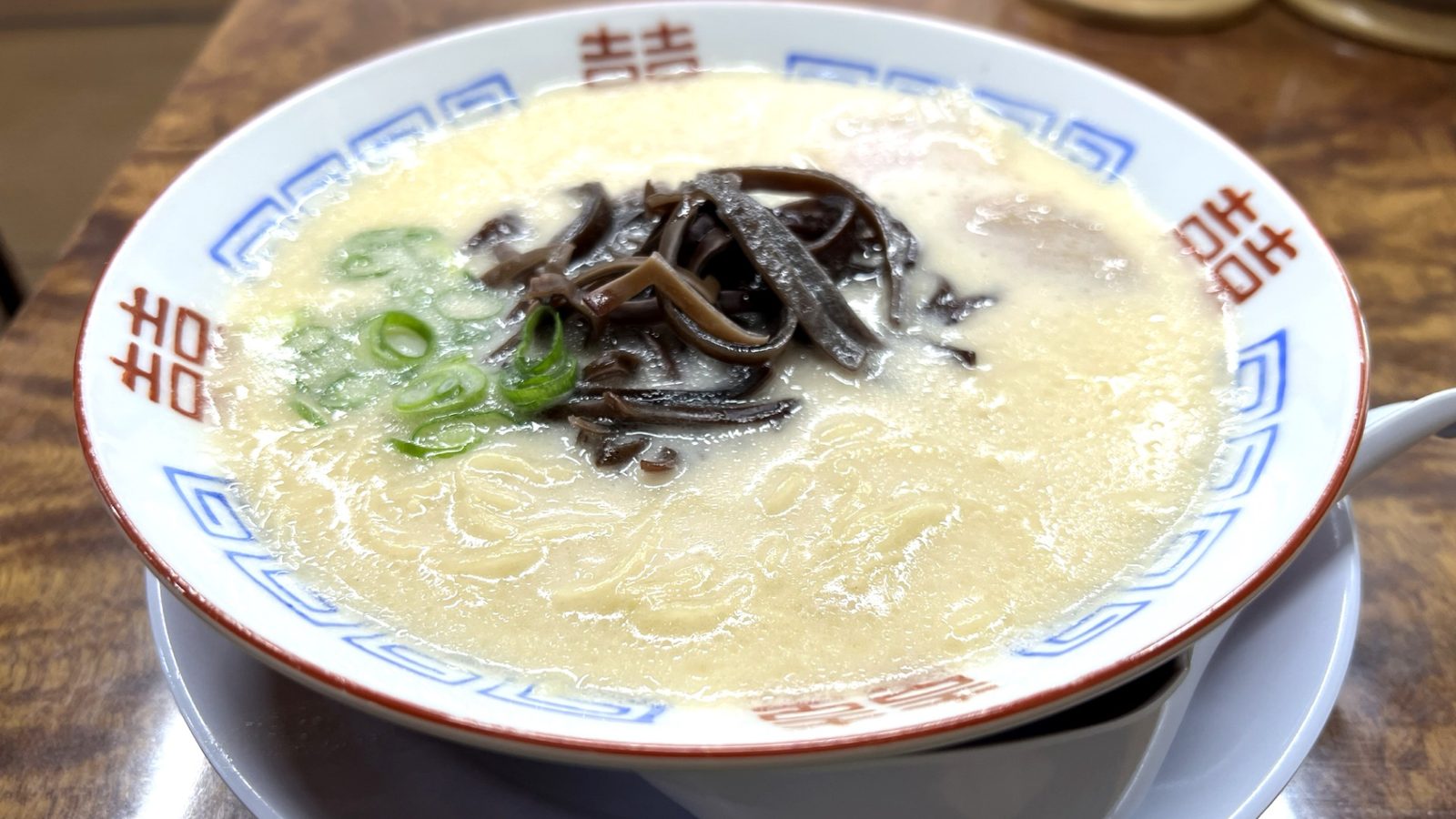
Cloudy white tonkotsu (pork bone) broth, straight noodles as thin as wire, and the "kaedama" (noodle refill). Hakata ramen is now known all over the world simply as "TONKOTSU". Its very form is a portrait of the working lives of the people of the port town of Hakata.
Labels: Factdocumented Likelysupported by most sources Legendoral tradition Urban legendlocal lore and rumour
Tonkotsu ramen came from Kurume
LikelyThe roots of Kyushu's tonkotsu ramen are thought to lie in Kurume, in the south of Fukuoka Prefecture. It is said to have started in 1937, when a Kurume yatai (street stall) called Nankin Senryo served ramen in a broth made from pork bones. The broth of those days is said to have been clear, not cloudy white as it is now.
LegendThere is a famous story about the cloudy white broth. In 1947, at a Kurume yatai called Sankyu, the owner went out partway through making the broth and left his mother to mind the fire. She kept it boiling hard, and when the cloudy white broth was seasoned and served as it was, it became a hit. The tale is passed down as a happy accident that created a local speciality, but there is no record to confirm it.
FactWhen pork bones are boiled hard for a long time, the collagen and fat that dissolve out of the bones are emulsified into fine droplets, turning the broth cloudy white. Hakata's tonkotsu broth is white because of this way of cooking it.
Thin noodles and kaedama run on market time
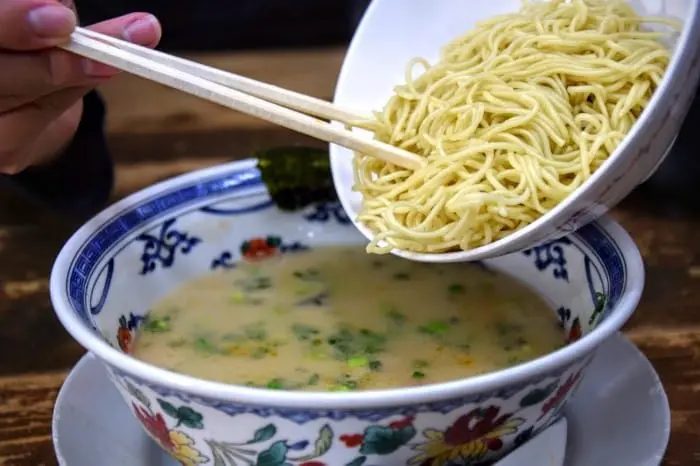
LikelyOne reason given for Hakata's ultra-thin straight noodles is that they cook in a very short time, so bowls could be served fast to busy market workers. Thin noodles go soggy quickly, so the portion was kept small, and the "kaedama" (noodle refill) system was born: if you want more, you order just another serving of noodles.
LikelyKaedama is said to have started at Ganso Nagahamaya, a yatai founded in 1952. When the fish market moved to Nagahama in 1955, ultra-thin noodles and kaedama, quick to serve to the market workers, became the norm. Named after the market, "Nagahama ramen" became another name, alongside Hakata ramen, for Fukuoka's tonkotsu ramen.
"Barikata", "harigane": how firm do you want it?
FactAt Hakata ramen shops, it is normal to order how firm you want your noodles. From softest to firmest, the levels are called "yawa" (soft), "futsu" (regular), "kata" (firm), "barikata" (very firm), "harigane" (wire) and "konaotoshi" (just shaking off the flour), and some shops have an even firmer level, "yuge-doshi" (just passed through the steam). "Bari" is Hakata dialect for "very" (see Hakata Dialect).
FactOn the table you will find beni-shoga (red pickled ginger), karashi takana (spicy pickled mustard greens), ground sesame, garlic and more, so you can adjust the flavour to your taste. Some shops also let you add "ramen tare" (seasoning sauce) if the broth gets thin after a kaedama.
Look for this: yatai ramen and "yaki-ramen"
In Fukuoka you can eat tonkotsu ramen not only at ramen shops but also at yatai. Some yatai serve "yaki-ramen", boiled noodles fried with tonkotsu-broth seasoning, a dish known to have been born at the stalls (see the Yatai). Famous shops cluster around Hakata Station, Tenjin and Nakasu, and the city alone is said to have several hundred ramen shops.
Main sources: Tourist information from Fukuoka Prefecture and Fukuoka City / Kurume City, "Kurume Ramen" guide / Materials on the Nagahama Fish Market / Published information on the founding of individual shops (accounts vary)