Home / Dazaifu Tenmangu and Sugawara no Michizane
Dazaifu Tenmangu and Sugawara no Michizane
Every exam season, crowds of students visit Dazaifu Tenmangu to pray for success. The man enshrined here, Sugawara no Michizane, rose to the post of Minister of the Right in the capital, only to be banished to Kyushu on false charges, and died here two years later. How did this ill-fated scholar become the "god of learning"?
Labels: Factdocumented Likelysupported by most sources Legendoral tradition Urban legendlocal lore and rumour
From Minister of the Right to Dazaifu
FactSugawara no Michizane (845–903) was born into a family of scholars and, favoured by Emperor Uda, rose with unusual speed. In 899 he became Minister of the Right, but in 901, after slanders by the Minister of the Left, Fujiwara no Tokihira, and others, he was demoted and sent to Dazaifu as Dazai no Gon-no-Sochi (provisional governor-general). He was an official in name only; in reality he was kept away from all government business, in what was little different from exile.
FactMichizane lived in a humble residence south of the Dazaifu government office (today's Enoki Shrine), and died there on the 25th day of the 2nd month of 903, aged 59. He was never able to return to the capital.
LegendThe story goes that as his body was being carried on an ox cart, the ox lay down and refused to move, so he was buried on that spot, which is said to be where the Tenmangu's main hall stands today. There are ox statues all over the shrine grounds, and stroking an ox's head is said to make you wiser.
The legend of the flying plum
FactAccording to the Shui Wakashu poetry anthology and other sources, as he left the capital Michizane addressed the plum tree in his garden with this poem: "Kochi fukaba / nioi okoseyo / ume no hana / aruji nashi tote / haru o wasuru na" (When the east wind blows, send me your scent, plum blossoms; though your master is gone, do not forget the spring).
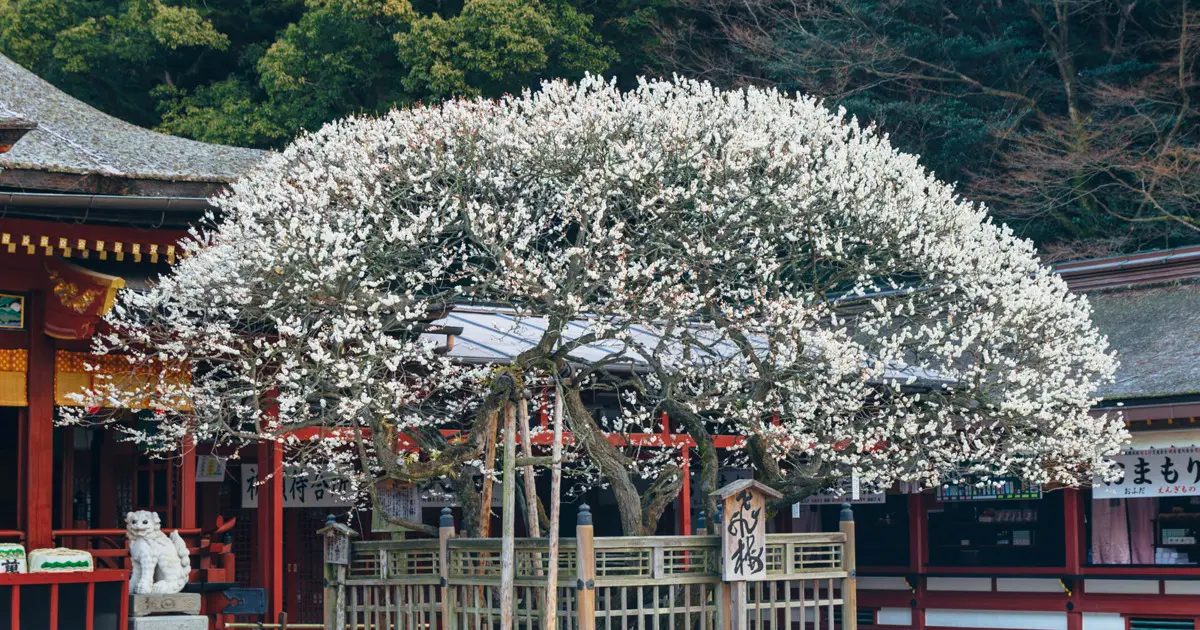
LegendThe legend of the "Tobiume" (flying plum) says that this tree, longing for its master, flew from Kyoto to Dazaifu in a single night. The white plum standing to the front right of the main hall is said to be the Tobiume, and it is said to bloom first of all the trees in the grounds every year.
From thunder god to god of learning
FactAfter Michizane's death, strange events struck the capital one after another. Fujiwara no Tokihira, who had been behind his demotion, died in 909 at the age of 39, and in 930 lightning struck the Seiryoden hall of the imperial palace, killing people. People feared it was the work of Michizane's vengeful spirit, and the court cleared his name, granted him posthumous rank, and built Kitano Tenmangu in Kyoto to enshrine him.
LikelyOver time, the feared thunder god "Tenjin-sama" merged with the image of Michizane as a brilliant scholar, and came to be worshipped as a god of learning, calligraphy and poetry. The fact that Tenjin was enshrined in terakoya (temple schools) in the Edo period is also thought to have spread his image as a god of learning.
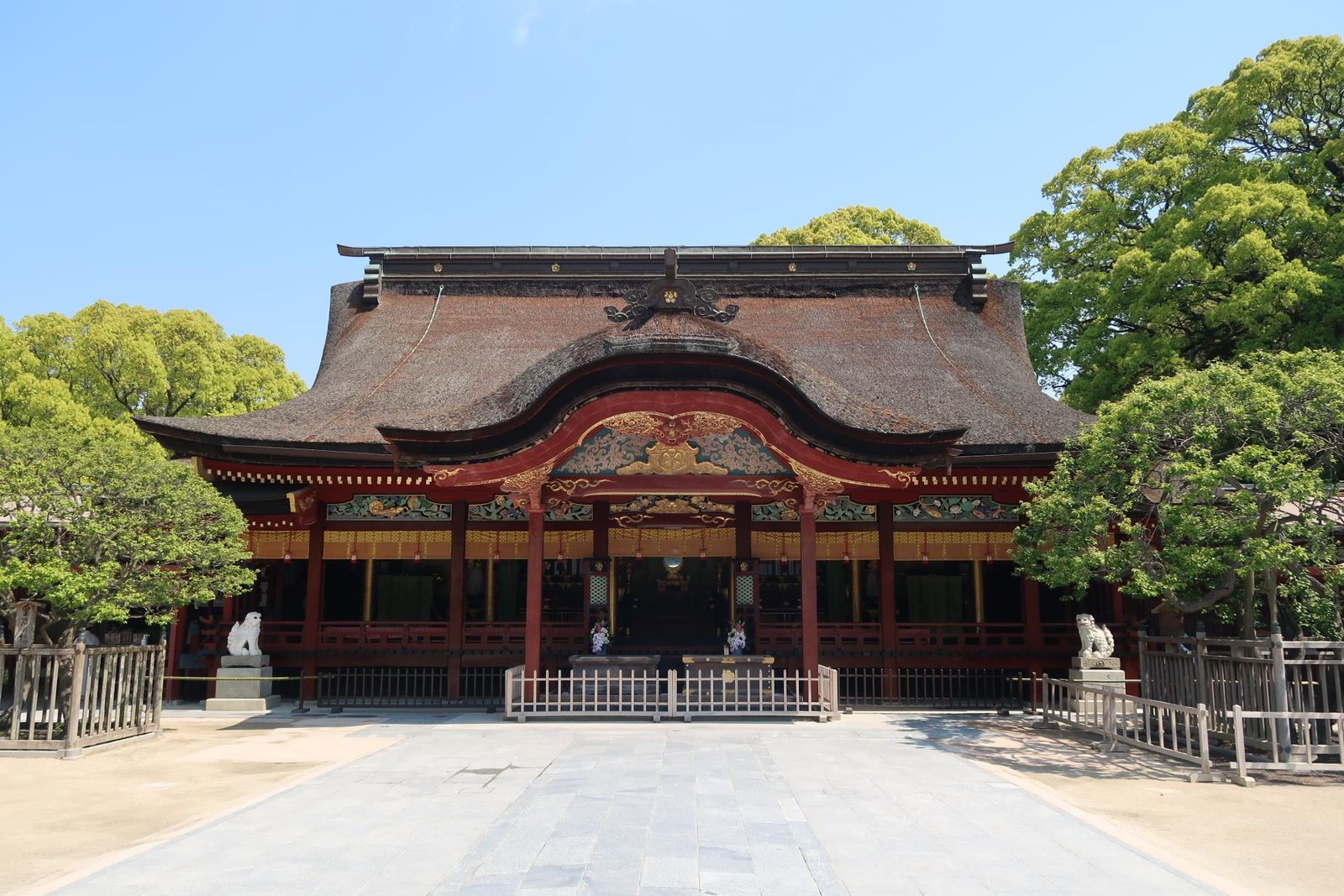
FactAt his grave in Dazaifu, his disciple Umasake no Yasuyuki built a shrine in 905, and in 919 shrine buildings were erected on the orders of Emperor Daigo. The present main hall was built by Kobayakawa Takakage in 1591 and is an Important Cultural Property.
Umegae mochi on the approach, and a museum on the hill
Legend"Umegae mochi", the famous rice cakes sold along the approach to the shrine, are said to be named after a story in which an old woman brought the unfortunate Michizane rice cakes stuck on a plum branch. There is no plum inside; the plum crest branded on top is the reminder. On the 25th of every month, linked to Michizane's birthday and the day of his death, umegae mochi made with mugwort are sold.
FactIn 2005 the Kyushu National Museum opened on the hill behind the Tenmangu. Japan's fourth national museum after Tokyo, Kyoto and Nara, its stated aim is "to understand the formation of Japanese culture from an Asian historical perspective", and its displays focus on the history of exchange with the mainland. It is linked to the shrine grounds by a moving walkway and escalators.
Look for this: the arched bridges over Shinji Pond
On the way from the approach to the main hall, you cross three bridges over Shinji Pond. They are said to represent the past, present and future, from front to back, and run in the order arched bridge, flat bridge, arched bridge. There is also an old saying that you must not look back as you cross. Every year on the night of 7 January, the "Usokae" ritual is held, in which people swap carved wooden bullfinches (uso) to turn the year's lies (also uso) into good luck.
Main sources: Dazaifu Tenmangu official website / Dazaifu City, "The History of Dazaifu" / Kyushu National Museum official website / Okagami (The Great Mirror) / Database of National Cultural Properties, "Main Hall of Dazaifu Tenmangu"