Reading the landThe grand avenue is today's Senbon-dōri
In 794 Emperor Kanmu abandoned Nagaoka-kyō after just ten years and founded Heian-kyō: a grid city about 4.5 km east–west and 5.2 km north–south. Down its centre ran Suzaku Ōji, the grand avenue, about 84 metres wide. Fact Far wider than a modern six-lane road, it was built for ceremony, not traffic.
Where is it now? Not under touristy Karasuma or Kawaramachi, but beneath Senbon-dōri, an ordinary local street near Nijō Station and Nishijin that roughly follows the old avenue. Fact The capital's backbone is now a neighbourhood shopping street.
Solving the mysteryHeian Shrine is a 5/8-scale model
Heian Shrine, with its vermilion halls, looks every inch the Heian period. It was built in 1895 to mark the 1,100th anniversary of the capital. Fact Its main buildings reproduce the Chōdō-in government compound at roughly five-eighths scale. Fact
It isn't even inside the old city: Okazaki was then a suburb to the east. Visit it not as a Heian building but as "the Heian period imagined by the Meiji era", and it becomes far more interesting. The Jidai Matsuri, the Festival of the Ages, was also born then.
Butterfly effectGhosts moved the capital
The very founding of Heian-kyō has a ghost in it. Emperor Kanmu's brother, Prince Sawara, was implicated in the assassination of the official in charge of building Nagaoka-kyō. He protested his innocence, refused food, and died on the way into exile. Afterwards, Kanmu's relatives died one after another and epidemics struck. Diviners blamed the prince's angry spirit. Fact
Why Nagaoka was abandoned is debated — floods, politics — but escaping the curse is counted among the reasons. Likely The prince was posthumously named Emperor Sudō and is enshrined at Sudō Shrine in northeastern Kyoto, among other places.
Michizane's lightning and Kitano Tenmangū
The other great vengeful spirit is Sugawara no Michizane, a scholar who rose to Minister of the Right, was framed, exiled to Dazaifu and died there. His enemies then died one by one, and in 930 lightning struck the palace, killing and injuring courtiers. Fact People blamed Michizane and around 947 enshrined him at Kitano — the origin of Kitano Tenmangū. Likely
Today students pray to him as the god of learning before exams. But the shrine began as a way to appease a terrifying curse. Beneath many of Kyoto's bright prayers lies fear — that's the key to its shrines.
Solving the mysteryThe palace wall with a missing corner
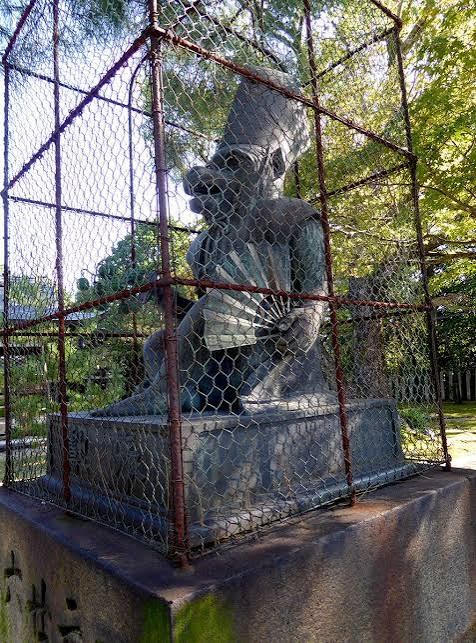
Walk around the earthen wall of the Kyoto Imperial Palace and you'll find that only the northeast corner is notched inward. In Onmyōdō (Japanese yin-yang divination), the northeast is the kimon, the "demon gate" through which evil enters. Remove the corner, and you remove the gate. Fact
This corner is called Sarugatsuji, "Monkey Corner". Under the eaves sits a carved wooden monkey in a court cap, holding a sacred wand, behind wire mesh. "Monkey" (saru) puns on "leave" (saru) — evil, begone. Legend says the monkey used to slip out at night to make mischief, so it was caged. Legend
Solving the mysteryRashōmon — the city gate that became a global word
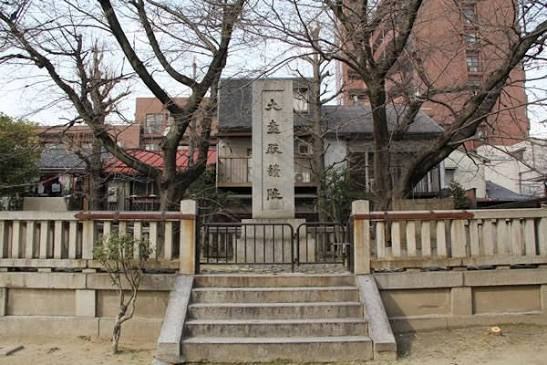
At the south end of the grand avenue stood the city's main gate, Rajōmon. By the mid-Heian period it had collapsed and was never rebuilt. Fact Today a single stone in a tiny park on Kujō-dōri marks the spot.
Bodies were dumped at the ruined gate and demons were said to live there. Akutagawa Ryūnosuke turned the old tale into the short story Rashōmon; Kurosawa Akira's film Rashomon (1950) won the Golden Lion at Venice in 1951, and "the Rashomon effect" entered languages worldwide. Fact A gate reduced to one stone became part of the global vocabulary.
Up closeAbe no Seimei and the Bridge of Return
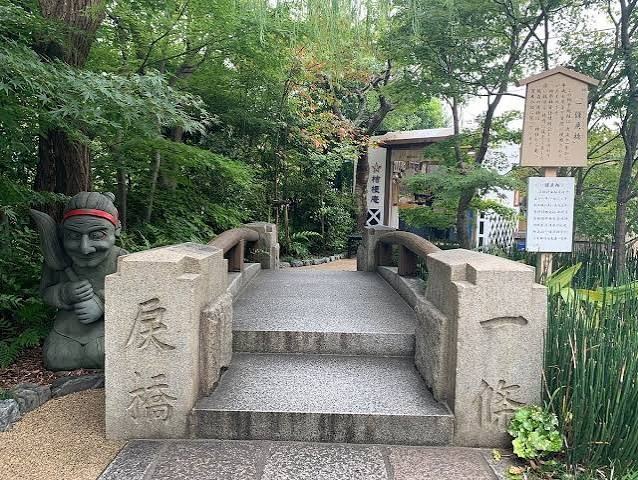
The onmyōji Abe no Seimei was a real person who served in the Bureau of Divination, in charge of astronomy and calendars. Fact Seimei Shrine stands on the site said to be his home. Legend says he hid his shikigami — spirit servants — under the nearby Ichijō Modoribashi bridge. Legend
The bridge has another famous story. In 918, when the scholar Miyoshi no Kiyoyuki died, his son Jōzō rushed back from Kumano and met the funeral procession on this bridge. He prayed, and his father briefly came back to life. Legend Hence the name: Modoribashi, "the bridge of return".