Solving the mysteryNot one day, but a whole month
Thanks to TV footage of the float parade, many people think the Gion Festival happens on July 17. To locals, though, it's the festival of Yasaka Shrine that runs the whole of July, from the opening rites on the 1st to the closing purification on the 31st. Fact The parade is just one of its highlights.
It began in 869, when plague swept the capital: 66 halberds — one for each province of Japan at the time — were raised and portable shrines were sent to the Shinsen-en garden to drive away disaster. Likely Prayers to calm vengeful spirits and plague gods (see Heian-kyō) continue more than 1,100 years later.
Today there are two parades: the Saki-matsuri on the 17th and the Ato-matsuri on the 24th. The second was merged into the first for decades and restored in 2014 after 49 years. Fact The float ceremonies are inscribed on UNESCO's Intangible Cultural Heritage list. Fact
Kyoto & the worldThe Trojan War, on a Kyoto float
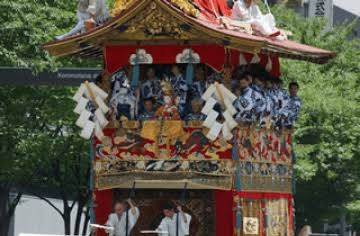
The festival is called a museum on wheels because of the textiles that drape the floats. They include not only Japanese work but Persian, Indian and Chinese weavings — and European tapestries. Fact
The Koi-yama float on Muromachi-dōri, for example, is hung with a 16th-century tapestry woven in Brussels, depicting a scene from Homer's Iliad — the Trojan War. Fact It's said that one large tapestry was cut up and shared among several floats. Likely
The Kanko-boko float preserves a tapestry of the Old Testament story of Isaac and Rebecca from Genesis. Fact Even in the Edo period, when Christianity was banned in Japan, scenes from the Bible were being paraded through the streets of Kyoto.
Solving the mysteryFamilies who won't eat cucumbers in July
Some Kyoto households avoid eating cucumbers during the festival. Legend Slice a cucumber and the cross-section resembles the crest of Yasaka Shrine. Eating the god's emblem would be disrespectful.
Few families keep the custom strictly now, but people in the float neighbourhoods and those involved in the festival are still conscious of it. Likely In Kyoto, the summer dinner table follows the festival calendar.
Up closeThe float that never draws lots, and the boy who never touches the ground
The parade order is decided every July 2 by a lottery ceremony at Kyoto City Hall — a custom going back to the Muromachi period to prevent disputes. Fact
Only the Naginata-boko always leads, without drawing lots (kuji-torazu). Fact It is also the only float that still carries a living child, the chigo. During the festival the boy is treated as a messenger of the gods and is not allowed to touch the ground, carried on the shoulders of attendants. Fact
Butterfly effectA float burned in 1864, back after 150 years
- 1864 — Kinmon RebellionThe "Don-don Fire" destroys many floats (see Shinsengumi).
- The Ōfune-boko can no longer paradeThe ship-shaped float becomes a "resting" float.
- Its neighbourhood keeps the festival aliveResidents guard surviving treasures and keep practising the festival music.
- 2014 — Back after 150 yearsIn the same year the second parade was restored, the Ōfune-boko returned. Fact
In 2022 the Taka-yama, damaged in a storm in 1826, rejoined the parade after 196 years. Fact Keeping a single float running takes tens of millions of yen and dozens of volunteers. The Gion Festival isn't a tourist event but a townspeople's festival sustained by local money and sweat — the same spirit that revived it after the Ōnin War (see The Ōnin War & Hideyoshi).