Solving the mystery"The last war" means the 1460s
Ask an old Kyoto family about damage from "the last war," goes the famous joke, and they'll be talking not about World War II but the Ōnin War of 1467. Urban legend You may not actually meet anyone who says this, but the joke captures two truths: Kyoto escaped the massive firebombing that levelled other Japanese cities, and the Ōnin War was that devastating.
From 1467 to 1477, succession disputes in the shogun's family and among powerful lords split the country into an Eastern Army (Hosokawa Katsumoto) and a Western Army (Yamana Sōzen), and the streets of Kyoto themselves became the battlefield. Fact Temples, noble mansions and townhouses burned; the capital became a wasteland.
Reading the landNishijin is named after an army camp
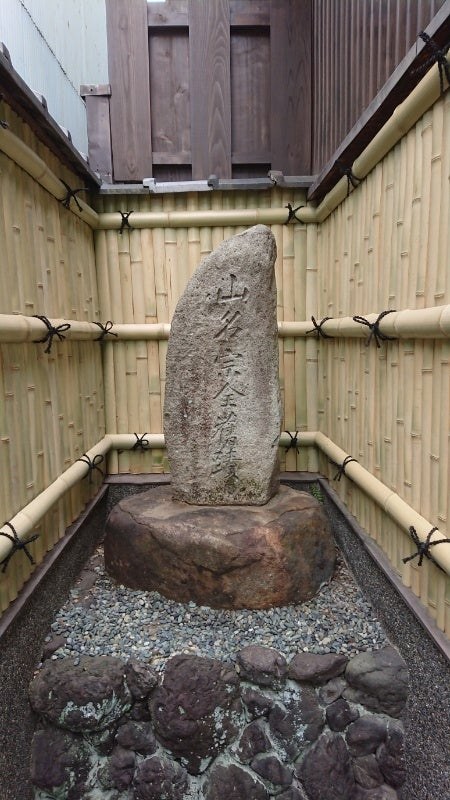
"Nishijin" is synonymous with luxury silk brocade. The name literally means "Western Camp" — it's where Yamana Sōzen, commander of the Western Army, set up headquarters. Fact After the war, weavers who had fled returned to the area and set up their looms, and the name of a military camp became a world-famous textile brand.
A small stone marking the site of Yamana's mansion stands in a back lane near Horikawa and Kamidachiuri streets. (See From Silk Looms to Game Consoles.)
The challengersThe townspeople rebuilt the city
After the war Kyoto shrank into two separate clusters, Kamigyō (upper town) and Shimogyō (lower town), linked by a single road through fields and empty lots. Fact
The people who rose in this era were the merchants and artisans known as machishū, "townsfolk". Each neighbourhood built its own gates for defence, made decisions in assemblies, and in 1500 revived the Gion Festival, which the war had halted. Fact Neither samurai nor aristocrats, they rebuilt the capital themselves — a DNA of self-government that resurfaces in the community-funded schools of 1869 (see The City Fights Back).
Solving the mysteryNobunaga didn't die at today's Honnō-ji
In 1582 Oda Nobunaga, the warlord on the verge of unifying Japan, was attacked by his general Akechi Mitsuhide at Honnō-ji temple and died. But the Honnō-ji you can visit today, near Kyoto City Hall, is not where it happened. Fact
The temple then stood near Shijō-Nishinotōin — around today's Takoyakushi and Aburanokōji streets — and was fortified with moats and earthworks like a small castle. Hideyoshi later moved it as part of his city plan. A stone marker at the original site is easy to miss. Fact
The challengersHideyoshi's makeover: an earthen wall and "eel-bed" houses
Having unified Japan, Toyotomi Hideyoshi remade Kyoto. In 1591 he surrounded the city with the Odoi, an earthen rampart and moat about 22.5 km long. Fact It served both as defence and as a levee against Kamo River floods.
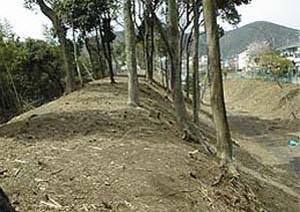
He also redrew the streets — the Tenshō land division. Heian-era blocks were squares about 120 m on each side, leaving unused land in the middle. Hideyoshi ran new north–south streets through the centres, cutting the blocks into long, narrow strips. Fact
Kyoto's townhouses (machiya) are famously narrow and deep — "eel beds" (unagi no nedoko). The popular explanation is "taxes were charged by frontage width". Urban legend Frontage-based levies did exist in the Edo period, but the long, street-facing plots created by Hideyoshi's redivision are thought to be the bigger underlying reason. Likely
Butterfly effectEight characters on a bell destroyed a dynasty
Hideyoshi built a giant Buddha at Hōkō-ji in eastern Kyoto. After his death his son Hideyori rebuilt it, and in 1614 the inscription on the new temple bell caused a crisis. Fact
It contained the phrases 国家安康 ("May the state be peaceful") and 君臣豊楽 ("Lord and subjects enjoy prosperity"). Tokugawa Ieyasu's side claimed the first phrase split the characters of Ieyasu's name (家康) with 安, cursing him, while the second celebrated the Toyotomi (豊臣) as rulers. The accusation became a pretext for the Sieges of Osaka, and in 1615 the Toyotomi clan was wiped out. Fact
- Hideyoshi builds a giant BuddhaA megaproject to display his power.
- Hideyori rebuilds it and casts a bellThe inscription is composed by the Zen monk Bun'ei Seikan.
- Ieyasu objects to "kokka ankō"The "bell inscription incident" becomes a political crisis.
- The Sieges of OsakaThe Toyotomi fall; 260 years of Tokugawa peace follow.
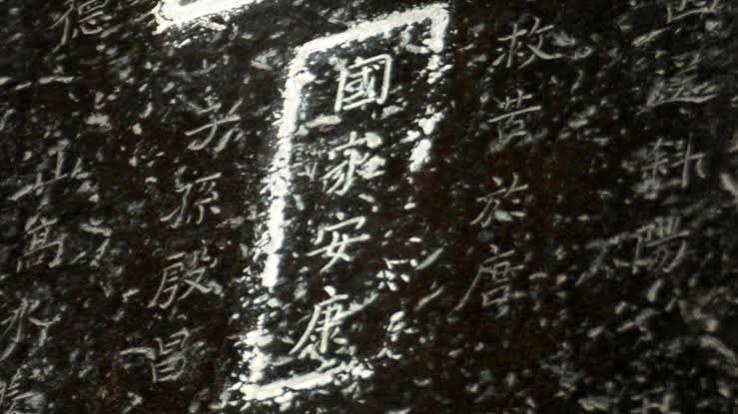
Astonishingly, the bell still hangs at Hōkō-ji, and anyone can walk up to it. The offending characters are outlined in white. The Buddha and its hall are gone, but the "evidence" that changed Japanese history hangs quietly in a small temple precinct. Fact