Solving the mysteryTechnically, Kyoto never stopped being the capital?
In 1868 Emperor Meiji travelled to Tokyo; in 1869 he went again and never came back. The government moved too, and Tokyo became the de facto capital. Fact
Yet no formal edict moving the capital was ever issued. Fact Historians therefore often call it Tōkyō tento ("establishing a capital in Tokyo") rather than sento ("moving the capital"). Kyotoites sometimes joke that "the Emperor's just popped over to Tokyo for a while." Urban legend
The reality was harsh. Courtiers and purveyors left, and the population fell sharply — from over 300,000 in the late Edo period to the low 200,000s in early Meiji, by some estimates. Likely "Kyoto will fade like Nara," people feared.
The challengersTownspeople built schools before the state did
The first counter-attack was education. In 1869 — three years before Japan's national school law — Kyoto's neighbourhoods each opened their own primary school. These were the Bangumi schools ("neighbourhood-unit schools"), 64 in all, considered Japan's first district-based elementary schools. Fact
Residents paid for much of the construction themselves, each household contributing according to the number of "hearths". Fact And the schools were more than classrooms: they served as neighbourhood meeting halls, had fire lookout towers, and hosted police posts and local offices — community centres in every sense. Fact
The challengersAn engineer in his twenties drills through a mountain — the Lake Biwa Canal
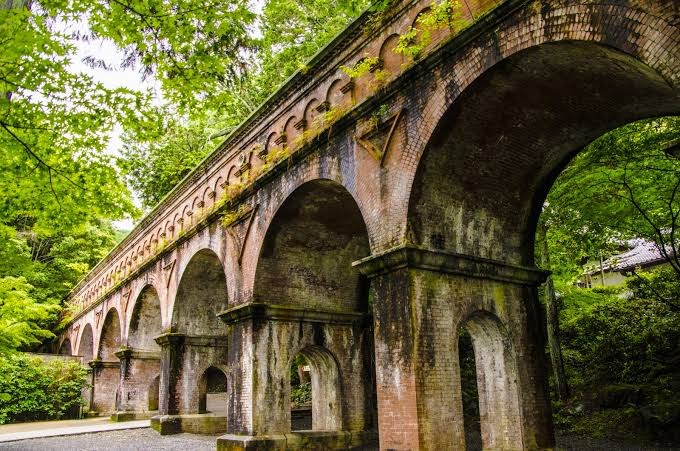
The next move was audacious: dig a canal from Lake Biwa in neighbouring Shiga, through the mountains, to Kyoto, for shipping, irrigation and water power — the Lake Biwa Canal (Biwako Sosui). It was driven by the third governor of Kyoto Prefecture, Kitagaki Kunimichi, and entrusted to Tanabe Sakurō, a new graduate of the Imperial College of Engineering (now the University of Tokyo). Fact
Tanabe had drawn up the canal plan as his graduation thesis. Recruited by the prefecture for his talent, he found himself, still in his early twenties, in charge of Japan's first large-scale modern civil engineering project. Fact Remarkably, surveying, design and construction were all done by Japanese engineers, without foreign advisers.
Work began in 1885 and the first canal opened in 1890. Fact The hardest part was the 2.4 km tunnel through Mount Nagara. Tanabe sank a vertical shaft from the mountaintop so crews could dig outward from the middle as well as from both ends — the first use of the method in Japan. Fact
Butterfly effectElectricity seen in America sets off a string of firsts
The canal was originally meant to power waterwheels. But in 1888, on a study tour of the United States, Tanabe and a colleague saw hydroelectric power being generated in Aspen, Colorado. Fact The plan changed, and in 1891 Keage Power Station — Japan's first commercial hydroelectric plant — began supplying electricity. Fact
- 1890 — The canal opensLake Biwa water reaches Kyoto.
- 1891 — Keage Power StationJapan's first commercial hydroelectric plant.
- 1895 — Japan's first commercial electric tramKyoto Electric Railway runs on canal power from near Kyoto Station to Fushimi. Fact
- Same year — National Industrial Exhibition & Heian ShrineOkazaki hosts the expo, and Kyoto is reborn as a modern city.
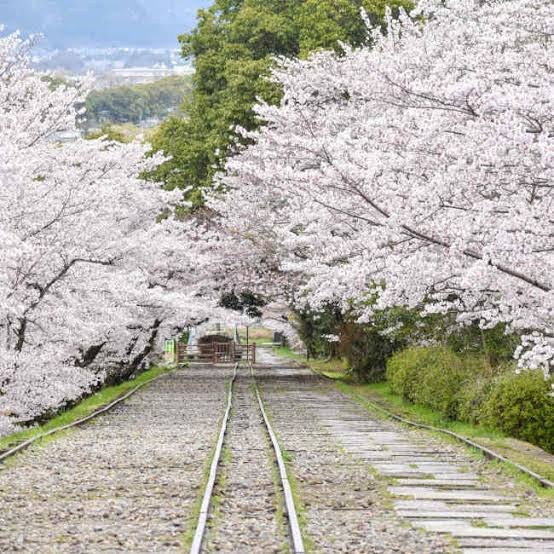
To move boats up and down the steep slope at Keage, engineers built the Incline: boats were loaded onto rail carts and hauled up or lowered down. It's about 582 m long. Fact Its shipping days are over; today you can walk along the rails, which turn into a tunnel of cherry blossoms in spring.
On the front lineKyoto today — tourism versus daily life
Now Kyoto faces a new challenge: overtourism. City buses packed with tourists leave locals stranded at stops; in Gion's narrow lanes, maiko are chased by cameras and crowds spill onto private property.
In 2024 the city launched express "sightseeing buses" linking major sights, to separate tourist traffic from regular routes. Fact Local councils posted no-photography signs on some private lanes in Gion. Fact And from March 2026 the accommodation tax was restructured, reaching up to ¥10,000 per night depending on room rate. Fact
Just as Meiji townspeople built their own schools ahead of the state, today's Kyoto is experimenting its own way toward a city that lives with visitors. As when it lost the capital, Kyoto is changing again.