Home / Dazaifu, the Mizuki wall and the Korokan
Dazaifu, the Mizuki Wall and the Korokan
In the 7th century, Japan suffered a crushing defeat in a war on the Korean Peninsula and lived in fear that the great armies of Tang China and Silla might invade. That was when an earthen wall more than 1 km long, the "Mizuki", was built at the inner end of Hakata Bay. Behind it sat Dazaifu, the government office that ruled Kyushu, and at the port stood a guesthouse to receive foreign envoys.
Labels: Factdocumented Likelysupported by most sources Legendoral tradition Urban legendlocal lore and rumour
Defeat at Baekgang, and a wall of earth
FactIn 663, Wa (Japan) sent a large army to the Korean Peninsula to try to restore the fallen kingdom of Baekje, but was crushingly defeated by the allied forces of Tang and Silla at the Battle of Baekgang. According to the Nihon Shoki (Chronicles of Japan), the following year, 664, a great embankment was built in Tsukushi to hold back water, and it was named "Mizuki" (water fortress).
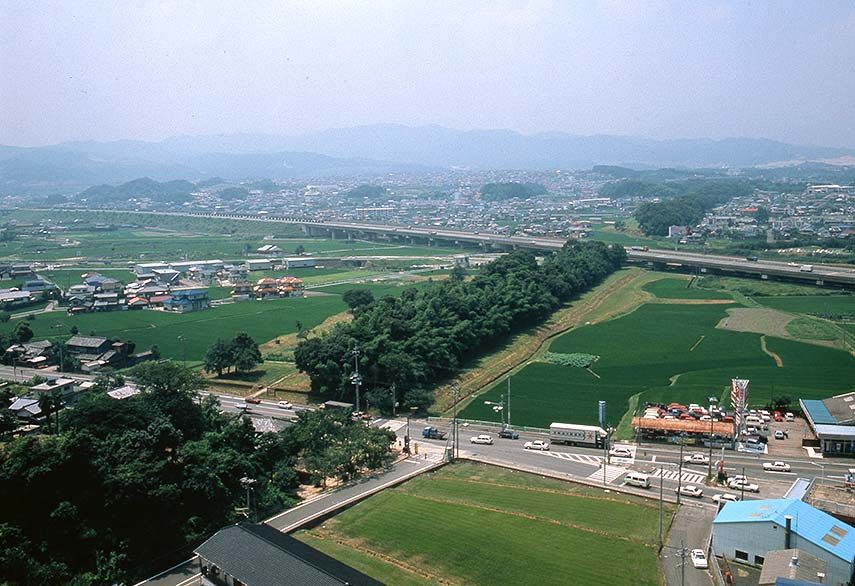
FactThe Mizuki is an earthen rampart about 1.2 km long, built to block the plain between two mountains and stop any invasion from the Hakata Bay side. Excavations have shown that it was about 9 m high, with a moat about 60 m wide on the Hakata side. It was built with the "hanchiku" technique, in which earth is pounded hard layer by layer, and archaeologists have also found "shikisoda", a method of laying tree branches and leaves into soft ground to stabilise it.
FactIn 665, under the guidance of aristocrats who had fled from Baekje, Korean-style mountain fortresses were built: Ono Castle on Mt Shioji to the north of Dazaifu, and Kii Castle to the south. Together, the Mizuki, Ono Castle and Kii Castle completed a line of defences around Dazaifu.
Dazaifu, the "distant court"
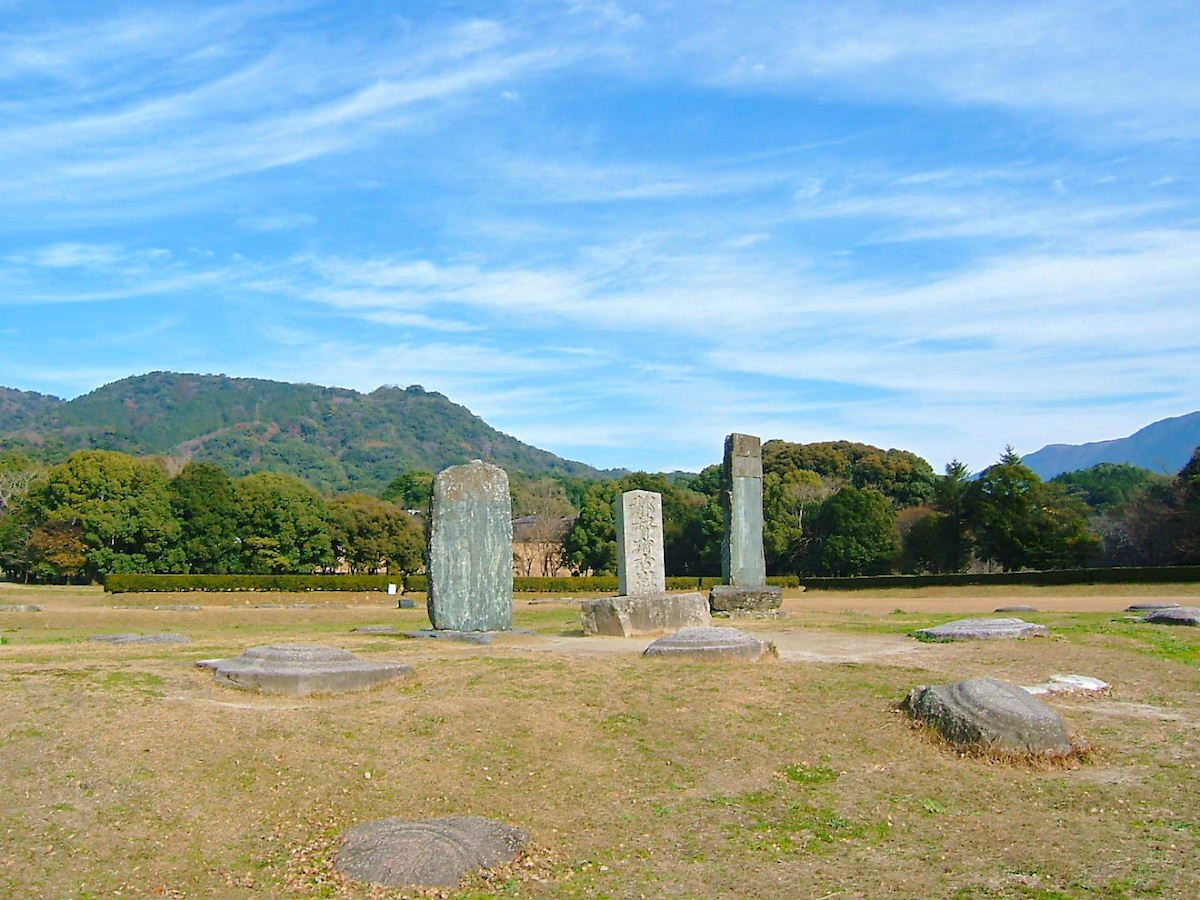
FactDazaifu was a regional branch of the imperial court that governed Kyushu (then nine provinces and two islands) and was responsible for diplomacy and national defence. The site of its central government office lies in today's Dazaifu City and is also known as the "Tofuro Site". In the Man'yoshu poetry anthology, Dazaifu is called "To no Mikado" (the distant court), meaning a seat of the court far away from the capital.
FactIn the Nara period, Otomo no Tabito was posted here as Dazai no Sochi (governor-general), and exchanged poems with Yamanoue no Okura and others. The preface to the poems composed at a plum-blossom party held at Tabito's residence became the source of the current era name, "Reiwa".
FactIn Japanese, the name of the government office and the name of today's city and Tenmangu shrine are written with different first characters, though both are read "Dazaifu". By convention, one character is used for the ancient office and its remains, and the other for the place name (see Dazaifu Tenmangu).
The Korokan: a guesthouse under a ballpark
FactDazaifu kept a facility near Hakata Bay for receiving and lodging foreign envoys and Japanese envoys to Tang China. In the 7th century it was called "Tsukushi no Murotsumi" (the Tsukushi lodge), and in the Heian period it came to be known as the "Korokan". Envoys from Tang and Silla, Japanese envoys to Tang, and later Chinese merchants all stayed here.
FactFor a long time no one knew where the Korokan had been. In the Taisho period, Nakayama Heijiro, a medical scientist at Kyushu Imperial University, argued that it had stood within the grounds of Fukuoka Castle, and in 1987 a survey carried out during renovation of the outfield stands at Heiwadai Stadium finally confirmed its remains. Of the Korokan guesthouses that also existed in Kyoto and Naniwa, Fukuoka's is the only one whose remains have been confirmed.
FactExcavations turned up Yue ware celadon from China, Islamic pottery and West Asian glass, showing that the Korokan was also a hub of international trade. Heiwadai Stadium closed in 1997, and the Korokan Site Exhibition Hall now stands on the site. The hall is closed for a renewal of its displays from October 2026 until late March 2027 (planned), and next to it work is under way to reconstruct a Korokan gate (see Fukuoka Castle).
Look for this: a "cross-section" of the Mizuki
The Mizuki still clearly keeps the shape of an embankment, and the JR and Nishitetsu railway lines and the Kyushu Expressway cut straight through it. If you see green embankments rising on both sides of the tracks from your train window, that is a line of defence more than 1,350 years old. At the "Mizukikan" near the East Gate site, you can learn about how the rampart was built and what the excavations found.
Main sources: Kyushu Historical Museum materials / Dazaifu City, commentary on the "Dazaifu Site" / Nihon Shoki, entries for the 3rd and 4th years of Emperor Tenji / Fukuoka City, Korokan Site Exhibition Hall commentary / Database of National Cultural Properties