Home / Fukuoka Castle and Ohori Park
Fukuoka Castle and Ohori Park
Walk 15 minutes west from Tenjin and you find cherry trees blooming on top of stone walls, and beyond them to the west a large pond 2 km around. These are Maizuru Park, on the site of Fukuoka Castle, and Ohori Park, once the castle's outer moat. This huge castle still holds one big mystery: did it ever really have a keep (tenshu)?
Labels: Factdocumented Likelysupported by most sources Legendoral tradition Urban legendlocal lore and rumour
Kuroda Nagamasa's great castle
FactGranted Chikuzen Province for his services at the Battle of Sekigahara in 1600, Kuroda Nagamasa first moved into Najima Castle (in today's Higashi Ward). It was cramped, though, and left little room to expand a castle town, so in 1601 he began building a new castle on Fukusaki, a hill west of Hakata. Finished after seven years of work, it was a hilltop-and-plain castle (hirayamajiro) that made use of the hill's shape, and with as many as 47 turrets it was one of the largest castles in Kyushu.
FactNagamasa named the place "Fukuoka" after Fukuoka in Bizen Province (today's Setouchi City, Okayama Prefecture), a place linked to the Kuroda family. Because of its graceful appearance the castle was also called "Maizuru Castle" (Dancing Crane Castle), and its site is now Maizuru Park (see Kuroda Kanbei and Nagamasa).
Was there a keep?
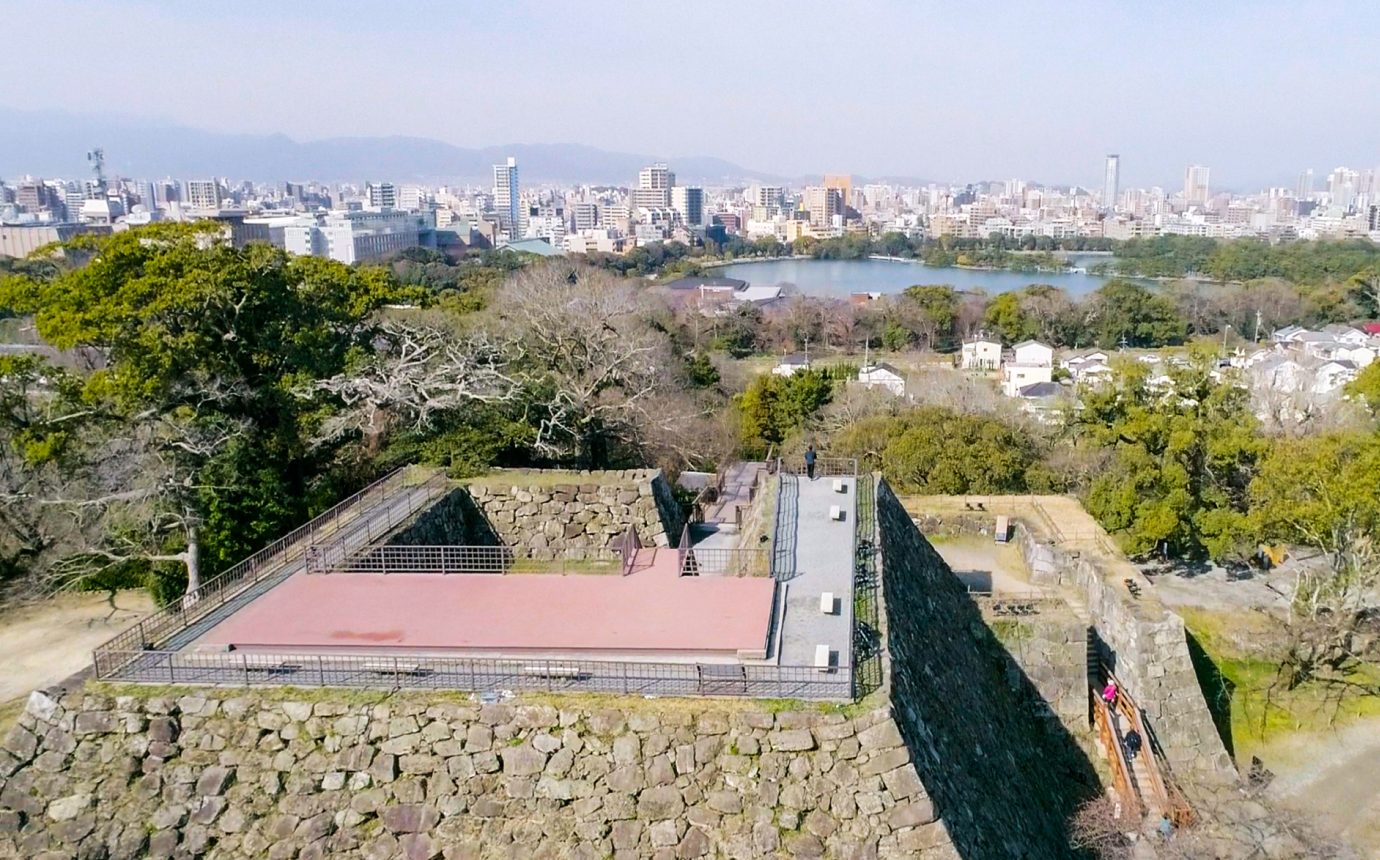
FactIn the honmaru (inner citadel) of Fukuoka Castle, the stone walls of a large keep base (tenshudai) survive. Yet the records of the Fukuoka domain and Edo-period maps show no keep, and for a long time people believed that "the base was built, but the keep never was".
LikelyIn recent years, however, a letter written in 1620 by Hosokawa Tadaoki of the Kokura domain in Buzen was found to contain a line saying that Kuroda Nagamasa was "apparently going to tear down his keep". This has led to the theory that a keep was built once but taken down early, out of deference to the Tokugawa shogunate. The foundation stones on the keep base can still be seen on the surface today. The first-ever excavation of the keep base, carried out in 2025, found thick footing stones laid beneath the foundation stones, suggesting they may have supported a large building. A letter in which Nagamasa appears to order the raising of the keep's pillars has also been presented, but none of this is yet conclusive proof that the keep existed, and the debate goes on.
FactOf the castle's buildings, the Tamon Turret in the southwest corner has survived since the Edo period and is a national Important Cultural Property. The Shimonohashi Gate, the Kinen Turret and others also remain within the castle grounds after restoration or relocation. The Shiomi Turret, which had been moved to a temple, has been moved back to its original spot and restored, and has been open to the public since 2025.
Ohori: a bay turned into a moat
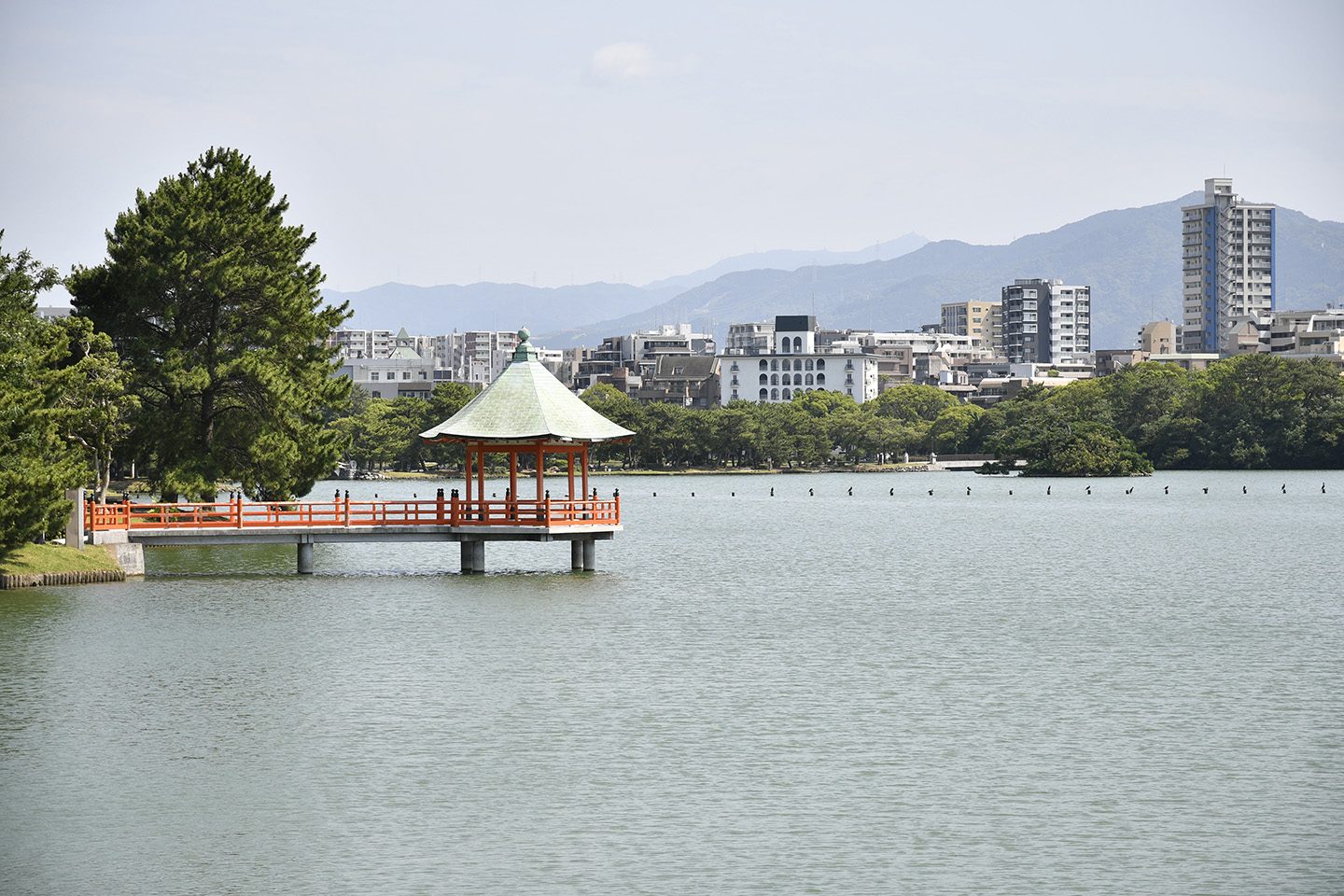
FactTo the west of Fukuoka Castle lay Kusagae, an inlet reaching in from Hakata Bay. Rather than fill it in, Nagamasa used it as the castle's outer moat. This is today's Ohori (literally "great moat").
FactIn the early Showa period, part of the Ohori was filled in to host the "East Asia Industrial Exposition" in 1927, and after the site was landscaped, the prefectural Ohori Park opened in 1929. Its layout, with islands and bridges set in the pond, is said to have been modelled on West Lake in Hangzhou, China. The path around the pond, about 2 km long, is now busy with locals jogging and strolling.
FactAfter the Second World War, one corner of the castle site was home to Heiwadai Stadium, the home ground of the professional baseball team the Nishitetsu Lions. The discovery beneath it of the remains of the Korokan, an ancient guesthouse for foreign envoys, was one of the great finds of Fukuoka archaeology (see the Korokan).
Look for this: the view from the keep base
Stairs lead up onto the keep base in the honmaru, from where you can look out over the high-rises of Tenjin, Hakata Bay and Ohori Park. (In 2026 the keep base is closed from May to the end of December [planned] for excavation work; check Fukuoka City's announcements for the latest information.) During the Fukuoka Castle Sakura Festival in spring, the stone walls and about 1,000 cherry trees are lit up at night. Look closely at the stone walls and you may spot marks carved into the stones (kokuin). They are thought to have identified which retainer was responsible for hauling each stone when the castle was built.
Main sources: Fukuoka City, "Fukuoka Castle Ruins" guide / Database of National Cultural Properties, "Fukuoka Castle Ruins" and "Fukuoka Castle Tamon Turret" / Fukuoka City Museum materials / Fukuoka Prefecture, "Prefectural Ohori Park" guide / Kuroda Kafu (Kuroda Family Records)