Home / Hakata, the international port
Hakata, the International Port
Hakata is one of the Japanese ports that has been open to the outside world the longest. At the end of the Heian period, merchants from Song China settled here, and in the Middle Ages it became the centre of trade between Japan and the mainland. When the town was burned to the ground in the age of civil war, it was Toyotomi Hideyoshi and the merchants of Hakata who rebuilt it.
Labels: Factdocumented Likelysupported by most sources Legendoral tradition Urban legendlocal lore and rumour
A town where Song merchants lived
FactIn the late 11th century, around the time trade at the Korokan came to an end, merchants from Song China began settling on the beaches of Hakata. Known as "Hakata goshu" (Hakata ship masters), they formed ties with Japanese temples, shrines and nobles and fitted out trading ships. Records say that the quarter where Chinese people lived together was called "Daitogai" (the Great Tang Street).
FactExcavations of the "Hakata Site Group", which lies beneath today's Hakata, have uncovered huge amounts of Chinese ceramics. In some places tens of thousands of fragments of Song and Yuan white porcelain and celadon turn up, dumped together, showing just how large a trading port Hakata was at the time.
FactThe most famous of the Song merchants is Xie Guoming. He lived in Hakata, married a Japanese wife, and gave major support when Shoichi Kokushi (Enni) founded Jotenji (see Jotenji).
The Ming tally trade, and a town in ashes
FactIn the Muromachi period, in the tally trade (kango boeki) with Ming China, Hakata merchants allied with the Ouchi clan and competed with the merchants of Sakai. They also traded busily with Joseon Korea and the Ryukyu Kingdom, and Hakata became a knot in the sea lanes of East Asia.
FactBut in the Sengoku (Warring States) period, wealthy Hakata became a prize fought over by the surrounding warlords. Amid the struggles between the Otomo, Mori, Ryuzoji and Shimazu clans, Hakata was burned again and again, and by the 1580s much of the town had been reduced to ashes.
Hideyoshi's "Taiko Machiwari"
FactIn 1587, having brought Kyushu under his control, Toyotomi Hideyoshi set up camp at Hakozaki (around today's Hakozaki Shrine) and ordered the burned town of Hakata to be rebuilt. This was the "Taiko Machiwari" (the Taiko's town plan). The town was laid out in a grid, with townhouses lined up along the streets.
FactThe blocks of town created by this plan are the "nagare". The nagare became the units of the town's self-government, and they are still carried on today as the organisation of the Hakata Gion Yamakasa festival (see Kushida Shrine and Yamakasa).
FactThe rebuilding was backed by two of Hakata's great merchants, Kamiya Sotan and Shimai Soshitsu. Both were close to Hideyoshi and Sen no Rikyu through the tea ceremony, and Sotan recorded scenes from Hideyoshi's tea gatherings and more in his "Sotan Nikki" (Sotan's Diary). Soshitsu made his fortune trading with Korea and China, and later left a set of precepts for his descendants on how a merchant should live.
Look for this: the temple district of Gokusho-machi
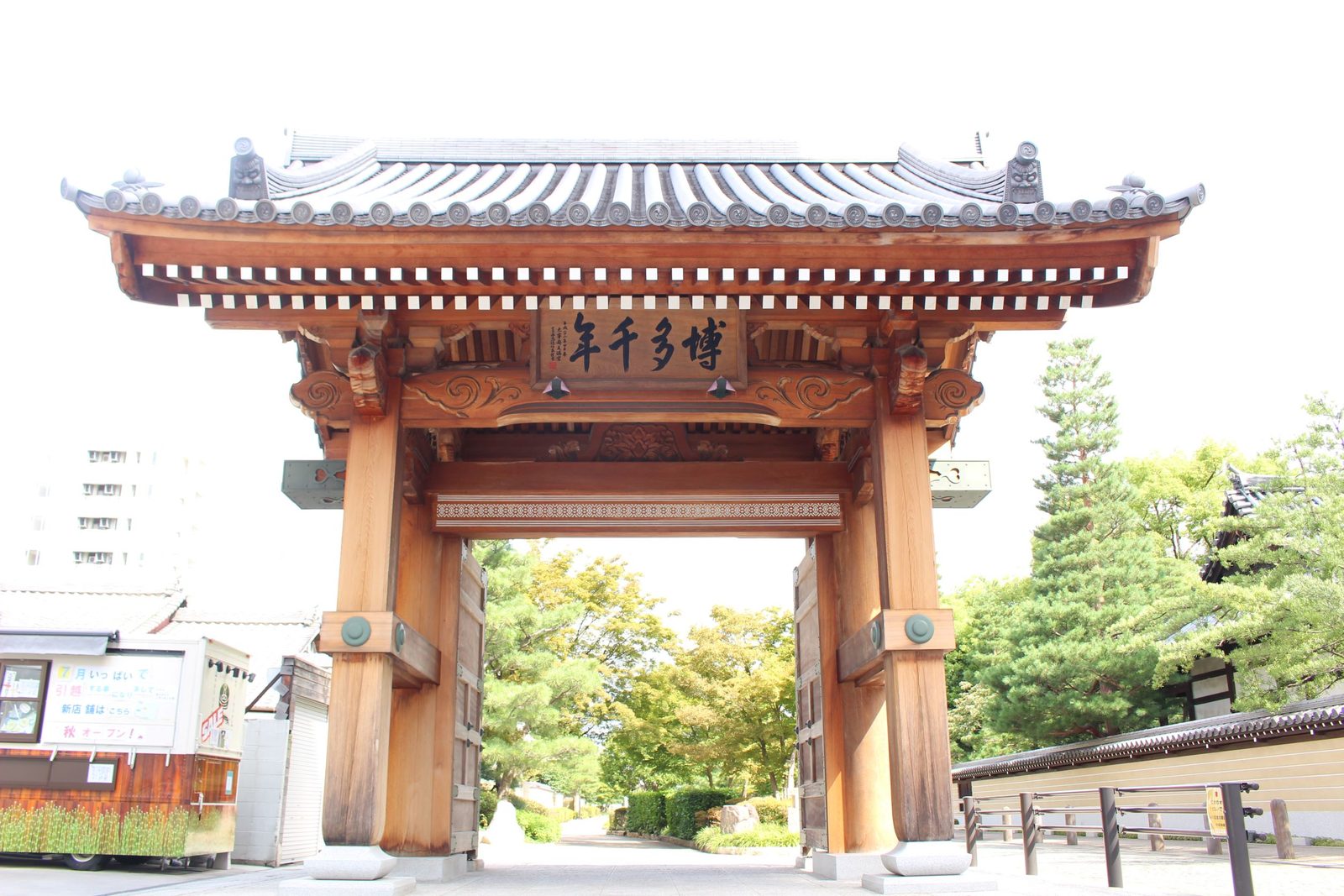
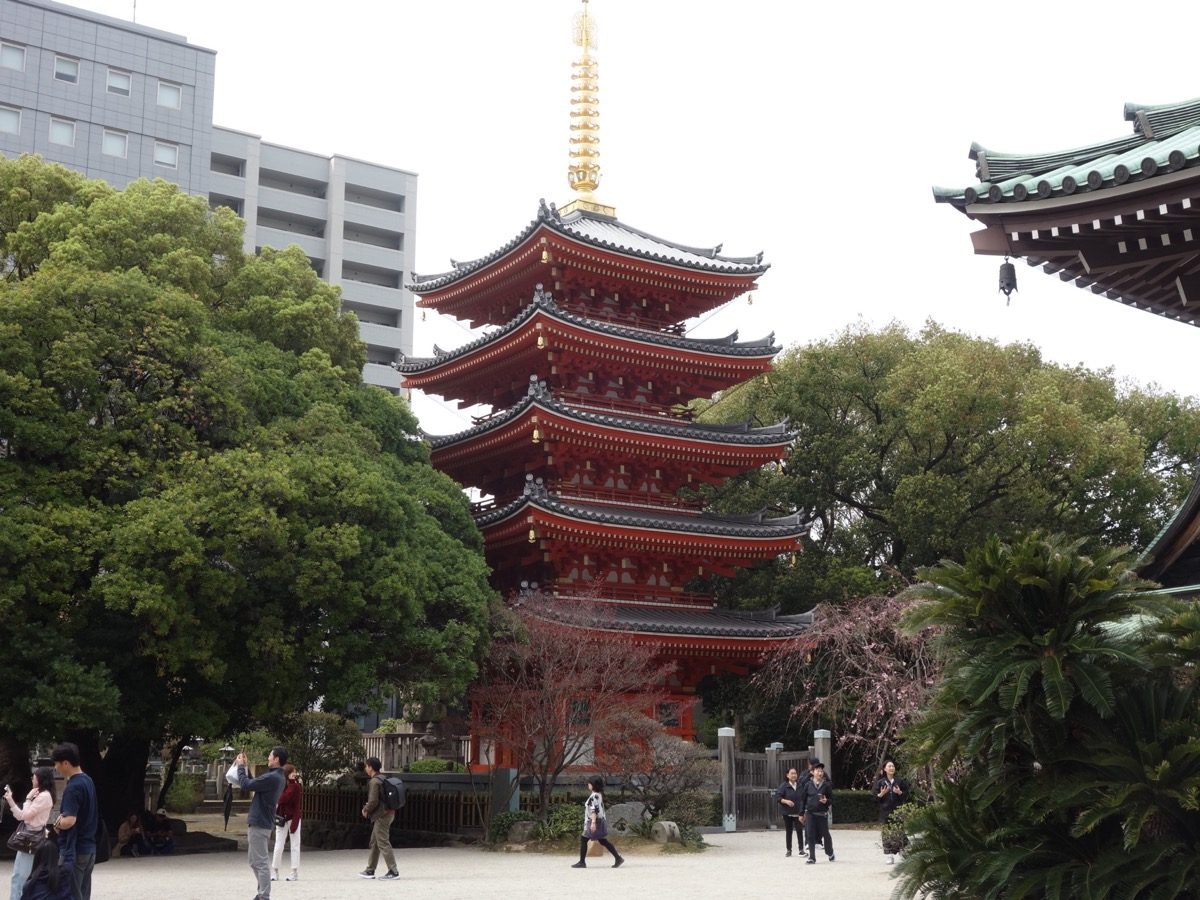
Walk north from Hakata Station and you enter Gokusho-machi, where temples such as Jotenji, Tochoji and Shofukuji are gathered. This temple district is said to have been laid out with its temples in a row as the eastern defence of the town of Hakata. In 2014 a wooden gate, the "Hakata Sennenmon", was built in front of Jotenji. The quiet streets lined with temple walls feel a world away from the office blocks just nearby.
Main sources: Fukuoka City Museum, exhibition materials on "Medieval Hakata" / Fukuoka City Archaeology Center, excavation reports on the "Hakata Site Group" / Jotenji official information / Sotan Nikki (Diary of Kamiya Sotan) / Fukuoka City, commentary on the "Taiko Machiwari"