Home / The Takayama Festival and Its Floats
04 — FESTIVAL
The Takayama Festival and Its Floats
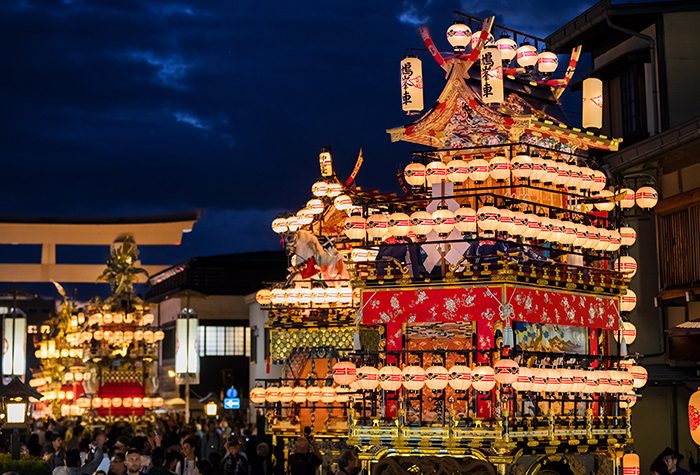
In spring and autumn, magnificent yatai (festival floats) are drawn out into the streets of Takayama. Carving, metalwork, embroidery, lacquer: the floats, into which the Hida craftsmen and townspeople poured their skill and wealth, have been praised as "moving Yomeimon gates". With string-worked karakuri puppets dancing, and a hundred lanterns lit at night, it is one of Japan's three most beautiful festivals.
Labels: Factdocumented Likelysupported by most sources Legendoral tradition Urban legendlocal lore and rumour
The spring Sanno Festival and the autumn Hachiman Festival
Fact"The Takayama Festival" is the collective name for two festivals. The spring Sanno Festival is the annual festival of Hie Shrine in the south of the town, held every year on 14 and 15 April. The autumn Hachiman Festival is the annual festival of Sakurayama Hachimangu in the north of the town, held on 9 and 10 October. The two are carried on by different parts of town: the upper town in spring, the lower town in autumn.
FactThe yatai drawn out for the festivals number 12 in spring and 11 in autumn, 23 in all. They appear in records from around the 18th century, and from the late Edo period into the Meiji era they were brought to their present splendour. Together with Kyoto's Gion Festival and Saitama's Chichibu Night Festival, the Takayama Festival is counted as one of "Japan's three most beautiful festivals".
Moving art galleries built by townspeople
FactThe floats belong to each neighbourhood's "yatai-gumi" (float guild). In Takayama, a town ruled directly by the shogunate, wealthy merchants in each float guild competed with one another, pouring money into the floats' carvings and decorations (the Old Town room). Among the craftsmen who carved the floats was Taniguchi Yoroku, a master whose work was hailed as "divine".
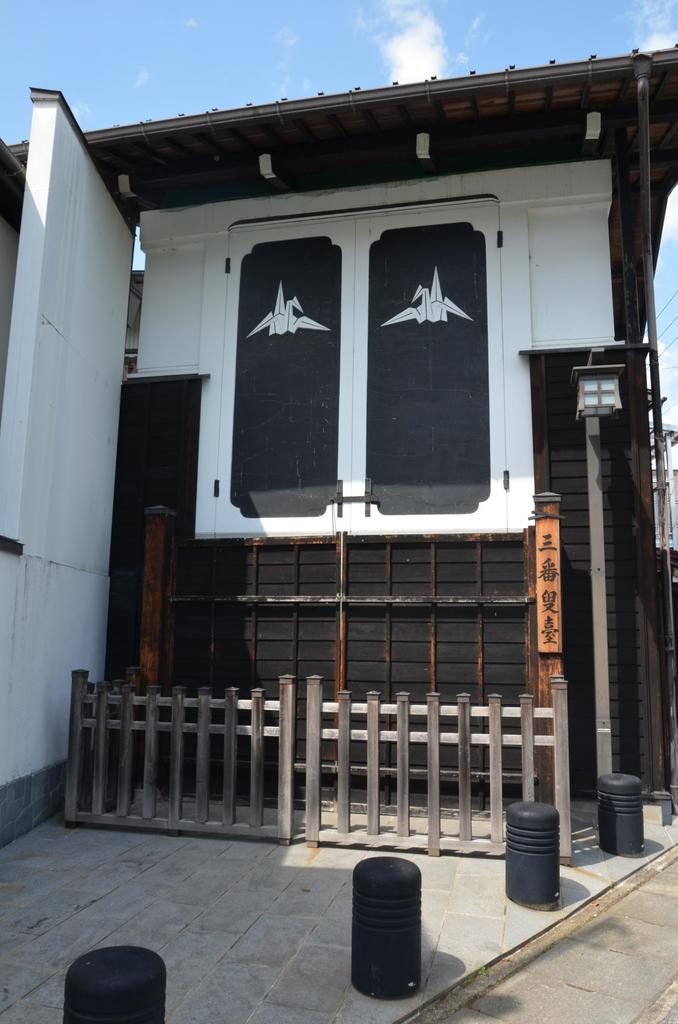
FactWhen the festival is over, the floats are put away in their neighbourhood's "yatai-gura" (float storehouse). These tall, white-walled storehouses with long, narrow doors stand here and there throughout the old town. Repairing the floats, too, has been handed down through the generations by the float guild members and craftsmen.
Karakuri puppets worked by strings
FactSeveral floats carry karakuri puppets (mechanical puppets). Puppeteers hidden inside the float work the puppets with many fine strings. At the spring festival three floats, Sanbaso, Sekkyo-tai and Ryujin-tai, perform karakuri as an offering, and at the autumn festival Hotei-tai does so. On Hotei-tai, you can watch a remarkable feat in which a karako (Chinese boy) puppet swings across the air from trapeze to trapeze and leaps onto the shoulder of the god Hotei.
"Moving Yomeimon gates"
Because of their lavish carvings and decorations, Takayama's floats have been likened to the Yomeimon gate of Nikko Toshogu shrine and called "moving Yomeimon gates".
Value recognised by the nation and UNESCO
The 23 floats were designated national Important Tangible Folk Cultural Properties in 1960, and the festival's float events Important Intangible Folk Cultural Properties in 1979. In 2016, together with 33 festivals from around the country, they were inscribed on UNESCO's Intangible Cultural Heritage list as "Yama, Hoko, Yatai, float festivals in Japan".
Look here: the Takayama Festival Floats Exhibition Hall
You can see the floats even when it is not festival time. At the Takayama Festival Floats Exhibition Hall in the grounds of Sakurayama Hachimangu, some of the autumn festival's floats are displayed in rotation. At the night festival, each float is lit with many lanterns and makes its slow way through the town, a beauty quite different from the floats by day.
Main sources: Takayama City, "Takayama Festival Floats" / Takayama Yatai Preservation Society / Agency for Cultural Affairs, Cultural Heritage Online / Sakurayama Hachimangu, "Takayama Festival Floats Exhibition Hall"