Home / Hida-Furukawa
08 — FURUKAWA
Hida-Furukawa
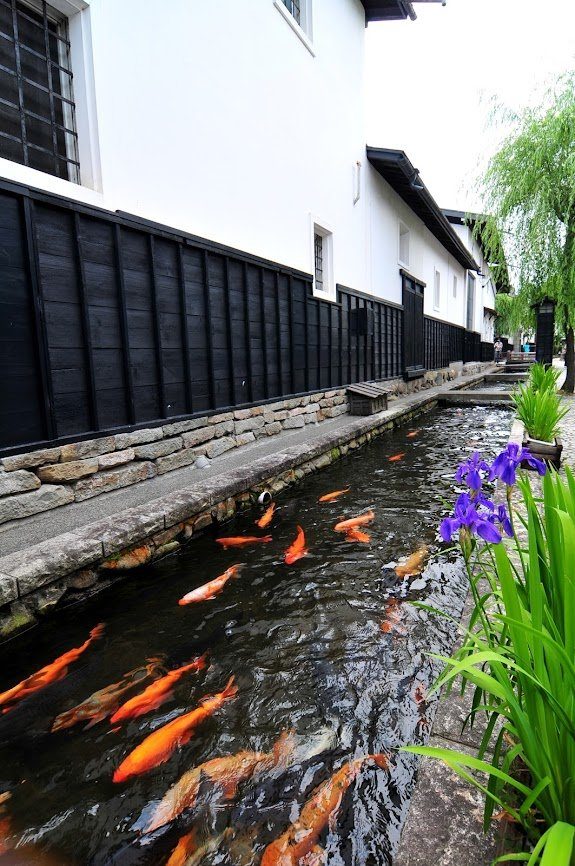
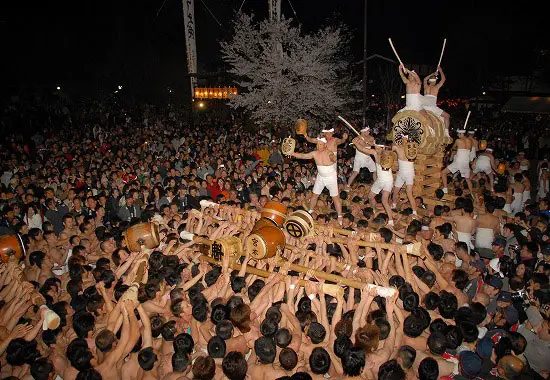
About 15 minutes north of Takayama by train lies Hida-Furukawa, a town where colourful carp swim in a canal lined with white-walled storehouses. It is a little smaller and quieter than Takayama. Yet on the night of its spring festival, men wrapped in white cotton sashes clash fiercely over a great drum. This is the story of the town of "Furukawa yancha", Furukawa's irrepressible spirit.
Labels: Factdocumented Likelysupported by most sources Legendoral tradition Urban legendlocal lore and rumour
The Seto River and the white storehouses
FactFurukawa-cho in Hida City began as a castle town laid out by Arishige, the second Kanamori lord of Takayama, when he built Masushima Castle (the Castle Town room). The Seto River that runs through the town is a canal dug to carry water to the rice fields, and white-walled storehouses and merchant houses line its banks.
LikelyA great many carp swim in the Seto River. This is said to have begun in the late 1960s and early 1970s (the Showa 40s), when townspeople released carp to clean up a river fouled by household waste water. In winter the carp are moved to ponds to escape the cold, and in spring they are returned to the river.
Okoshi-daiko: the night of "Furukawa yancha"
FactThe Furukawa Festival, held every year on 19 and 20 April, is the annual festival of Keta Wakamiya Shrine. On the night of the 19th, the "Okoshi-daiko" (the "rousing drum"), which announces the start of the festival, sets out into the town. Several hundred men wrapped in white cotton sashes carry a wooden tower bearing a great drum, and on top of the tower two drummers, sitting astride either side of the drum, beat it in turn.
FactThe men of each neighbourhood hold aloft small drums called tsuke-daiko, charge at the tower and fight for the place at its head. The fierce clashes go on until late at night. The next day the mood changes completely, as nine magnificent floats make their way around the town, performing karakuri puppet shows and children's kabuki. The Furukawa Festival was designated a national Important Intangible Folk Cultural Property in 1980, and in 2016 it was inscribed on UNESCO's Intangible Cultural Heritage list together with the Takayama Festival.
"Furukawa yancha"
The character of the Furukawa people is summed up as "Furukawa yancha" (Furukawa mischief). Locals speak with pride of the roughness of the Okoshi-daiko as an expression of that character.
A drum that announces the festival
The Okoshi-daiko was originally beaten to let the town know the festival was beginning. The struggle of the tsuke-daiko around that drum grew into the highlight of the festival.
Sandera Mairi: a night of Japanese candles
FactOn the night of 15 January every year, people make "Sandera Mairi", a pilgrimage around three of the town's temples (Enko-ji, Shinshu-ji and Honko-ji). It is held in memory of the virtues of the Buddhist teacher Shinran, and large warosoku (traditional Japanese candles) are lit along the Seto River.
LegendIn the past, the night of the temple visits was also a chance for young men and women to meet, so Sandera Mairi also came to be known as an occasion for finding love. Women in their finest kimono walk through the snow along the candlelit river.
Look here: a town visited by film fans
In the animated film Your Name. (Kimi no Na wa.), released in 2016, Hida-Furukawa's station, library, shrine and other places served as models for scenes in the film. Since its release, many fans from Japan and abroad have visited the town. When you walk around, please remember that this is where local people live their daily lives.
Main sources: Hida City, "Furukawa Festival" and "Sandera Mairi" / Hida City Tourism Association / Agency for Cultural Affairs, Cultural Heritage Online, "Okoshi-daiko and Float Events of the Furukawa Festival"