Home / Food of the Gods
06 — Food and folklore
Breakfast for the gods — without a day off in 1,500 years.
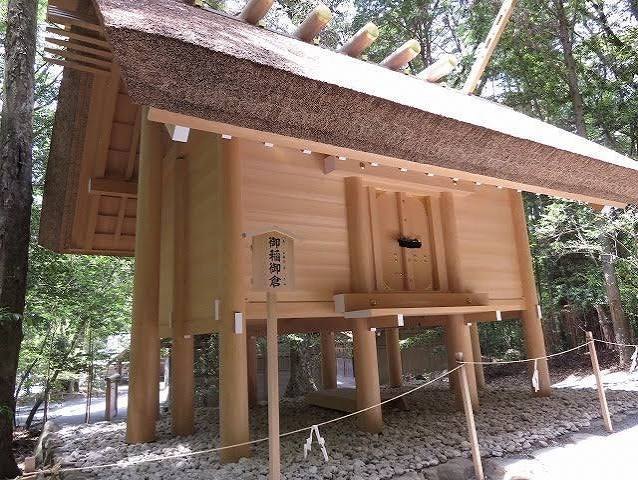
Every morning and evening at Gekū, meals are offered to the gods. Rice, salt, abalone, sake, even the dishes — almost all are produced by Jingu itself. The fire is lit not with matches but by friction; the water is drawn from a well inside the sacred precinct. Here is the supply chain behind the gods' table, and the food that filled pilgrims' stomachs.
The question of this room
Where does the gods' food come from?
THE QUESTION
How does Jingu source the daily offerings (shinsen)?
Jingu produces much of the food and tableware for its offerings in its own fields, salt pans and workshops. Instead of buying from outside, making it is itself part of the ritual.
In the Higoto Asayū Ōmikesai, held every day at Gekū's Mikeden, meals are offered to Amaterasu, Toyouke and the deities of the auxiliary shrines. The menu: three servings of rice, dried bonito, fish, seaweed, vegetables, fruit, salt, water and sake — morning and evening, rain or shine, New Year's Day included, for about 1,500 years.
The cooking fire is made at the Imibiya-den with a hikiri-gu, a fire drill spun against a cypress board. The water is drawn every morning from the well of Kaminomii Jinja within Gekū's precinct.
No "four-legged" food. Jingu's offerings contain no meat from animals such as cattle or pigs. The gifts of sea, mountain and paddy are at their heart.
Jingu's self-sufficiency
Rice, salt, abalone, sea bream — and the dishes
| Item | Where it is made | Notes |
|---|---|---|
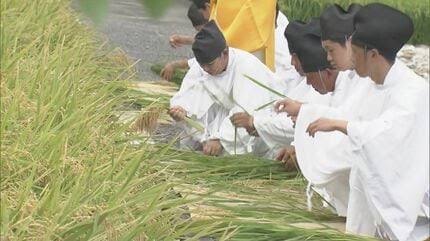
| Sacred rice | Jingu Shinden (Kusube, Ise) | Harvested after the spring sowing and autumn nukiho rites; offered at the Kanname-sai and more. |
| Vegetables & fruit | Jingu Misono (Futami, Ise) | Seasonal vegetables and fruit. |
| Sacred salt | Mishiohama & Mishiodono Jinja (Futami) | Crude salt from traditional salt pans is packed into earthenware and fired into hard triangular cones (katashio). |
| Abalone | Goryō Awabi Chōseisho (Kuzaki, Toba) | Abalone gathered by ama divers, sliced thin and dried as noshi-awabi. |
| Dried sea bream | Goryō Hidai Chōseisho (Shinojima, Aichi) | The island of Shinojima in Mikawa Bay has offered dried sea bream since ancient times. |
| Earthenware | Doki Chōseisho (Meiwa, Taki) | Unglazed vessels for the offerings are used once and never again. |
| Sacred sake | Misakadono of Naikū and Gekū, etc. | Shiroki (white), kuroki (black), reishu and other sakes brewed by Jingu. |
- LegendYamatohime receives abalone at KuzakiAn ama diver offers abalone to the travelling princess
- ThereafterKuzaki's abalone offering continuesAbalone stretched thin and dried — noshi-awabi
- Medieval–Noshi-awabi becomes a lucky giftLong, stretched abalone symbolises long life and prosperity
- TodayThe "noshi" on gift envelopesThe noshi decoration on Japanese gift wrapping is a simplified noshi-awabi
Shinojima's dried sea bream comes by boat from an island in Aichi Prefecture across the bay. That this cross-border offering has continued for over a thousand years shows that Jingu's "land of sacred food" once stretched around the whole of Ise Bay.
Feeding the pilgrims
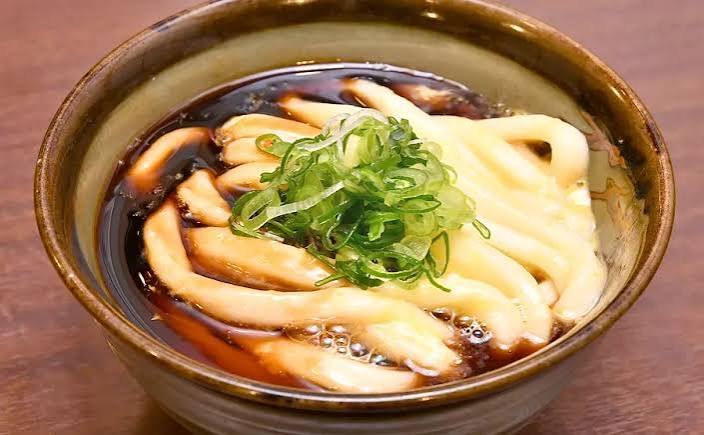
Why is Ise udon so soft?
Extra-thick noodles, so soft they seem to break when lifted with chopsticks, coated in a dark tamari-soy sauce: that is Ise udon. First-timers are often surprised at its lack of chewiness (koshi) — but there are good reasons for it.
① No waiting
In a gate town flooded with pilgrims, boiling noodles to order was impossible. Noodles were boiled for a long time in advance; when an order came in, they were simply reheated and sauced. Edo-period fast food.
② For weary travellers
After days on foot, a soft noodle was kind to the stomach. Locals still treat it as an easily digestible dish, fine even when you're ill.
③ Tamari country
Mie is tamari-soy country. Despite its dark colour, the sauce is less salty than it looks, with sweetness and depth.
④ A surprisingly new name
Locally it was long just "udon". The name "Ise udon" is said to have spread nationally after the TV personality Ei Rokusuke championed it on radio in the 1970s.
Tell a local that Ise udon "has no koshi" and you'll be told, "No koshi is the whole point." Some shops boil their noodles for close to an hour.
The mochi road
The road to Ise was paved with rice cakes
The roads to Ise have long been dotted with famous mochi rice cakes. For pilgrims, mochi were a quick way to fill up, a treat on the road and a cure for fatigue.
Akafuku mochi
Founded 1707. The three ridges on the smooth bean paste represent the clear stream of the Isuzu River; the white mochi, the pebbles on its bed.
Tsuitachi-mochi
Akafuku's special of the month, sold only on the first of each month. Before dawn on the 1st (except New Year's Day), long queues form at the head shop — inseparable from the custom of first-of-the-month worship.
Henba-mochi
Founded 1775. The name comes from the Miya River bank, where pilgrims who arrived on horseback or by palanquin "returned the horse" (henba).
Nikenjaya-mochi
Said to date from 1575, dusted with kinako. At the mouth of the Seta River, it was the first teahouse for pilgrims arriving by boat.
Other mochi
Kamiyo-mochi and Taikō Shusse-mochi in front of Naikū, Iwato-mochi in Futami… Ise is truly a mochi town, and every shop has its story.
Tekone-zushi
Not mochi, but a local staple: fishermen of Shima marinated fresh skipjack in soy sauce and mixed it by hand (tekone) with vinegared rice on board.
Read next
To the salt shore
Futami's shore, where Jingu's salt is made, was also where pilgrims once purified themselves.