Home / People of Ise
10 — Who's who
Those who upheld Jingu, and those who went out into the world.
Ise's history has been woven by the passions of many people: from mythical figures to medieval priests, a Warring States nun and modern entrepreneurs. Here are people you won't find in textbooks but who make Ise more fascinating once you know them.
Myth and the Middle Ages
Those who laid Ise's foundations
Yamatohime-no-mikotolegend
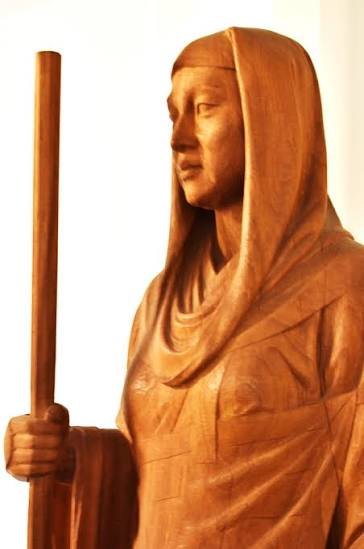
The princess who led Amaterasu to Ise
Said to be a daughter of Emperor Suinin, she travelled in search of a home for Amaterasu and enshrined her by the Isuzu River in Ise. Many of Jingu's rites, including the system of offerings and the abalone of Kuzaki, are traced to her.
The Nihon Shoki also tells how, when Yamato Takeru set out on his eastern campaign, his aunt Yamatohime gave him the sacred sword Kusanagi.
Watarai Ieyukic.1256–c.1351
The Gekū priest who systematised Ise Shinto
A member of the Watarai family, hereditary priests of Gekū. In an age dominated by Buddhism, he completed Ise (Watarai) Shinto, which systematised Shinto as an independent body of thought. His main work, the Ruijū Jingi Hongen, is said to have strongly influenced Kitabatake Chikafusa, a leading statesman of the Southern Court.
Arakida Moritake1473–1549
Naikū priest and a founder of haikai
A negi priest of Naikū. He established haikai, born as a playful offshoot of linked verse, as a literary form in its own right, and left the Moritake Senku. Praised with Yamazaki Sōkan as a founder of haikai, he stands at the source of the stream that led to Matsuo Bashō.
Keikōin Seijun?–1566
The nun who revived the Sengu after more than 120 years
Abbess of Keikōin, a convent in Uji. To revive the Sengu, halted during the Warring States period, she travelled the provinces raising donations, and in 1563 achieved the Gekū Sengu for the first time in 129 years. Her successor Shūyō carried on her work, leading to the rebuilding of both shrines in 1585.
From Edo to the modern age
Ise's scholars, and people who went out from Ise
Motoori Norinaga1730–1801
The kokugaku scholar of Matsusaka, Ise province
A man of Matsusaka in Ise province. He spent 35 years completing the Kojiki-den and brought kokugaku ("national learning") to maturity. Living a short distance from Jingu, he made the pilgrimage many times. His scholarship greatly influenced Jingu and modern Shinto.
Ajiro Hironori1784–1856
Gekū priest and kokugaku scholar
A scholar who served as a gon-negi priest at Gekū. He trained many students and sustained Ise as a centre of learning, and is also remembered for his efforts to relieve the poor during the great Tenpō famine.
Ozaki Yukio1858–1954
The "god of constitutional government" grew up in Ise
Born in Sagami province (now Kanagawa), he moved to Ise with his family as a boy. He was elected to the House of Representatives from Mie again and again, serving over 60 years, and was called the "god of constitutional government". The Ozaki Gakudō Memorial Hall in Ise tells his life story, including the cherry trees he gave to Washington.
Mikimoto Kōkichi1858–1954
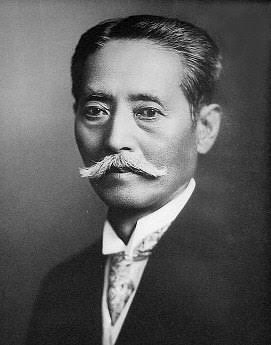
From Ise-Shima to the world: the Pearl King
Born the eldest son of an udon shop in Toba, in 1893 he became the first person in the world to succeed in culturing pearls. Chasing his dream to "adorn the necks of all the women of the world with pearls", he made Mikimoto a global brand. He spent his own money building a road for Ise, still called "Mikimoto Road" today.
Today, and an extra
The man who saved the gate town, and a writer who loved Ise-Shima
Hamada Masutane1937–
The businessman behind the gate-town revival
As president of Akafuku, he took on the revival of Naikū's declining gate town and led the opening of Okage Yokochō in 1993. His vision of reviving an entire town, beyond the bounds of one company, is known nationwide as a model for community renewal.
Edogawa Ranpo1894–1965
Extra: the mystery writer who lived in Toba
Before becoming a writer, in the Taishō era, he worked at a shipyard in Toba. There he met the woman he married, and formed a lifelong friendship with Iwata Jun'ichi, a Toba painter and folklorist. The seaside landscapes of Ise-Shima cast their shadow on his work.
Those who wrote of Ise
Ise in words
What it is that dwells here, I do not know — yet from sheer awe, my tears overflowA poem attributed to Saigyō, still widely recited as expressing the spirit of the Ise pilgrimage (translation)
From what tree's blossom, I cannot tell — but oh, the fragranceMatsuo Bashō, on visiting Gekū in 1688 (translation)
Saigyō, the poet of the late Heian period, is said to have spent several of his last years near Futami in Ise. The poem above is widely known as his, but it does not appear in reliable collections of his work, and some consider it attributed to him.
Matsuo Bashō came from Iga province (now Iga, Mie). He visited Ise many times, and left this haiku on sensing the sacred in the scent of a blossom whose tree he could not name, deep in the shrine forest.
Read next
What's normal for the people of Ise
Year-round shimenawa, first-of-the-month visits, the white-stone ceremony: common knowledge to locals, surprises to visitors.