Home / Shikinen Sengu
00 — A 1,300-year project
Every twenty years, the gods move house.
The main sanctuaries of the Inner and Outer Shrines, some 65 buildings, Uji Bridge, and more than 1,500 sacred robes and treasures: every 20 years Ise Jingu rebuilds all of it, new, on the plot next door. The cost: about 55 billion yen. The preparation: eight years. This national project, running since 690, stopped once — for more than 120 years during the Warring States period. What brought it back was the alms-collecting of a single Buddhist nun.
The question of this room
Why twenty years?
THE QUESTION
Not ten years, not fifty. Why every twenty?
Jingu itself says the reason is not certain. It has been explained from four directions: architecture, craft, economics and philosophy. This room examines each theory to get at the essence of the Sengu.
It is not only the buildings that are renewed. The fences and gates around the sanctuary, the treasure houses, and the 1,576 sacred objects in 714 categories known as Goshōzoku Shinpō — swords, bows and arrows, mirrors, textiles, even brushes and inkstones — are all made anew in the ancient manner. Besides the two main shrines, the 14 auxiliary shrines (betsugū) are rebuilt in turn.
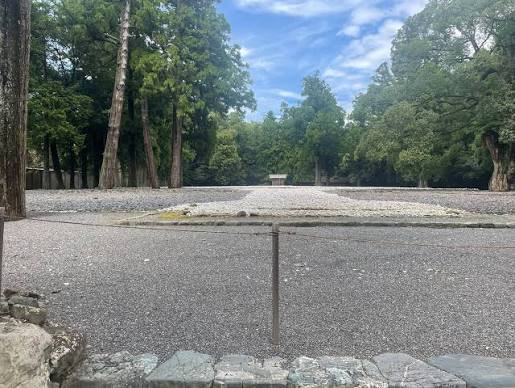
Each sanctuary has two sites of equal size, east and west. While the buildings stand on one, the other waits as a bare plot covered in white pebbles, the kodenchi. In the middle of the kodenchi stands a tiny hut. Beneath it is the spot where the shin-no-mihashira, a sacred pillar set under the centre of the sanctuary floor, stood — carefully guarded until the next rebuilding.
Four hypotheses
Four theories for the 20-year cycle
① Lifespan of materials
The sanctuary uses no foundation stones: its pillars are sunk directly into the earth (hottate-bashira) and its roof is thatched. One theory holds that 20 years is roughly how long plain, unpainted wood exposed to the weather can stay pristine. But with care it can last much longer, so this alone doesn't explain it.
② Passing on skills
A craftsman who joins as an apprentice at 20 can take part as a mid-career hand at 40 and as a master at 60 — two or three times in a lifetime. Twenty years is about the longest interval that can reliably pass on skills that can't be written in blueprints. This is the most widely supported theory today.
③ Grain storage limits
Under the ancient ritsuryō codes, long storage periods were set for emergency provisions such as dried rice. The theory links the cycle of food reserves with the cycle of ritual, and draws attention for the close ties between rice farming and Jingu.
④ The idea of tokowaka
Rather than repairing what has aged, you build it new to keep it forever young. An expression, some say, of a Japanese way of achieving permanence not through stone but through repetition.
The whole process
A move that takes eight years
The Sengu is not just the day the deity moves into the finished sanctuary. Taking the 62nd (2013) as an example, it was eight years from the first rite to the transfer, with more than 30 ceremonies and events carried out in a fixed order.
Yamaguchi-sai and Misoma-hajime-sai
Rites to the mountain gods at the forests where the timber is cut. In the Kiso forests, the sacred trees were felled with the ancient mitsu-himo-giri method, cutting from three sides with axes.
Okihiki (timber hauling)
The townspeople of Ise haul the timber into the sacred precincts on sledges and wagons; for Naikū, they pull it up the Isuzu River itself.
Chinchisai
Purification of the new site and prayers for safe construction.
Uji Bridge opening
The bridge is rebuilt ahead of the Sengu. Couples from three generations of the same family, chosen from across Japan, lead the first crossing.
Pillar-raising and ridge-raising
The pillars of the sanctuary go up, then the ridge beam: the climax of construction.
Oshiraishi-mochi
Citizens carry white stones gathered from the Miya River and place them one by one around the new sanctuary.
Sengyo (the transfer)
At night — 2 October for Naikū, 5 October for Gekū — with every light extinguished, the sacred object is carried to the new sanctuary, screened by silk curtains.
The night of the transfer is total darkness. At 8 p.m. all lights in the precinct go out and a priest calls out "Kakekō" three times, imitating a cockerel's crow — a re-enactment, it is said, of the myth in which crowing birds lured Amaterasu out of the Heavenly Rock Cave. The permitted attendees hear only the rustle of the silk screens moving through the dark.
A 200-year forest plan
Where do 10,000 cypress trees come from?
One Sengu needs roughly 10,000 hinoki cypress trees. The largest pillars require giants over a metre in diameter and more than 200 years old. In ancient times, the timber came from Mt. Kamiji and Mt. Shimaji behind the shrine — the misomayama, or sacred timber mountains. But as the rebuilding was repeated, good trees ran out. From the Kamakura period the source moved to Mikawa and Mino, and from the mid-Edo period to the mountains of Kiso.
Alarmed, Jingu drew up a forest management plan in 1923. The goal: in 200 years, to supply the timber once again from its own forest. This ultra-long-term plan, which began with planting, is bearing fruit. For the 62nd Sengu in 2013, cypress grown in the shrine forest was used for part of the timber for the first time in about 700 years.
The shrine forest covers about 5,500 hectares — roughly a quarter of Ise City. Only a tiny part near the approaches is open to people; most of it protects the source of the Isuzu River and grows cypress for future rebuildings. When locals say "the river is clean because of Jingu's forest", they mean it literally.
The 120-year gap
Dark ages, and a single nun
In the late Muromachi period, around the Ōnin War, the finances of both the imperial court and the shogunate collapsed, and no one could pay for the Sengu. Naikū's last rebuilding was in 1462, and Gekū's had stopped even earlier; for both shrines the gap exceeded 120 years. The buildings decayed, and rites were carried on in temporary halls.
The person who changed this was Seijun, a nun of Keikōin, a Buddhist convent in Uji. She travelled the provinces collecting donations (kanjin), first rebuilt Uji Bridge, and in 1563 finally achieved the Gekū Sengu — the first in 129 years. Her successor Shūyō secured the backing of Oda Nobunaga and Toyotomi Hideyoshi, and in 1585 both shrines were rebuilt in the same year. Throughout the Edo period, Keikōin remained deeply involved in the practical work of the Sengu.
When neither court nor shogunate could be relied on, the Sengu was supported by donations from countless ordinary people.The turning point at which Ise faith spread from state ritual to popular devotion
Butterfly effect: what one interruption created
- 1467–Ōnin War and bankruptcyThe court and shogunate can no longer fund the Sengu
- 15–16cSengu stops; fundraising beginsNuns of Keikōin collect donations from commoners across the provinces
- 16c–Ise becomes the people's shrineFor those who gave, Ise became "our Jingu"
- 17c–Oshi networks spread nationwideIse-kō associations form everywhere; pilgrimage becomes a popular dream
- 1705–Okage Mairi of millionsSometimes called Japan's first mass-tourism boom
Nothing is thrown away
Old timber works three times over 60 years
The parts of the old sanctuaries are not discarded. The most famous example is the fate of the munamochi-bashira, the thick free-standing pillars at each end of the sanctuary that support the ridge.
Naikū's old ridge pillars are reshaped into the inner torii of Uji Bridge (on the shrine side) and Gekū's into the outer one. Twenty years later, the Uji Bridge torii are raised again at the Higashi-no-Oiwake in Seki-juku, at the foot of the Suzuka Pass on the Tōkaidō, and at the Shichiri-no-Watashi ferry landing in Kuwana. In the Edo period, travellers from the east passed under the torii at Seki, and those arriving by boat under the one at Kuwana, and felt they had entered the province of Ise.
Other old timber goes to shrines across Japan for repairs and rebuilding. After the Great East Japan Earthquake of 2011, Jingu's old timber was used to rebuild damaged shrines.
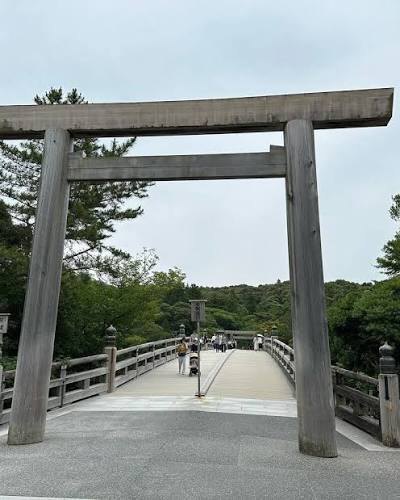
Insider's view: when you look up at the torii of Uji Bridge, remember it held up the ridge of the sanctuary until 20 years ago. And if you pass a torii at Seki or Kuwana, it may have stood in Ise's sanctuary 40 years ago.
The Sengu in numbers
The 62nd Shikinen Sengu (2013)
Funded not by the state but by Jingu's own funds and donations from across Japan.
Mainly from national forests in Kiso, and partly — for the first time in about 700 years — from Jingu's own forest.
714 categories, each handmade by master craftsmen in the ancient manner.
From the Yamaguchi-sai in 2005 to the transfer in 2013.
Counting from the first in 690. The 63rd is planned for 2033.
A record for the two shrines at the time.
Read next
How do the two shrines differ?
Gekū and Naikū, the stage of the Sengu, differ clearly — in the order of worship, the shape of their roof finials, even which side of the path you walk on.