Home / Legends & Myths
08 — Checking the rumours
Hexagram lanterns and a jealous goddess.
A place with nearly two thousand years of history attracts rumours. Stone lanterns carved with hexagrams, Hebrew letters on the sacred mirror, couples who break up after visiting. In this room we take Ise's legends and urban myths one by one and sort them against the sources into "Fact", "Mixed" and "Myth".
The question of this room
Why does Ise have so many rumours?
THE QUESTION
The less you can see, the more is said.
No one can see Jingu's sacred object, the Yata no Kagami mirror. The inner sanctuary and the Sengu rites are almost entirely closed to view. That invisibility has fired imaginations and given birth to countless legends and urban myths.
How we judge:
Fact Confirmed by historical sources or official records
Mixed Facts mixed with interpretation or folklore
Myth No reliable evidence found
The hexagram rumours
"Kagome" lanterns and the Japanese-Jewish common ancestry theory
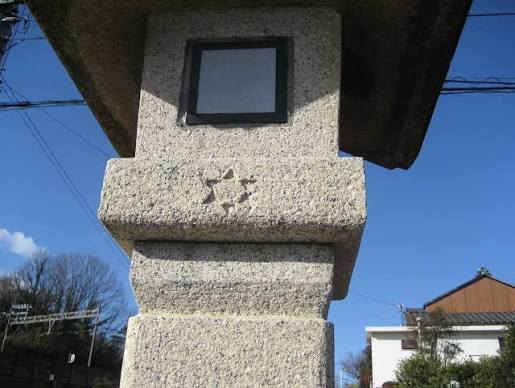
The Star of David is carved on the lanterns along the approach
Along pilgrim roads in Ise City stand rows of stone lanterns carved with a hexagram (the kagome pattern). Some call it the Star of David and cite it as evidence for the theory that ancient Israelites and Japanese share common ancestors. In fact these lanterns were donated by a private supporters' association in the 1950s–60s and are not Jingu facilities. The hexagram is said to be that association's emblem, not something handed down from antiquity. The lanterns are real; the "trace of ancient Israel" interpretation has no basis.
Jingu's crest is a hexagram
Jingu's crest is the hanabishi, a four-petalled flower lozenge, seen on its lanterns and elsewhere — not a hexagram. A story also circulates that Izawa-no-miya's old crest was a hexagram, but no reliable source has been found.
Hebrew is written on the back of the sacred mirror
Books on the common-ancestry theory repeat a tale that a Meiji-era official saw the sacred mirror and found the words "I am that I am" in Hebrew on its back. But the sacred object is something even emperors do not look upon directly, and there is no record of anyone examining it. The story's origin is unclear — a textbook urban legend.
Rumours about worship
Do couples who visit Ise really break up?
Couples who visit Ise Jingu together will break up
The reason given is that "Amaterasu is a goddess and gets jealous of happy couples". But nothing of the kind appears in the myths or in Jingu's teaching. On the contrary, couples of three generations lead the first crossing of the new Uji Bridge, and Futami has its Wedded Rocks. Ise is a place that has cherished the bonds of couples and families. If anyone does break up, it may be because they quarrelled on the long approach.
You shouldn't make personal wishes at Ise Jingu
In ancient times, anyone other than the emperor was forbidden to make personal offerings at Jingu (shihei kindan). Hence the saying "give thanks at the main sanctuary; take personal wishes to Aramatsuri-no-miya". The history of shihei kindan is real, but Jingu today welcomes individual worshippers and performs private prayers at the Kaguraden. There is no rule against making a wish.
If the curtain at the sanctuary lifts in the wind, you are welcome
When the white curtain (mitobari) at the sanctuary gate billows up in the breeze while you pray, people say "the gods are welcoming you". A heart-warming tale, but not a tradition with any particular basis. Still, if you get to feel that moment, it makes a good memory.
Rain on your visit is "purifying rain" and brings good luck
Locals say this too. Rain is purification from heaven, cleansing you before worship. It isn't based on any specific source, but it chimes with Shinto ideas of purifying with water — and the shrine forest in the rain has a beauty of its own.
Real wonders
Stories that sound like myths but are true
There's a talisman inside a Uji Bridge finial
Uji Bridge has 16 giboshi finials on its railings. Inside the second from the north on the west (town) end is a talisman (mandoma) of Aedo-hashihime Jinja, the shrine that guards the bridge. That's why you'll see visitors touching this particular finial.
Chickens roam free at Jingu
You may see chickens strolling in the grounds of Naikū and Gekū. Called shinkei, sacred chickens, they recall the "long-crowing birds of the eternal land" that were made to crow to lure Amaterasu out of the Rock Cave. They were donated by worshippers and are treasured as messengers of the gods.
Ise has several "Heavenly Rock Caves"
Sites claiming to be Ama-no-Iwato, where Amaterasu hid, exist all over Japan — and several in Ise-Shima. The stone chamber of the mound on Mt. Takakura behind Gekū drew pilgrims as the "Iwato" in the Edo period. The Erihara Water Cave in Shima is also called Ama-no-Iwato, and its spring is one of Japan's 100 best waters. None can be proven as the mythical site, but the history of belief is genuine.
Sarutahiko is the prototype of the tengu
The Nihon Shoki describes Sarutahiko with a nose seven hands long, a height of over seven feet and eyes shining like mirrors. That "long nose" linked him with the image of the long-nosed tengu, and in festivals across Japan a Sarutahiko in a tengu mask often leads the portable shrine. There's no proof they are the same being, but the theory is persistent.
How to read legends
Why do urban legends keep appearing?
Many of Ise's urban legends arise from a combination of the unseen and the ancient. The sacred object can't be seen. The secret rites of the Sengu can't be seen. And nearly two thousand years of history can hardly be verified by anyone. People have written stories into those gaps.
Yet the facts are often more fascinating than the legends. Meals offered to the gods for 1,500 years, pillars used three times over 60 years, a shrine that claimed to be the true original in the Edo period — Ise's real wonders lie in the sources.
A tip for checking: when you meet a story that "is said to be", ask who started saying it, and when. Many urban legends trace back to relatively recent books and magazines.
Read next
Modern Ise was called the "Holy City"
The Meiji Restoration transformed Ise to its roots: temples destroyed, oshi abolished, and the railway.