Home / Futami & Mt. Asama
07 — The full pilgrimage
Begin at the purifying shore, end at the mountain temple.
In the Edo period, an Ise pilgrimage didn't end with Gekū and Naikū. First you purified yourself at Futami-ga-ura, then worshipped at both shrines, and finally climbed Mt. Asama. "If you go to Ise, climb Asama too — or your pilgrimage is only half done." Let's follow the original route.
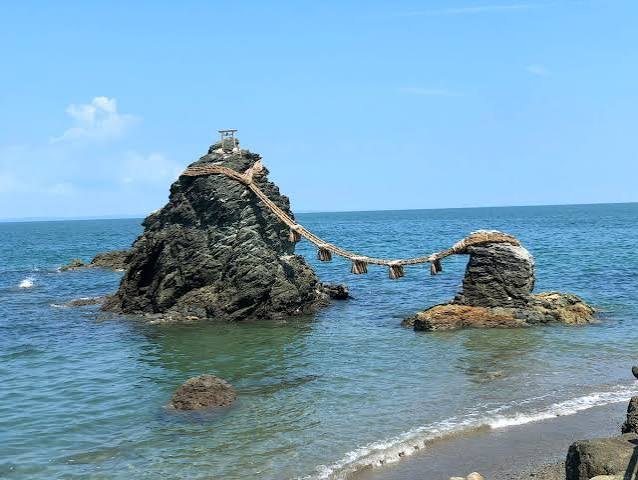
The question of this room
What are the Wedded Rocks actually worshipping?
THE QUESTION
Meoto Iwa is a symbol of marriage — but that's not the whole story. What did people really worship here?
The two rocks joined by a great shimenawa are famous as a symbol of marital harmony. But originally they serve as a "torii" for worshipping a sacred rock beneath the sea offshore, and the sun that rises beyond it.
About 700 m off the Wedded Rocks lies a submerged rock called Okitama Shinseki, a sacred stone associated with the deity Sarutahiko. The Wedded Rocks are thought to act as a torii framing this stone and the sunrise.
Around the summer solstice, the sun rises between the two rocks. On clear days it can even appear from behind the distant Mt. Fuji, and people gather before dawn to see it.
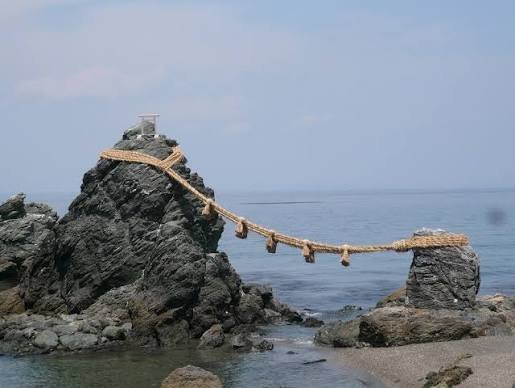
The great rope
The rope joining the husband and wife rocks is about 35 m long. Worn by the salt wind, it is replaced in a ritual three times a year (May, September, December).
Hama-sangū
Edo-period pilgrims bathed in the sea at Futami to purify themselves before visiting Ise. Today a purification with muku-shiogusa, a seagrass, at Futami Okitama Jinja takes its place.
The frog shrine
Futami Okitama Jinja is full of frog statues, messengers of Sarutahiko. In Japanese, kaeru (frog) also means "return" — a safe return, or getting back what you lent.
Japan's first beach?
Futami-ga-ura was officially designated a sea-bathing beach in 1882, often called Japan's first. Hinjitsukan, built as a rest house for the imperial family, is an Important Cultural Property.
The salt shore
Jingu's salt is still made at Futami
Futami also produces Jingu's sacred salt. At the Mishiohama salt pans near the mouth of the Isuzu River, concentrated brine is collected in the traditional way around midsummer. It is boiled down in the grounds of Mishiodono Jinja into crude salt, then packed into triangular earthenware moulds and fired into hard katashio. The salt is used throughout the year in offerings and purifications.
Insider's view: making salt at the mouth of the Isuzu has meaning too. Here, the clear river water flowing out of Jingu's forest meets the sea of Ise Bay. The sacred salt embodies the connection between the shrine forest and the ocean.
Mt. Asama
"Skip Asama, and your pilgrimage is only half done"
If you go to Ise, climb Asama too — without Asama, it's only half a pilgrimageWords passed down as a line of the Ise Ondo
Mt. Asama (555 m) rises on the border of Ise and Toba. At its top stands Kongōshō-ji, an ancient Rinzai Zen temple said to guard Jingu's "demon gate" (the unlucky north-east direction). In the Edo period it was an essential final stop on the pilgrimage. In an age when kami and buddhas were seen as one, an Ise pilgrimage wasn't complete with the shrines alone.
The stupas of the Oku-no-in
The path to the temple's inner sanctuary is packed with huge wooden memorial tablets (sotoba), some several metres tall, erected by families for the dead. The sight is overwhelming.
Take-mairi
In the Ise-Shima region, when someone dies the family climbs Mt. Asama to hold a memorial — a custom called take-mairi. "The souls of the dead go to Asama", people say; the tablets are its expression.
Mankintan
A pill famed as the speciality of Mt. Asama. Carried home across Japan as a standard Ise souvenir, it was known as "Ise's Mankintan".
A footbath in the sky
From the summit observatory of the Ise-Shima Skyline you can see Ise Bay, and on clear days Mt. Fuji. Soak your feet in the footbath and look down on the whole pilgrim route.
The god who leads the way
Sarutahiko Jinja and its descendants
Sarutahiko Jinja, near Naikū, enshrines Sarutahiko Ōkami, who guided Amaterasu's grandson Ninigi on his descent from heaven. He is the god of michi-hiraki, "opening the way", who leads things in a good direction. The shrine's priestly family, the Uji no Tsuchigimi, are said to be Sarutahiko's descendants. When Yamatohime came to Ise, Sarutahiko's descendant Ōta no Mikoto is said to have offered her the land by the Isuzu River, and the family was long deeply involved in running Naikū.
Hōi-seki, the direction stone
An octagonal stone post in the grounds, marking the site of a former sanctuary. Many visitors touch its engraved directions for good fortune.
Sarume Jinja
A shrine within the grounds to Ame-no-Uzume, who danced before the Heavenly Rock Cave. As the deity of the performing arts, it is popular with entertainers.
The whole course
The ideal Edo-period pilgrimage
Purify at Futami
Bathe in the sea to cleanse yourself — ideally at sunrise.
Worship at Gekū
Following Gekū senzai, go to the Outer Shrine first. Most oshi mansions were in Yamada, around Gekū.
Cross Ai-no-yama
The slope of the pilgrim road. Many took a break at Furuichi…
Worship at Naikū
Cross Uji Bridge, purify your hands in the Isuzu, and proceed to the sanctuary.
Climb Mt. Asama
Visit Kongōshō-ji to complete the pilgrimage.
Read next
Strange stories of Ise
Hexagram lanterns, couples who break up after visiting… Ise's rumours, checked against the sources.