Home / Furuichi
04 — The pilgrim road's other side
"Off to Ise — and dropping by the Grand Shrine too."
Halfway along the pilgrim road between Gekū and Naikū, on a hill called Ai-no-yama, stood one of the great pleasure quarters of Edo-period Japan. At its peak: some 70 brothels and 1,000 courtesans, theatres, and nightly performances of the Ise Ondo dance. Why did such a town of pleasure grow up right next to the town of the gods?
The question of this room
Why was there a pleasure quarter beside the sacred precinct?
THE QUESTION
Why did the sacred and the profane stand so close together?
An Edo-period senryū goes: "Ise mairi / Daijingū ni mo / chotto yori" — "Off on the Ise pilgrimage, and dropping by the Grand Shrine too." The joke is that the real destination was Furuichi. But it's more than a joke: it reflects the very structure of the pilgrimage.
After a long journey and their worship, pilgrims looked for somewhere to release the tension — an indulgence called shōjin otoshi, "ending the abstinence". For men carrying their association's travel funds on the trip of a lifetime, Furuichi was the journey's other highlight.
Furuichi lies exactly halfway along the roughly 5 km pilgrim road between Gekū and Naikū. Everyone going from Gekū to Naikū, or back, had to climb this slope. Where everyone passed, a town grew up that everyone wanted to stop at — that is how Furuichi began.
Furuichi at its height
70 houses, 1,000 courtesans
Furuichi flourished most around the Tenmei era in the late 18th century. According to records of the time, there were about 70 brothels and 1,000 courtesans, and it was spoken of alongside Yoshiwara in Edo and Shimabara in Kyoto. The great houses — Bizen-ya, Sugimoto-ya, Abura-ya and others — were known for their grand buildings and lavish hospitality.
The Ise Ondo ensemble
Furuichi's speciality was the Ise Ondo danced in unison by courtesans in matching costumes. The great houses had stages in their halls, and guests watched while they feasted.
A proving ground for actors
Furuichi also had theatres where many actors from Osaka and Kyoto performed. Playing to discerning audiences from all over Japan, the Furuichi stage was said to be a kind of test for actors.
Osugi and Otama of Ai-no-yama
On the Furuichi slope, women entertainers known as "Osugi and Otama" sang to the shamisen and dodged, with great skill, the coins pilgrims threw at them. They appear again and again in travel diaries and guidebooks of the time.
A crossroads of news
With people gathering from all over Japan, Furuichi was also a crossroads of fashion and information. The Ise Ondo is thought to have spread nationwide because pilgrims who enjoyed it in Furuichi took it home.
The Aburaya incident
From crime to kabuki in two months
In the summer of 1796, an incident took place at Abura-ya, one of Furuichi's great houses. Magofuku Itsuki, a doctor from Uji, flew into a rage over a misunderstanding concerning Okon, a courtesan he favoured, and slashed staff and guests with a sword. Nine people are said to have been killed or wounded; Itsuki fled and later took his own life.
The case shocked the public and was dramatised with astonishing speed. Within about two months it was staged in Osaka as the kabuki play Ise Ondo Koi no Netaba, and it was a huge hit — as fast as any modern tabloid TV. The play is still performed today and has carried Furuichi's name down the centuries.
Insider's view: Dairin-ji temple in Furuichi has a hiyoku-zuka, a joint memorial to Okon and Magofuku Itsuki. Kabuki actors are said to visit it when staging the play, and the story lives on as a tragic romance.
- May 1796Bloodshed at Abura-yaA doctor, enraged over a courtesan, kills and wounds many
- c. July 1796Kabuki in OsakaStaged as Ise Ondo Koi no Netaba — a smash hit
- AfterFuruichi and Ise Ondo go nationalThe incident itself advertised the town
- TodayA classic still on stageOkon of Abura-ya remains a signature kabuki role
Walking Furuichi today
Looking for traces on the Ai-no-yama slope
After the Meiji era, as the railway changed pilgrims' routes, Furuichi gradually declined, and with the postwar Anti-Prostitution Law its history as a pleasure quarter came to an end. Today Furuichi is a quiet residential area with only faint traces of its past.
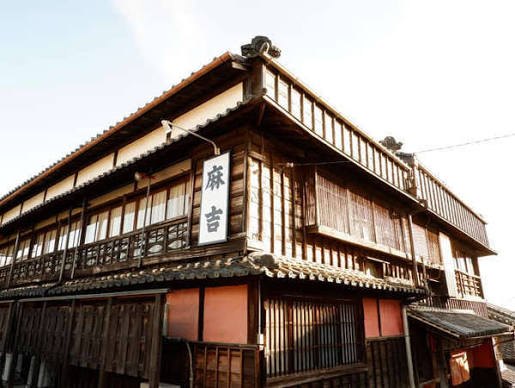
Asakichi Ryokan
An inn said to date from the late Edo period. Its wooden buildings climb a steep slope in tiers (kengai-zukuri), and it is a registered tangible cultural property. It is almost the only large building that conveys old Furuichi.
Ise Furuichi Sangū Kaidō Museum
A small museum with materials on Furuichi's history, the kabuki play Ise Ondo Koi no Netaba and folk life along the pilgrim road. A good starting point for a walk.
Dairin-ji
The temple with the joint memorial to Okon and Magofuku Itsuki. The site of Abura-ya, scene of the incident, is nearby.
The pilgrim road slope
The old road from Gekū to Naikū. Quiet and nearly car-free now, it was once travelled by millions.
Furuichi survives in place names such as Furuichi-chō and Nakano-chō, but many younger locals don't know there was once a pleasure quarter here. Asakichi still operates as an inn — stay the night and you can experience the Furuichi slope after dark.
Read next
How did the gate town survive?
While Furuichi declined, Naikū's own gate town faced a crisis of survival at the end of the Shōwa era.