Home / Gekū & Naikū
01 — The two main shrines
From Gekū to Naikū: the order has a reason.
Ise Jingu has two centres: the Inner Shrine, Naikū (Kōtai Jingū), dedicated to Amaterasu Ōmikami, and the Outer Shrine, Gekū (Toyouke Daijingū), dedicated to Toyouke Ōmikami, who provides her food. About 5 km apart, the two differ in many details, from the cut of their roof finials to the side of the path you walk on. Knowing them makes a visit far more interesting.
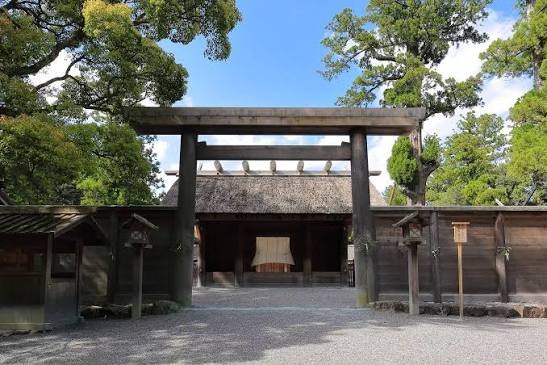
The question of this room
The goddess's "caterer" is worshipped first.
THE QUESTION
Why visit Gekū before the higher-ranking Naikū?
In Ise, almost every ceremony has long been held at Gekū first — a rule called Gekū senzai. Worshippers traditionally follow the same order. The reason lies in why Gekū was founded.
Gekū's origin is recorded in the Toyukegū Gishikichō, a report submitted by the shrine to the court in 804. It tells how Amaterasu appeared in a dream to Emperor Yūryaku and said: "Alone, I cannot even take my meals in peace. Bring me Toyuke no Ōkami from the land of Tanba to serve my food." The deity invited in answer was Toyouke Ōmikami, and this is said to be the beginning of Gekū.
Gekū, in other words, is a shrine born to feed Amaterasu. That role continues today: for about 1,500 years, twice every day, morning and evening, Gekū has offered meals to Amaterasu and other deities in the Higoto Asayū Ōmikesai, without missing a single day. Starting with the one who prepares the meal and moving on to the one who receives it — the order from Gekū to Naikū is thought to reflect this relationship.
Visiting only one of the two shrines has long been frowned on in Ise as kata-mairi, a "one-sided pilgrimage". When locals ask visitors "Did you go to Gekū-san too?", it isn't just small talk — it's the echo of this idea.
How to tell them apart
Look at the roof, and you'll know which shrine it is
Both main sanctuaries are built in the same yuiitsu shinmei-zukuri style, but look closely at the ornaments on the roof. The boards that cross at the ends of the roof and project skyward are chigi; the cylindrical logs lying across the ridge are katsuogi.
Horizontal cut and even numbers = goddess; vertical and odd = god
Amaterasu, a goddess, has horizontal chigi and 10 katsuogi. But Toyouke is also a goddess, and Gekū has vertical chigi and 9. The "rule" already breaks at Gekū.
Exceptions everywhere
The idea linking chigi and katsuogi to the deity's gender spread from around the Edo period, but many shrines across Japan don't fit it. It can't be called a real rule.
Other differences between the two shrines:
| Gekū (Toyouke Daijingū) | Naikū (Kōtai Jingū) | |
|---|---|---|
| Deity | Toyouke Ōmikami (food, clothing, shelter, industry) | Amaterasu Ōmikami (ancestral deity of the imperial house) |
| Entrance bridge | Hiyoke-bashi | Uji Bridge (approx. 102 m) |
| Walking side | Keep left | Keep right |
| Purification | Temizusha basin | Temizusha and the Isuzu River at Mitarashi |
| Chigi / katsuogi | Vertical cut / 9 | Horizontal cut / 10 |
| Access | About 5 min walk from Iseshi Station | About 15–20 min by bus |
Why different walking sides? Because of where the purification basin stands: on the left of the approach at Gekū, on the right at Naikū, so the flow of people naturally follows that side. When it's crowded, just follow the staff.
Gekū for insiders
Six things most visitors miss at Gekū
Mitsu-ishi (Kawara Haraedo)
A triple-stacked stone inside a rope enclosure beside the path. You'll see people holding out their hands to it, but it is a ritual site where priests and participants are purified during the Sengu and other rites. The proper manner is to look without touching or reaching out.
Kame-ishi, the turtle stone
A large turtle-shaped stone that serves as a small bridge on the way to the auxiliary shrines. Tradition says it was taken from the stone chamber of a burial mound on Mt. Takakura behind the shrine.
The "Heavenly Rock Cave" of Mt. Takakura
Near the summit of Mt. Takakura, behind Gekū, lies the Takakurayama Kofun, with one of the largest horizontal stone chambers in Mie. In the Edo period it drew crowds as the "Ama-no-Iwato", but it is now sacred ground and closed.
98 steps to Takanomiya
Takanomiya, Gekū's first auxiliary shrine, sits at the top of 98 stone steps. It enshrines the aramitama (active spirit) of Toyouke and ranks just below the main sanctuary.
Mikeden, the offering hall
The hall of the daily meal offering. It stands inside the fence and is hard to see, but it is built in the ita-azekura style of interlocked boards, one of the most archaic forms in Jingu.
Sengūkan museum
Beside the Magatama Pond, the Sengūkan museum has a full-size replica of part of the Gekū sanctuary — one of the few places to see Sengu craftsmanship up close.
Naikū for insiders
What to look for from Uji Bridge to the sanctuary
The kiyoke-gui of Uji Bridge — the row of posts upstream of the bridge protects its piers from driftwood in floods. Unsung guardians of a bridge that is itself rebuilt with each Sengu.
Mitarashi on the Isuzu River — step down the stone paving on the right of the approach and purify your hands in the river. The paving is said to have been donated by Keishōin, mother of the fifth shogun Tokugawa Tsunayoshi.
Takimatsuri no Kami — a small shrine by the Mitarashi with no building: a sacred stone rests on the paving. Locals have long called it "Toritsugi-san", the deity who passes your wishes on to Amaterasu.
Photos stop at the foot of the steps — you may photograph the sanctuary from below its stone steps, but not beyond the gate at the top. Keep what lies beyond in your eyes and memory.
At the main sanctuary, ordinary worshippers pray before the Tonotamagaki Minami Gomon, near the outermost of four fences. Worship further inside (mikakiuchi sanpai) is limited to those who have made donations to Jingu, among others, and formal dress is required — which is why locals can tell at a glance that "the people in suits are going inside".
A remnant of shihei kindan — in ancient times, anyone other than the emperor was forbidden to make personal offerings at Jingu. That is why people say "At Ise, don't make personal wishes; just give thanks." Today, however, Jingu welcomes individual worshippers and offers private prayers (mike and mikagura) at the Kaguraden.
Jingu's calendar
Jingu's "New Year" falls in October
Jingu holds about 1,500 ceremonies a year, and the most important is the Kanname-sai each October, when the year's new rice is first offered to Amaterasu. Because robes and ritual implements are renewed at this time, it is also called "Jingu's New Year". The Shikinen Sengu itself is regarded as a grand Kanname-sai held once every 20 years.
The highest ritual role is the saishu, held since the war by women of or formerly of the imperial family. Since 2017 it has been Kuroda Sayako, the Emperor's younger sister and a former princess.
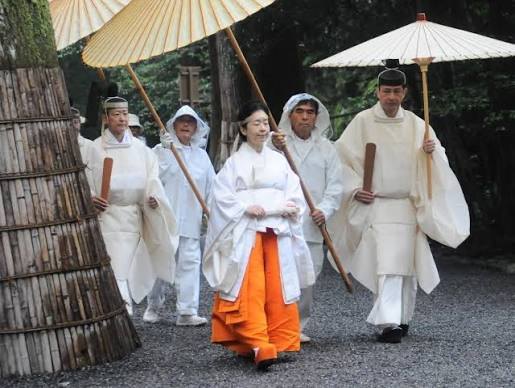
Higoto Asayū Ōmikesai
Morning and evening at Gekū's Mikeden, rain or shine, New Year's Day included.
Kinen-sai
Prayers for a good harvest.
Tsukinami-sai
With the Kanname-sai, one of the three great festivals (sansetsusai).
Kanname-sai
Offering of new rice — Jingu's most important rite.
Niiname-sai
An imperial envoy attends, in step with the court's harvest rite.
Read next
Jingu is more than two shrines
Ise Jingu is actually the collective name for 125 shrines — from remote "distant shrines" to one that claimed to be the true original.