Home / Oshi & Okage Mairi
03 — Edo-period tourism
Edo Japan's travel agents were called oshi.
In the Edo period, a pilgrimage to Ise was the dream trip of a lifetime for ordinary people. Planning, recruiting, lodging, meals, guiding and souvenirs were all handled by the oshi (pronounced onshi in Ise). At their peak, hundreds of oshi houses lined Yamada and Uji, and roughly every sixty years millions of people surged towards Ise in the "Okage Mairi".
The question of this room
How did commoners pay for the trip?
THE QUESTION
Travel wasn't free in the Edo period. Why was a pilgrimage to Ise allowed?
Crossing domain borders freely was hard for commoners. But say "I'm going to Ise" and a travel pass was relatively easy to obtain; servants who left without their master's permission might even go unpunished. The oshi built the system that made this possible, and spread it across the country.
The oshi were originally people of priestly status who performed prayers for worshippers. Kumano and Mt. Fuji had them too, but whereas elsewhere the word is read oshi, in Ise it is onshi.
Each oshi was responsible for particular regions of Japan, called danna-ba. Every year they visited the households in their territory, distributing Jingu's talismans (oharai taima) and the Ise-goyomi, a calendar that guided farm work. The Ise calendar became one of the most widely used in Japan, keeping Ise close to people all year round. And when those people actually came to worship, the oshi put them up in their mansions, arranged sacred dances and treated them to lavish feasts.
Oshi houses were concentrated in Yamada, near Gekū, and Uji, near Naikū. Some records from the 18th century speak of more than 600 oshi in Yamada and more than 200 in Uji. Traces survive in old place names and house names in Ise today.
The oshi full course
VIP treatment, once in a lifetime
Pilgrims arriving in Ise were treated to every comfort.
Met at the Miya River ferry
The oshi's staff went out to the banks of the Miya River, the gateway to Ise, to greet them.
The oshi mansion
Fine rooms and plump silk futons — bedding unimaginable in everyday life.
Dai-dai kagura
Splendid sacred dances performed in the house's own kagura hall, scaled to the group's size and offering.
Delicacies from sea and mountain
Formal banquets rich in spiny lobster, abalone and sea bream.
Guided tours of both shrines
Gekū, Naikū, and on to Futami and Mt. Asama — a tour guide in all but name.
Talismans and souvenirs
Sent home with talismans for the whole association and gifts from Ise.
Ise-kō and daisan — Japan's oldest travel savings club: Local people formed Ise-kō associations and saved a little money each month. Members chosen by lot went to Ise as proxies (daisan) for everyone. They brought back talismans for all members, so the blessings reached those who couldn't go. Keep it going for a few years, and everyone's turn would come.
Okage Mairi
One in six people headed for Ise
Roughly every sixty years in the Edo period, an explosive mass pilgrimage called Okage Mairi broke out. It usually began with rumours — "talismans from Jingu are falling from the sky" — that spread like wildfire, and people dropped their work and set off for Ise.
Japan's population was then about 30 million. In the Okage Mairi of 1830, more than 4 million people are said to have set off for Ise within a few months — on simple arithmetic, one in every six or seven people.
Nuke-mairi
Servants and children setting off for Ise without telling their masters or parents. If they were returning from Ise, showing a talisman would usually spare them punishment — an unspoken rule.
Segyō
People along the roads and wealthy merchants gave pilgrims free food, lodging and straw sandals. "Okage" means the help of such people and the blessing of the gods.
The ladle
Okage pilgrims walked with a ladle in hand: a bowl for receiving alms, and a sign that said "I am an Okage pilgrim".
Okage-inu, pilgrim dogs
There are records of dogs making the pilgrimage in place of owners too sick to go. With money and a name tag around their necks, they were passed along from person to person all the way to Ise.
What the oshi created
Yamada hagaki and self-government
The prosperity of the oshi gave Ise its own economy and self-government. From the medieval to the early modern period, Yamada, the gate town of Gekū, was run by a self-governing council called the Sanbō Egō, and Uji by the Uji Egō. Not samurai but leading townsmen, mostly oshi, handled administration and even justice.
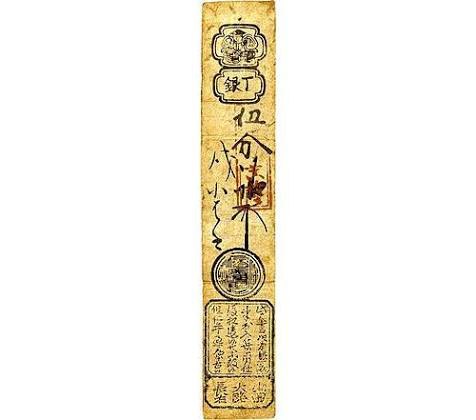
And in Yamada, from around the early Edo period, paper certificates called Yamada hagaki circulated. Issued by merchant-oshi to make up for a shortage of small change, they are sometimes called Japan's oldest paper money. Seen as forerunners of the domain notes (hansatsu) later issued across Japan, they show how deep Ise's economy ran.
- Medieval–The oshi credit networkPeople and money flowing between Ise and danna-ba nationwide
- c. 1600Yamada hagaki issuedPaper certificates circulate to make up for a lack of coins
- 17c–Domain notes spreadDomains across Japan begin issuing paper money
- 1871The oshi system abolishedIn the Meiji shrine reforms, talisman distribution passes directly to Jingu
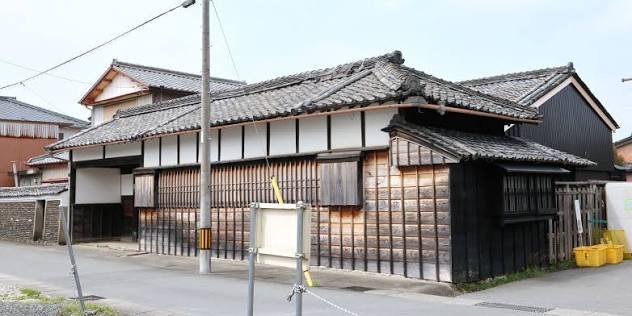
After the oshi: in 1871 the oshi system was abolished, and the talismans once distributed nationwide were reorganised as Jingu Taima, issued centrally by Jingu. Many former oshi became innkeepers or merchants, and the town changed dramatically. The former residence of the oshi Maruoka Sōdayū, preserved in Ise, is a rare survivor that conveys what an oshi house was like.
Ise Ondo
"At least once in a lifetime"
I long to go to Ise, to see the road to Ise — at least once in my lifeA line from the Ise Ondo, a folk song widely sung in the Edo period
Pilgrims returning from Ise carried the Ise Ondo home, and it was absorbed into folk songs all over Japan. That songs echoing the Ise Ondo are still sung at festivals and banquets across the country is proof of how many people visited Ise and brought its memory back to their home towns.
Read next
The "real purpose" of the pilgrimage?
On the hill between Gekū and Naikū stood Furuichi, one of the great pleasure quarters of the Edo period.