Home / Local Knowledge
11 — Life in Ise
The shimenawa stays up all year.
Walk through Ise and you'll notice shimenawa ropes over many front doors — even when it isn't New Year. The people of Ise, who have lived alongside Jingu for centuries, take for granted many things that surprise visitors. Here are some of them.
The question of this room
Why do Ise homes keep a shimenawa up all year?
THE QUESTION
Elsewhere the shimenawa is a New Year decoration. Why is it up all year in Ise?
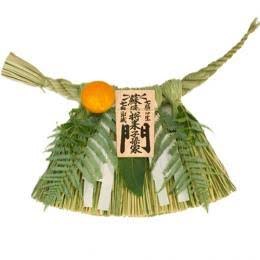
In the Ise-Shima area, the shimenawa at the entrance is displayed not just at New Year but all year round, and replaced with a new one at year's end. The wooden tag at its centre usually reads Somin Shōrai shison kamon: "House of the descendants of Somin Shōrai".
The name comes from this tale. Long ago, the god Susanoo, travelling, asked for a night's lodging. The wealthy Kotan Shōrai refused him, but his poor elder brother Somin Shōrai welcomed him warmly. In thanks, Susanoo promised that any house displaying a tag reading "descendants of Somin Shōrai" would be protected from plague.
The people of Ise hang shimenawa with this tag at their doors all year round as protection against misfortune. Some tags read shōmon, "laughing gate", or senkyaku banrai, "a thousand guests", in the hope that fortune comes to a cheerful house.
Shimenawa are replaced at the end of the year, and the old ones are burned at shrine bonfires. In late December, stalls selling shimenawa pop up all over Ise — a seasonal sight of the town.
Starring once every 20 years
Okihiki and Oshiraishi-mochi: the days citizens enter the sanctuary
In the Shikinen Sengu, there are two events in which the people of Ise are the stars.
Okihiki (timber hauling)
The townspeople haul the Sengu timber into the sacred precinct. Each neighbourhood forms a hauling team, wears matching happi coats and pulls the great logs to the rhythm of kiyari work songs — overland by wagon to Gekū (okabiki), and through the waters of the Isuzu River to Naikū (kawabiki). Whole neighbourhoods join in, from children to the elderly.
Oshiraishi-mochi (white stones)
Just before the transfer, white stones are offered to cover the ground of the new sanctuary. Participants wrap a stone gathered from the Miya River in white cloth and carry it right up to the new sanctuary. It is a once-in-20-years chance to enter the normally closed inner precinct and stand close to the brand-new sanctuary.
Those who take part are the people of areas that were once Jingu's domain — the kyū-shinryōmin. Because the events happen once every 20 years, most people experience them only two or three times in a lifetime. "I carried a white stone as a child. Next time as a parent, the time after that as a grandparent." In this way the people of Ise have passed the memory of the Sengu from generation to generation.
The work songs, coats and wagons of the Okihiki are handed down in each neighbourhood, and practice begins as the Sengu approaches. Finding that the coat you pulled out after 20 years no longer fits is a common story.
Ise's calendar
First-of-the-month visits and the autumn Hatsuhobiki
Tsuitachi-mairi
The custom of visiting Jingu early on the first of each month, giving thanks for the month past and praying for the month ahead — long practised by the people of Ise. Akafuku sells its tsuitachi-mochi that day, and Okage Yokochō holds a first-of-the-month morning market. A gate town bustling before dawn is a sight unique to Ise.
Hatsuhobiki
An event in October, timed with the Kanname-sai, to offer the year's new rice to Jingu. People from across Japan join the townsfolk, hauling the rice on wagons to Gekū and through the Isuzu River to Naikū. A relatively new event begun in the Shōwa era, building on the Okihiki tradition.
Ise Matsuri
Ise's autumn festival in October celebrating the Kanname-sai. Dances and floats from neighbourhoods across the city fill the streets as the whole town celebrates.
Jingu Hōnō Fireworks
A fireworks festival held every July on the banks of the Miya River. It is a competition in which pyrotechnicians from all over Japan show their skills — offered, in spirit, to Jingu.
How locals talk
"Gekū-san", "Naikū-san" and Ise dialect
Locals rarely say "Ise Jingu". Naikū is "Naikū-san", Gekū "Gekū-san", and Jingu as a whole "Oise-san" or "Daijingū-san". Adding the friendly -san, as if speaking of neighbours, is the Ise way.
| Ise dialect | Meaning | Example |
|---|---|---|
| sekoi | tired, hard going | "Walked up the slope — sekoi wa." (Not "stingy", as elsewhere.) |
| togoru | to settle at the bottom of a liquid | "The sugar's togotteru — stir it well." |
| tsuru | to lift and carry (a desk, etc.) | "Tsutte that desk." |
| ~yanka | "…isn't it?" | "Shittoru yanka" — "You know that, don't you." |
| ōkin | thank you (mainly older people) | "Ōkin na." |
Note: Mie dialects vary greatly by area; the words here are used across wide parts of Mie including Ise. Some are rarely used by younger people.
How locals worship
The local way to visit
Go early
Depending on the season, Jingu opens at 5 a.m. Many locals visit in the clear early morning, before the tourists — some drop in at "Gekū-san" on their morning walk.
Shift New Year a little
On New Year's Day, Naikū is packed with visitors from all over Japan. Plenty of locals avoid the first three days and make their first visit once things calm down.
School-trip memories
Many primary schools in the Tōkai and Kansai regions once made the Ise pilgrimage their standard school trip. That's why so many adults say "I came to Ise as a child".
Minding kata-mairi
Visit both Gekū and Naikū. When locals ask visitors "Did you go to Gekū-san too?", it's because this sense is still alive.
Read next
Out and about
A guide to the places in these stories, seen with an insider's eye.