Home / The Modern Holy City
09 — Light and shadow of modernisation
150 years of the town called the "Holy City".
The Meiji Restoration changed Ise to its roots. Temples vanished, the oshi vanished, and in their place came railways, museums and a new role as the centre of state ritual. Uji-Yamada City, the Shinto tram line, the Sangū Express: we trace Ise's era as Shinto, the "Holy City", as a chain of events each triggering the next.
The question of this room
What disappeared from Ise with the Meiji Restoration?
THE QUESTION
What did Edo-period Ise have that today's Ise doesn't?
The answer: Buddhist temples, and the oshi. Edo-period Uji and Yamada had many temples and streets lined with oshi mansions. In the first years of Meiji, both disappeared within a few years.
The 1868 edicts separating Shinto from Buddhism triggered haibutsu kishaku, the destruction of Buddhist temples and images, across Japan. In Uji and Yamada, at Jingu's feet, it was especially fierce: nearly 200 temples are said to have been closed. Buddhist elements were removed from Jingu's grounds and surroundings, and monks disappeared completely from the sacred precinct.
Then in the Jingu reforms of 1871, the oshi system was abolished along with hereditary priesthoods. The system that had supported Ise's economy throughout the Edo period was gone almost overnight.
Emperor and shrine
A first: Emperor Meiji's visit
In 1869, Emperor Meiji worshipped at Jingu. This is considered the first reliably recorded visit to Jingu by a reigning emperor in person. Since antiquity, emperors had sent envoys to Jingu but never gone themselves. The visit symbolised the beginning of the modern era, in which Jingu was positioned as the centre of state ritual.
- 1868Shinto–Buddhist separationFierce anti-Buddhist destruction around Jingu
- 1869Emperor Meiji worships at JinguThe bond between emperor and Jingu made visible
- 1871Jingu reforms; oshi abolishedTalismans distributed nationwide as "Jingu Taima"
- 1886–The Shin'enkaiHouses in front of Uji Bridge are relocated to create today's spacious shrine gardens
- PrewarUji-Yamada, the "Holy City"A national sacred site and destination for school trips and group pilgrimages
Insider's view: the open space in front of Uji Bridge used to be town. Today there is an expanse of lawn and gravel before Uji Bridge, but in the Edo period inns and houses crowded right up close. The Shin'enkai, a private association founded in 1886, relocated these buildings and landscaped the area as a shrine garden fitting for a sacred precinct. Part of what we take to be "timeless Ise" was created in the Meiji era.
The railway arrives
Sangū Railway, the Shinto Line and the Sangū Express
Sangū Railway opens
From Tsu to Miyagawa; four years later, in 1897, it reached Yamada (today's Iseshi Station), linking Ise by rail.
Trams begin running
The tram line later called the "Shinto Line" opens, linking the stations, Gekū, Naikū and Futami.
Uji-Yamada City is born
The two gate towns merge into one city; the name "Holy City" takes hold.
Sangū Express opens
A fast electric railway links Osaka directly with Ise (today's Kintetsu). In 1931 the reinforced-concrete Uji-Yamada Station is completed.
Renamed Ise City
Uji-Yamada City becomes "Ise City".
Shinto Line closes
With the spread of cars, the tram disappears after more than half a century.
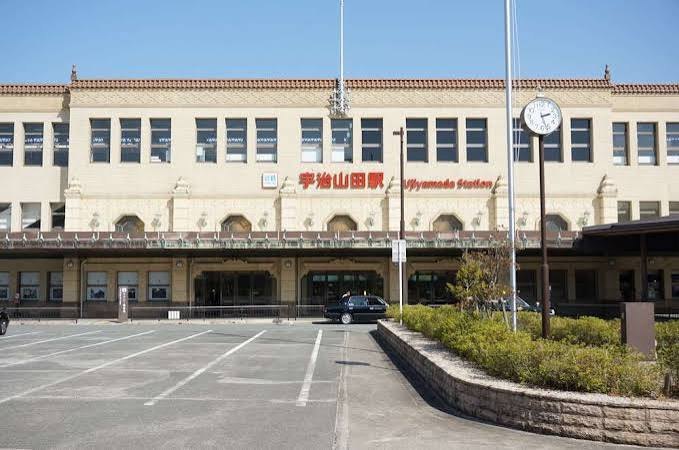
Uji-Yamada Station, completed in 1931, is a three-storey reinforced-concrete station building and a registered tangible cultural property. Dressed in Spanish-style tiles and terracotta ornament, it was a gateway worthy of the "Holy City", welcoming pilgrims arriving by express from Osaka.
Butterfly effect: how the railway changed pilgrimage
- EdoWeeks on footPilgrims stayed at oshi mansions and spent days touring
- 1930A day trip from OsakaThe Sangū Express makes same-day visits from Kansai possible
- ShōwaPilgrimage without an overnight stayIse shifts from a town to stay in to a town to stop by
- Late ShōwaCars, and a hollow gate townVisitors drive straight to the shrine; the gate town empties
- 1993–Towards revivalOkage Yokochō brings back "Ise on foot"
The museum hill
Jingu's knowledge gathered on Kurata-yama
On Kurata-yama, between Naikū and Gekū, facilities presenting Jingu's history and culture were brought together in the Meiji era.
Jingu Chōkokan Museum
Opened 1909, designed by Katayama Tōkuma, architect of the Akasaka Palace. A Renaissance-style building displaying Jingu's historical materials and sacred treasures retired after the Sengu. Damaged in the war, it was rebuilt retaining its exterior.
Jingu Agricultural Museum
Opened 1891, said to be one of the oldest industrial museums in Japan. Specimens of the farm and sea products offered to the gods show Jingu's ties with food.
Jingu Art Museum
Opened in 1993 to commemorate the 61st Sengu, housing works of art and craft dedicated on the occasion.
Yamatohime-no-miya
Also on Kurata-yama stands Yamatohime-no-miya, the betsugū founded in 1923. A quiet hill where museums and shrine can be visited together.
War and postwar
From the state's shrine to the people's shrine
In the air raids of 1945, Uji-Yamada City suffered heavy damage, and parts of Jingu and surrounding facilities were hit. After defeat, the Allied occupation's Shinto Directive separated state and Shinto, and Jingu began a new path as a religious corporation.
The first postwar Sengu should have been held in 1949. But postwar turmoil and lack of funds forced a postponement, and only Uji Bridge was rebuilt that year. Thanks to donations from people across Japan, the 59th Shikinen Sengu was finally carried out in 1953. A Sengu funded not by the state but by the people's donations — the same pattern as the Warring States fundraising, and the starting point for how the Sengu is carried out today.
Air raid on Uji-Yamada
Much of the city is damaged.
Jingu becomes a religious corporation
Leaves state control and starts afresh as an independent body.
59th Shikinen Sengu
Four years late, carried out through nationwide donations.
Isewan Typhoon
The shrine forest suffers heavy damage.
G7 Ise-Shima Summit
G7 leaders visit Naikū, and the name of Ise goes out to the world.
Read next
The people who made Ise
A nun who revived the Sengu, a priest who founded haikai, the Pearl King, and the businessman who saved the gate town.